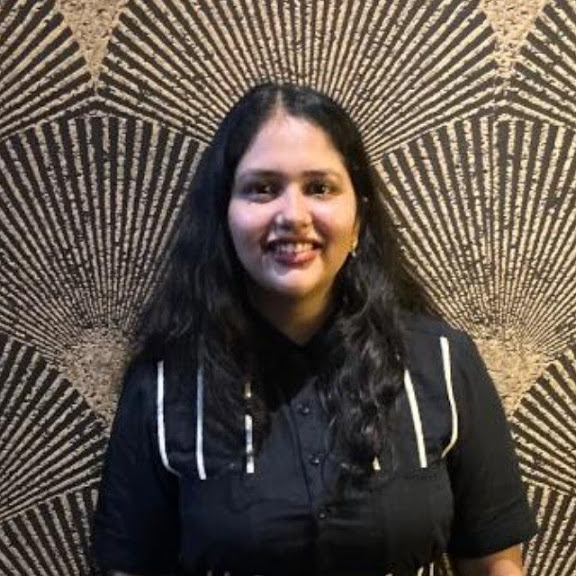
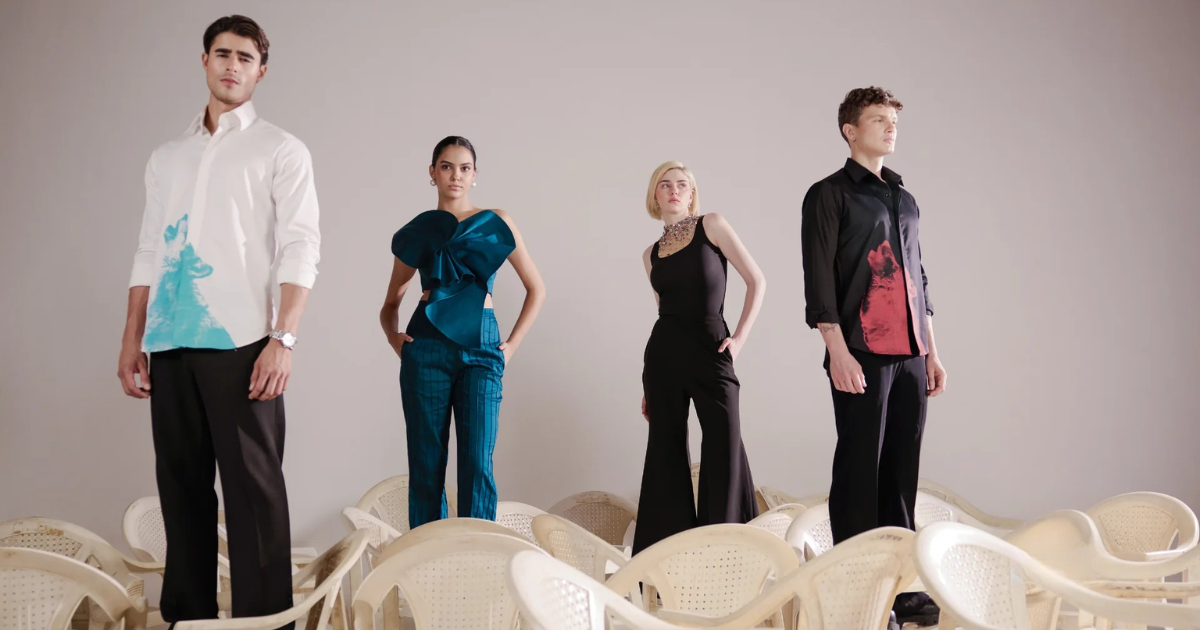
Some brands are born out of a business plan. FLLAE was born at a party, when a NIFT-and-London-College-of-Fashion-trained designer and an engineer with no formal fashion training discovered they shared an obsession with fashion, music and travel, and decided that was reason enough to build something together. What followed is a label defined less by a singular aesthetic than by a working method: nothing leaves the studio until it has been fit-tested on two co-founders with entirely different bodies. We spoke to Alekya and Sritha about why that became non-negotiable, the failed prototypes behind their signature convertible pieces, and what inclusivity actually requires once you stop treating it as a size chart.
Alekya, you trained at NIFT Hyderabad and London College of Fashion and worked on a Kering Group project with Bottega Veneta. Sritha, you’re an engineer with no formal fashion training. What made you two decide, of all the people you could have built something with, that you needed each other?
Alekya: FLLAE actually started at a party, where Sritha and I discovered a shared obsession with fashion, music, travel and the desire to create something of our own. What made us the right partners was how differently we approached the same idea. My background in fashion naturally makes me think through design, fabric, proportion and construction, while Sritha’s engineering background brings a strong lens of functionality and problem-solving.
Sritha: Our differences have always been our biggest strength. Even our personal styles are quite distinct, Alekya gravitates towards feminine, polished dressing, while I’m more experimental and drawn to quirky, unexpected combinations. We constantly challenge each other, which allows us to look at every garment from multiple perspectives.
We didn’t set out to find a fashion designer and an engineer. We simply realised that our strengths complemented each other, and that together we could build something neither of us would have created alone.
FLLAE runs on the idea that a garment isn’t finished until it’s been fit-tested on two co-founders with completely different bodies. Whose idea was that, and what was the moment that convinced you it had to be non-negotiable?
Alekya: It wasn’t a rule we consciously set, it evolved naturally from the way we worked. We have very different body types; I have more of an hourglass shape, while Sritha has an inverted-triangle silhouette. We’d try on the same garment and immediately notice completely different things. Something could look perfect on one of us, yet the proportion, comfort or movement would feel completely different on the other.
Sritha: That made us realise that fit can’t be a final checkpoint; it has to be part of the design process itself. For us, a garment isn’t finished simply because it looks good, it needs to move, feel comfortable and work on a real body.
Alekya: Testing on both of us became non-negotiable because our differences expose what one body alone might miss. We then take that further by testing across a wider range of silhouettes, because great design should work with the body, not against it.
Design and engineering don’t always speak the same language, one dreams, the other has to make it hold together on a body in motion. Where do the two of you disagree the most, and how do you actually resolve it?
Sritha: Usually when one of us says, “It will work,” and the other asks, “But technically, how?”
Alekya: I’m usually the one pushing an idea because I can already see the finished garment in my head. Sritha brings it back to construction, functionality and how it will actually behave on a moving body.
Sritha: Sometimes that means rethinking the design, and sometimes it means finding a technical solution that allows us to keep the original idea intact.
Alekya: We don’t really resolve disagreements by deciding who’s right. We prototype, test and refine until the garment works. In fact, that tension between creativity and functionality is often where our strongest pieces come from.
We do have our good days and bad days too that come out of disagreements but we put the brand first and think practically and take decisions.
Your signature piece is the detachable, multi-way convertible outfit, technically one of the hardest things to design well. What was the failure before you got the first one right?
Alekya: Our first multi-way outfit came in our second collection. We wanted one midi dress to transform into a short dress and then into a top, so the same piece could genuinely take you from day to night.
The biggest challenge was proportion. Every time we changed one length, another version could lose its balance. We went through countless iterations where something would work beautifully as a midi but feel too short or awkward once converted.
Sritha: Then we had to solve the hardware. Finding a zipper system that was long enough, reliable and could be integrated seamlessly took a lot of time. We went through several versions before we found something that actually worked in the garment.
Alekya: The breakthrough was realising that the three versions couldn’t feel like compromises of one another. Each had to look like a complete garment in its own right. That’s what finally made the concept work, and we started exploring more styles in skirts, dresses and pants in the same concept in every collection of ours since then.
“The Elevated Bodysuit” is a very specific obsession to build a brand pillar around. Why does that one garment matter so much to what FLLAE is trying to say?
Alekya: Our obsession is because it sits perfectly between statement and effortless dressing. A beautifully constructed bodysuit can instantly make you look more polished and put-together, without feeling like you’ve tried too hard.
It also creates a clean, flattering silhouette without the rolling, bunching or folds you often get with conventional fitted tops.
Sritha: And we’ve taken that very functional foundation and made it distinctly FLLAE through interesting silhouettes, surface detailing and embellishment. So it can either be the subtle foundation of a look or the statement itself, and there are hardly many brands doing this so you will find the right options with us.
You’ve said fashion should be “liberating, inclusive, and an absolute blast.” What does a FLLAE piece let a woman do that she couldn’t do in her wardrobe before?
Alekya: We don’t think every FLLAE piece needs to scream for attention. Some pieces are unapologetically statement-making, the kind that gives you that extra confidence when you walk into a room. Others are more effortless and understated, but still have that considered FLLAE touch that makes them feel special.
Sritha: What connects the two is that they should make you feel good in what you’re wearing. Whether you’re someone who loves to make an entrance or prefers something more effortless and classy, we want the clothes to feel easy to own and easy to make your own.
Alekya: For us, that’s where fashion becomes liberating, you aren’t dressing to fit into one definition of style. You’re choosing how much of yourself you want to express that day.
Standard sizing frustrates almost everyone at some point, but most brands just apologise for it. You built your entire testing process around your own two bodies instead. What’s the most surprising thing you’ve learned about fit that the industry usually gets wrong?
Sritha: That there is no single definition of a perfect fit. Bodies can have similar measurements but completely different proportions, and a garment can behave very differently on each one.
Alekya: We’ve also learnt that fit isn’t just about measurements. It’s about how a garment makes your proportions look and, more importantly, how it makes you feel when you’re wearing it.
Sritha: That’s something we’ve particularly understood through our bodysuits and some draped silhouettes. When the construction is right, they can create a really polished silhouette without restricting movement or needing constant adjustment.
Alekya: For us, inclusivity therefore isn’t simply about adding sizes. It’s about understanding different bodies from the beginning of the design process. We do cater sizes from XS to 4XL, but we make sure we know each body type before we get on with making the outfit, making the process more personalised.
You call FLLAE a “movement,” not just a brand, #SlayInFllae. What does someone believe about themselves the day they put on a FLLAE piece that they didn’t believe the day before?
Alekya: That they can walk into a room and own it, without needing to change who they are. There’s a certain confidence that comes from wearing something that makes you feel seen, whether it’s a head-turning statement piece or something quietly powerful.
Sritha: For us, #SlayInFllae is about giving yourself permission to experiment. To be bold one day, understated the next, or completely unexpected whenever you feel like it.
If you look in the mirror and think, “This feels like me, just a little more fearless,” that’s the FLLAE feeling.
If FLLAE were a single piece, not your bestseller, but the one that most completely captures what the brand stands for, which one would it be, and why?
Alekya: I’d choose our multi-convertible tiered detachable skirt set from our Whispering Bling collection. It captures our belief that fashion can be experimental and functional at the same time.
One garment can change its identity completely depending on how you wear it, without asking the wearer to compromise on how each version looks. And it can be styled day to night for any mood.
Sritha: And it represents the engineering thinking behind FLLAE. There’s a lot of problem-solving hidden inside that garment, but none of it should be obvious when you look at it.
That’s what we love most, when the innovation is invisible and all you see is a beautiful piece of clothing.
Two very different people, two very different skill sets, one brand. What does FLLAE look like five years from now, and what’s the one thing about how you two built it that has to stay exactly the same no matter how big it gets?
Alekya: In five years, I want FLLAE to have a very distinct design language, one that people recognise, but that doesn’t fit into just one category of dressing. We want to be able to create the pieces that make you stop someone in a room, as well as those effortless, beautifully considered pieces you reach for again and again on a daily basis.
Sritha: And the curiosity and problem-solving behind the clothes has to remain. We never want to stop questioning how something can be made better, more functional or more exciting.
Alekya: Most importantly, we want to stay close to the product. FLLAE started with two friends who loved fashion and having fun with clothes. As we grow, that sense of experimentation, individuality and joy has to stay exactly the same, but to survive the tough market, we hope to not drift away from keeping the business commercially viable too.
So you will see more casual yet distinct styles added in limited batches to keep the exclusivity alive, and we plan to add something that is all things extra soon too, to cater to extraordinary, tasteful personalities as well.
Follow Best List India for the culture, conversations, and ideas worth paying attention to.