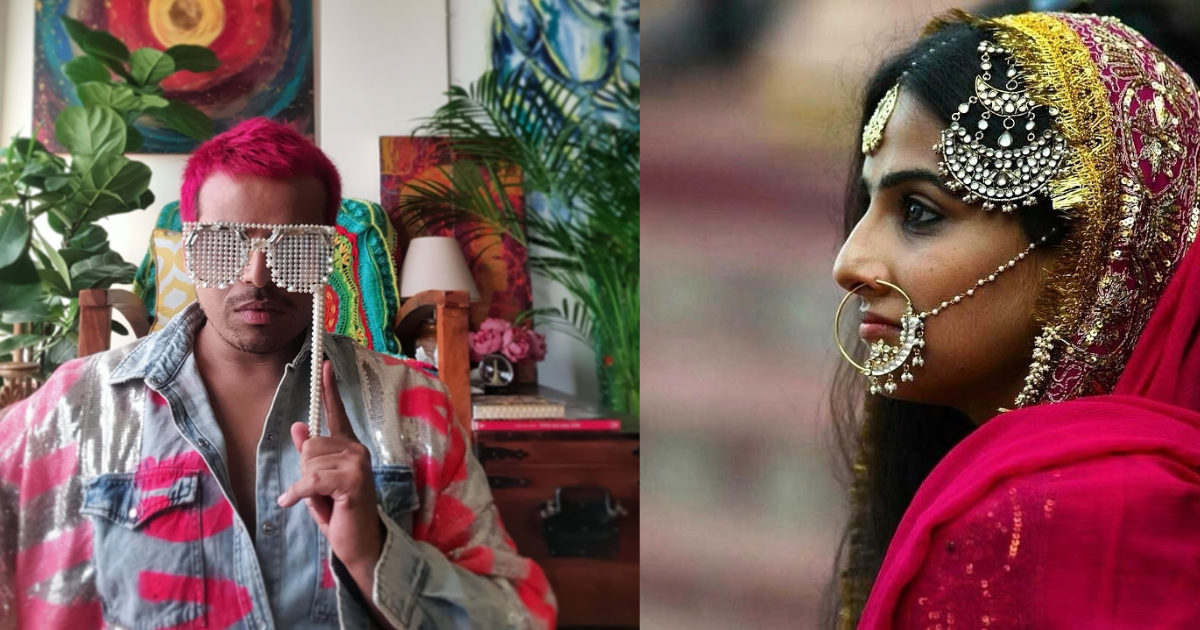
Some designers build a signature. Rick Roy built a refusal to have one. Across more than two decades dressing some of Hindi cinema’s most recognisable faces, from Vidya Balan and Akshay Kumar to Sonam Kapoor and Emraan Hashmi, Roy has made a career out of disappearing into the character rather than the actor, a philosophy that has carried him from a small-town childhood spent deliberately misplacing his school badge to a UK fashion magazine cover and a BAFTA-nominated production. His latest project, Vibe, reunites him with Kunal Khemu, this time as both actor and director. We spoke to Roy about the early grind of being an outsider in Mumbai, what changed when he stepped in front of the camera himself, and why “interesting” is the only signature he has ever claimed.
Every wardrobe story begins with a first stitch. Take us back to the very beginning. What was the moment you knew that dressing people, not just designing clothes, was your calling?
I don’t think I ever really had a “Eureka” moment where I suddenly realised that this was my calling. I have always loved clothes, looks and fashion, even as a little kid. I always wanted to stand apart. I wanted people to spot me in a crowd, and I would constantly try to dress differently and uniquely, within whatever means we had.
Even as a middle-class kid, I always made an effort to establish who I was through my clothes. I would make little things and add them to my clothes, just to make them look different from what everyone else was wearing. I remember in school we had this school badge that was supposed to be worn at a particular place on the shirt, and I would deliberately wear it somewhere else. I used to get into trouble for it during assembly too! But I would always find little ways of doing things differently.
So I guess I was probably born to dress people and make them stand out from the regular crowd.
Before the credits, the clients and the red carpets, there was a young designer trying to be noticed. What did those early years look like, and what did they demand of you?
Very honestly, the early days were tough and involved a lot of hard work. I was a kid from a completely different world, thrown into the madness of Mumbai while chasing a dream. Of course, it was difficult and demanded every ounce of faith and conviction in myself to keep moving forward through those crazy times.
But I guess my struggles were pretty much the same as those of a million other kids who come to a city like Mumbai with a dream. Everyone has to work hard to get what they want, especially when you come from a simple, middle-class background.
I honestly don’t have a sad story of struggle to tell. Everyone who is trying to make a mark has to put in the hard work. The good part about my life is that the hard work paid off, and I am here doing what I do and being who I am.
I believe you can either sit and turn your struggles into a story about everything you went through, or you can look at them simply as building blocks and an investment towards where you are today. I prefer to see them as the latter. So yes, it was tough, and it was absolutely gruelling at times, but all those days ultimately brought me here, so it was all worth it.


Fashion, Jannat, Desi Boyz, Housefull 2, Gabbar Is Back, Tumhari Sulu, Shiddat: each film asked for a different Rick Roy. Which project changed how you saw your own craft?
Honestly, I can tell you that each film always demands a different Rick! Every film comes with a different set of people, challenges and situations, and it needs a different avatar of me to deal with what that particular project requires.
So yes, every project sees a different version of me, depending on what the film needs.
I would say Tumhari Sulu was a film that pushed me, or rather gave me, an opportunity to showcase my craft in a way that the world had not seen from me before. So that one definitely did that for me. But as I said, every film gives me an opportunity to push myself and do something different. It is always a different story that we are telling, so I try to push myself to show the audience a different facet of my craft that they may not have seen before. At least, I always try to.

You have dressed Malaika Arora, Vidya Balan, Sonam Kapoor, Akshay Kumar and Emraan Hashmi, each with a distinct sense of self. How do you find the person beneath the persona before you pick up a single fabric?
Actually, I mostly try to ignore the persona completely. I try to forget the pre-existing image and idea of the actor before I choose anything, because for me, it is not the person who is playing the role; it is the character.
If I get too focused on the persona of the actor, then I am not focusing on the character. My creative process is different. I try to ignore the persona, image and reputation of the specific actor and simply imagine the actor as a canvas.
I focus on how I can transform that person into the character that exists in the script.
Then came a stage of your journey no one scripted: stepping in front of the camera in Dil Dosti Dilemma. What did being dressed teach you about the art of dressing others?
Honestly, that was pure fun! What that experience mostly taught me was that you need to have a lot of patience to be an actor in front of the camera because there is a lot of waiting.
But then again, you are always taken care of and treated with a lot more consideration compared to the rest of the crew, so it is not really a big deal.
It did, however, make me aware of the disparity in the treatment we receive as technicians behind the camera versus people in front of the camera. When I was shooting as an actor, I literally had a makeup van, I was asked what coffee I wanted, what I would like to have for lunch and there was a lot of pampering. The moment those shoot days ended, it was back to the no-AC costume van!
So yes, that was definitely an interesting thing to experience.
But when I shot my UK show, Rob & Romesh, it was very different. I didn’t feel that disparity as much. The entire technical crew felt much more at par with the actors in terms of the treatment they received.
A show you worked on was nominated for a BAFTA, and you carried Indian style to London Fashion Week. What did those rooms teach you about how the world reads Indian fashion, and how you want it to?
As I said, shooting for a UK production was very different from shooting with an Indian one. I guess it is a cultural thing as well. There is more value placed on labour, and there is a certain respect for every person on set and for whatever they are doing.
From the person handling the lights to the actors and the director, every individual is respected for their contribution to the functioning of the set. They are also definitely more organised and clear about what each person needs to deliver on set.
It is less chaotic. There is definitely less screaming and shouting at people on set, which, strangely enough, is a huge part of our sets.
London Fashion Week was honestly absolutely amazing. Again, I felt that the value placed on the craft was much more than simply your image or who you are.
I was literally an unknown person in that fashion circuit, but the way I was received and appreciated by the crowd and the press there was fantastic. It was purely based on what they saw me bringing to every red carpet or event I attended and nothing else.
There is a lot of value placed on effort and fewer preconceived ideas about who is or should be important and who isn’t or shouldn’t be.
In fact, I am actually on the cover of a UK fashion magazine this month, which came out of my association with a particular editor who saw me on the red carpet last season and loved my style. One thing led to another, and I ended up booking the cover.

Now to Vibe. When you first met Kunal Khemu’s character on the page, what did you see, and how did that first impression become a silhouette?
Vibe was a fun journey for me. Kunal’s character might be the easiest look I have ever done because fun, strong, individualistic and cool come naturally to me. It is very easy for me to do.
So it was too much fun dressing him, and honestly, it was probably one of the easiest projects for me.
Kunal is both the actor and the director. What changes in the styling room when the person wearing the clothes is also the one shaping the story?
Actually, it was very, very easy because generally you need to deal with two separate people, the actor and the director, and a lot of times they are not on the same page in terms of the look and style.
In this case, it was super easy because both were the same person. You convince one person and both are good!


From Malaika and Akshay to Raghav Juyal, Ibrahim Ali Khan and Vaani Kapoor, you are now dressing a new generation. How has your eye evolved, and what does Gen Z ask of a stylist that no one asked before?
I guess I am morphing with time! Yes, I am dressing a lot of the new-generation kids and absolutely loving it.
It is important not to be rigid when it comes to fashion and storytelling. Everyone used to ask me, “What is your signature style?” and I used to say, “INTERESTING is my signature style!”
I don’t have any specific signature style, and as a film costume designer, I don’t think one should. You give me any film and I will make that interesting. That is my signature.
I am, and I have always been, in touch with what is going on in the world in terms of fashion and film. Honestly, those are pretty much the only things I look at!
I like to always be aware of the latest things happening. That helps me bring a freshness and a current aesthetic to whatever I am doing. I like to keep things new and exciting, backed by my experience, and that combination works fantastically.
Gen Z is actually very easy to work with. They have a nicer temperament and, because they are literally kids, they are very sweet, more open to ideas and less rigid.
Looking back at the road from your first design to Vibe, what do you know now that you wish you had known then, and what is next for Rick Roy?
I only count my blessings. I have never really thought about what I could do to change my life or any of that.
I have huge faith in God and in the universal karmic cycle. I truly believe I am exactly where I am supposed to be, doing what I am meant to be doing, and that I will be taken wherever I am supposed to be next.
So I don’t really give it much thought. I don’t plan or think too far beyond right now. I truly just try to be happy and have fun. That’s all.
This philosophy has worked very well for me.
But if you ask me purely about work, I have a film coming out called Sarvagun, which I am very excited about. Then there’s Diler and two more releases in the pipeline, one with Vamika and the other with Aditi. So it’s all good and fabulous.
What makes Rick Roy’s story compelling isn’t the client list, however formidable, it’s the consistency of the instinct underneath it. The kid rearranging his own school badge and the costume designer refusing to be pinned to a signature style are, on inspection, the same person making the same argument: that individuality is a discipline, not a decoration. Decades into a career that has taken him from Mumbai’s costume vans to a London magazine cover, Roy still describes his work the same simple way he always has, find the character, forget the persona, make it interesting. It’s a modest line for a career this layered, and perhaps that’s exactly why it’s held up.
Follow Best List India for the culture, conversations, and ideas worth paying attention to.