
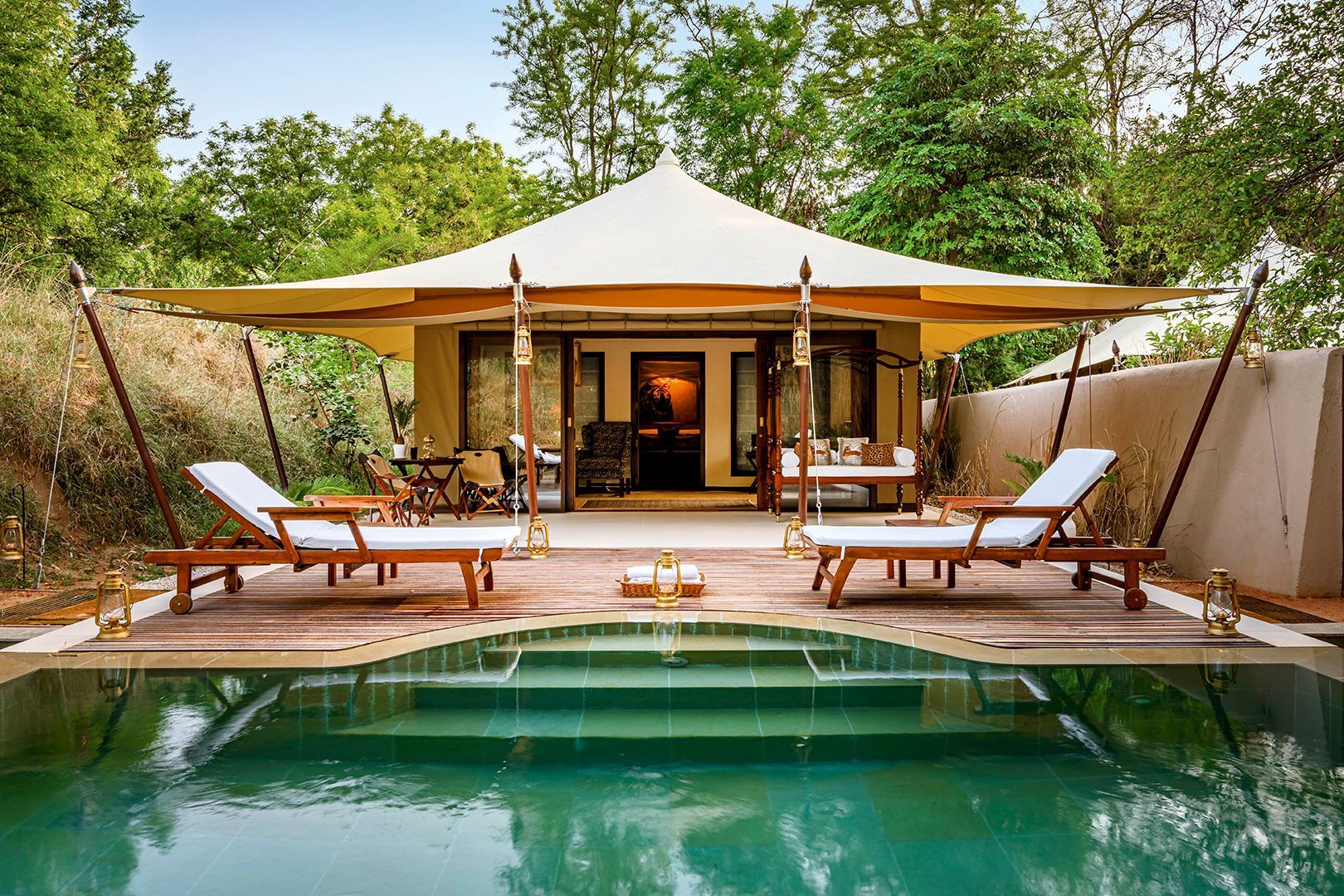
There is a particular kind of luxury that has nothing to do with thread counts or marble bathrooms. It is the luxury of waking before dawn to the sound of a jungle stirring, of watching light move across an ancient forest from the verandah of a canvas tent, of eating food grown fifty metres from where you are sitting, of being somewhere that has been loved and tended and fought for by the same family for half a century. SUJÁN Sher Bagh is that kind of luxury. And once you have experienced it, the hotel kind feels like a very poor substitute.
Nestled on the edge of Ranthambore National Park in Rajasthan, Sher Bagh sits ten minutes from the entrance to one of the world’s finest wild tiger habitats, in a setting so quietly extraordinary that guests routinely describe it as life-changing. The Singh family, who founded the camp and have been active in Ranthambore’s conservation since 1974, built something here that the hospitality industry has a word for but rarely produces: authenticity. Every detail of Sher Bagh, from the hand-stitched canvas tents to the family recipes cooked over clay ovens to the guides who carry 150 combined years of experience between them, feels like the result of genuine love for a place rather than a design brief.
The Camp
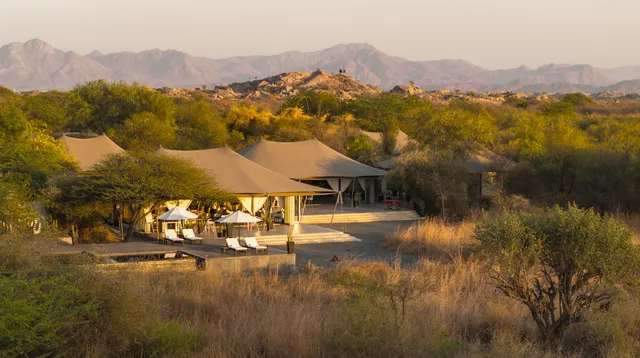
Twelve luxury tents arranged in a gentle arc on the edge of the wilderness. Each one hand-stitched from cotton canvas, furnished with teak and rosewood campaign furniture that evokes the 1920s-style safari camps of British India without tipping into pastiche. Private verandahs. En suite bathrooms that have been described, with some accuracy, as a hedonist’s delight. Arboreal lanterns lit every evening along the pathways. A watering hole adjacent to the camp that draws antelope, wild boar, and birds in extraordinary numbers at dawn and dusk, and occasionally, to the particular joy of arriving guests, something considerably more significant.
The accommodations span from the Jungle Tents, which already sit well above the luxury threshold, through to the Royal Sher Suite, a private, walled double bedroom suite with its own heated dip pool, outdoor fireplace, open-air tree shower, and bathtub that looks out into the forest. And then the Imperial Raj Bagh Suite, two double bedrooms in a private corner of the camp, with a sweeping pool deck and the kind of seclusion that makes you understand why people extend their stays without needing to be persuaded.
The Family Machlii Suite deserves a particular note: named after the late Machhli, the tigress whose legendary range included the land that Sher Bagh sits on, and sheltered by a grove of trees planted by the Singh family over decades. The naming is not incidental. This is a camp where the tigers are not the backdrop to the experience. They are its reason for existing.
The Safaris
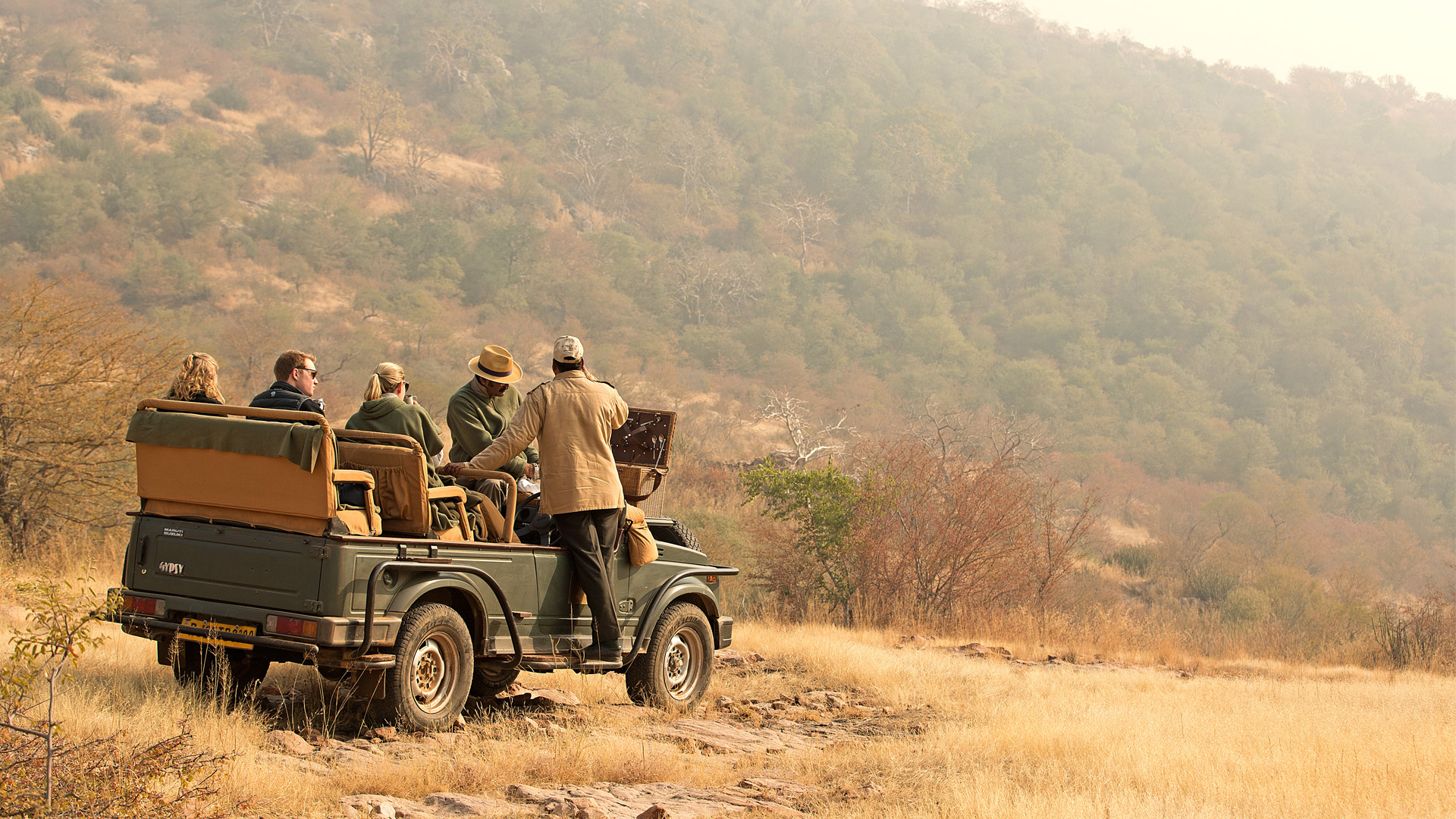
Ranthambore is widely cited as the finest place in the world to observe wild tigers in their natural habitat. The ancient forest it protects, a billion years old, contains over 40 mammal species including leopard, sloth bear, striped hyena, sambar deer, and chital, alongside more than 300 species of birds. The tigers, naturally, are what most guests come for. And the guides and drivers at Sher Bagh, with their combined 150 years of experience reading this particular landscape, give you the best possible chance of the encounter that stays with you forever.
What sets the safari experience at Sher Bagh apart from a purely transactional wildlife encounter is the knowledge that comes with every drive. The Singh family’s relationship with Ranthambore goes back to 1974. They know this forest the way a family knows its own home. The history, the geology, the individual animals, the warning calls, the patterns of movement, the ruins of palaces and cenotaphs and the 8th-century UNESCO Ranthambore Fort rising at the heart of it all. What you receive here is not just a game drive. It is an education delivered by people who have spent their lives paying attention.
For those who want to go deeper, specialist guiding is available through the Director of Wildlife Experiences, as well as dedicated wildlife photography safaris, birding walks, and the full range of experiences that only a family with this level of access and investment in the ecosystem can offer. Sher Bagh has made a financial contribution of over USD 2.1 million to Ranthambore National Park through gate receipts alone, making conservation not just a philosophy but a measurable commitment.
The Food
Ask anyone who has stayed at Sher Bagh what surprised them most and the answer, delivered with genuine enthusiasm, is consistently the food. As a member of Relais and Châteaux, the standard is exacting. But what makes dining here extraordinary is not the credential. It is the approach.
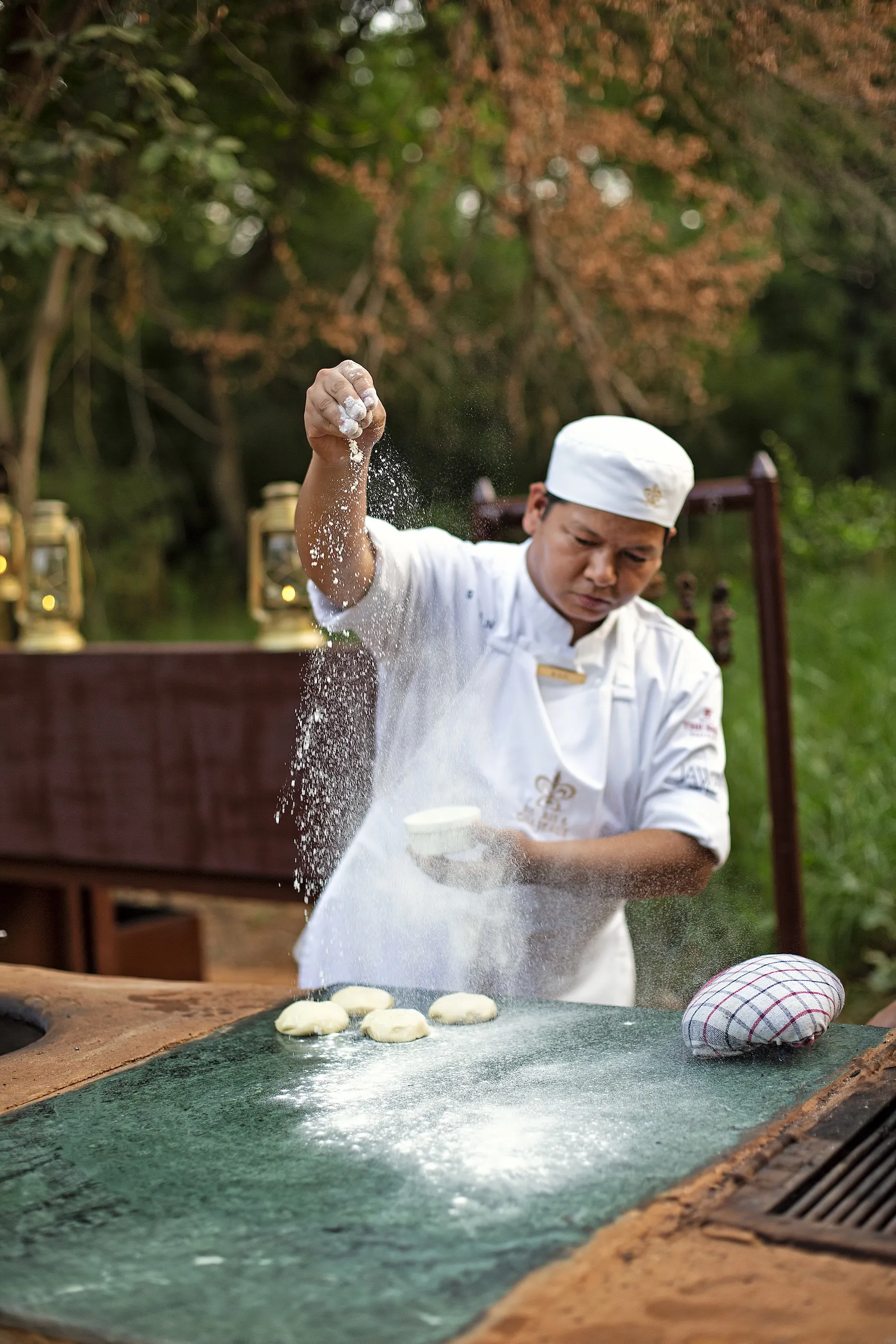
For over 25 years, Sher Bagh has operated a farm-to-table kitchen, growing as much as possible organically in its own herb and vegetable garden, supplemented by the Sher Bagh Farm and Dairy. The menus combine Anglo-Indian and European influences, cooked over outdoor clay ovens, served in the dining tent by candlelight or under the stars around the campfire. The traditional thaal dinners on open ground, surrounded by the sounds of the jungle and lit by oil lamps, are among the most atmospheric meals available anywhere in the country.
The family recipes, passed down through the Singhs and cooked with the produce of their own land, give the food a quality that is impossible to replicate in a restaurant context. Ask the chefs for a recipe you have particularly loved and they will walk you through it, informally, generously, in the way that people share something they are genuinely proud of.
Cocktails by the campfire as the stars emerge. Gin and tonics as the sun drops below the tree line. The Library Bar on the upper floor of the main building, stocked for the long evenings after safari. These rituals, which every Sher Bagh guest falls into naturally, are as much a part of the experience as anything the jungle delivers.
The Wellness
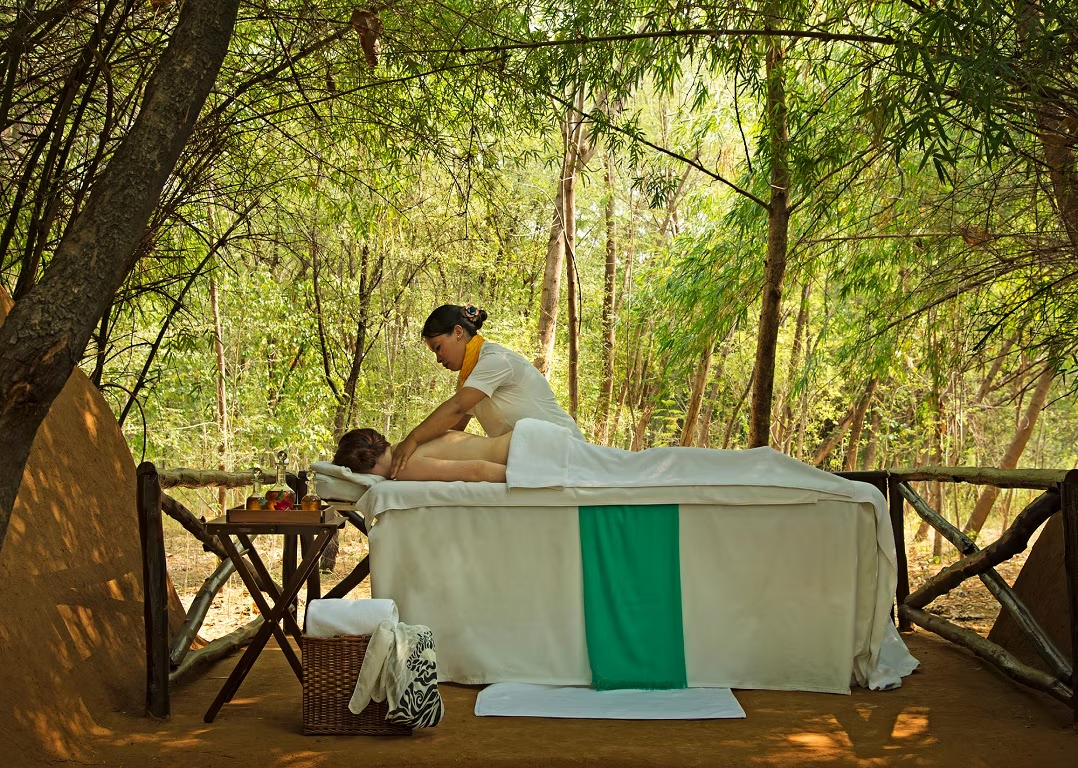
The Jungle Spa at Sher Bagh, featured in the Tatler 101 Best Spas list, sits beneath the canopy of an ancient peepal tree, surrounded by birdsong, and offers Ayurvedic therapies, full-body massages, and reflexology using organic, Ayurvedic products made with local ingredients and traditional Indian techniques. For guests wanting something more immersive, personalised Ayurvedic programmes from four nights to three weeks can be arranged, overseen by an in-house physician. The heated outdoor pool, small but perfectly positioned with views into the park, offers a different kind of restoration. And yoga under the peepal tree, with the jungle waking up around you, is the kind of morning practice that resets something you did not know needed resetting.
The Conservation Story
No account of Sher Bagh is complete without it. The Singh family’s work at Ranthambore began before the camp existed, in an era when the tiger population of India was under existential threat. Fifty years of filming, monitoring, researching, and advocating for this ecosystem is woven into every element of the camp’s identity. Staying at Sher Bagh is not simply consuming a luxury experience. It is participating, in a small but real way, in the ongoing effort to ensure that the tigers of Ranthambore have a future.
The conservation contribution included in the rates is one expression of that commitment. The depth of knowledge that every guide carries is another. The reforestation work, the community development initiatives, the collaboration with Dastkar Ranthambhore, the non-profit producing handmade crafts that guests can visit on a leisurely walk from camp, all of it tells the same story: this is a family that chose a forest over comfort, and built a very comfortable camp to share it with people who understand why that choice matters.
The Verdict
Someone once wrote that experiencing Sher Bagh is like going back in time to the days of Ernest Hemingway, tucked away in the jungle surrounded by elegance and the roar of the tiger. It is not a bad description. But it misses something. Sher Bagh is not nostalgic. It is deeply, completely present. The 1920s aesthetic is the container, not the content. The content is fifty years of conservation, a family’s love for one of the most extraordinary wild places on earth, food grown and cooked with genuine care, guides who have spent their lives learning this forest, and twelve canvas tents where the distinction between inside and outside dissolves entirely by the second morning.
Go for the tigers. Stay for everything else. Leave having understood something about what luxury actually means when it is built on something real.
Follow Best List India for the stays, experiences, and destinations worth planning your life around.