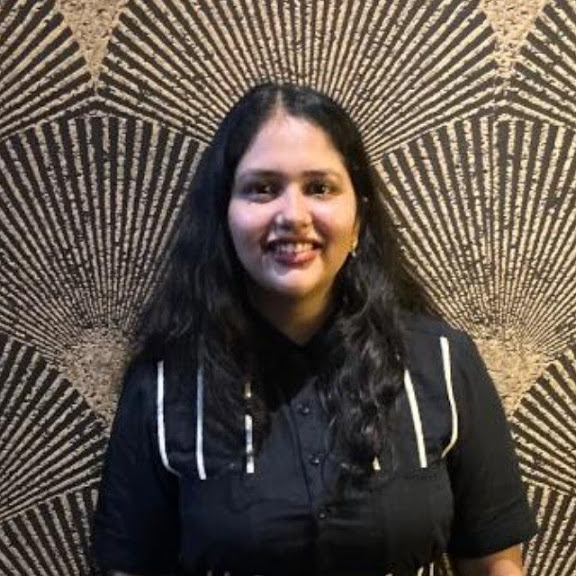
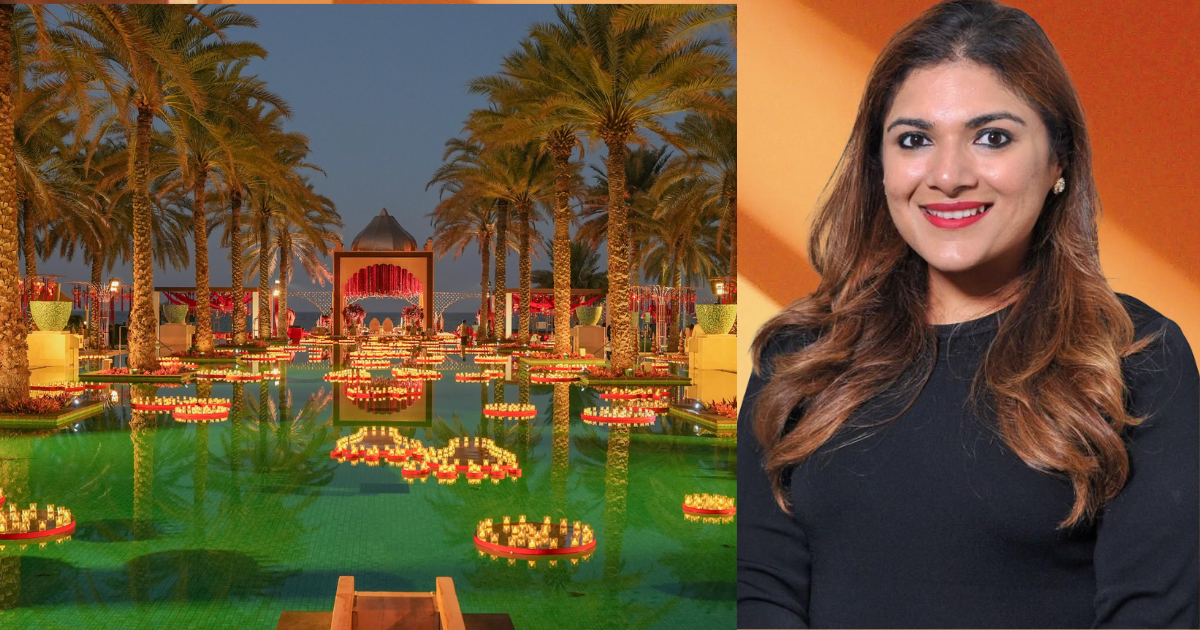
Some companies are planned into existence. Mosaic happened almost by accident, a chance introduction at a charity ball in Muscat that turned into a professional booking, then a career, then an entire company built from scratch in a market that had no real precedent for it. Fifteen years on, Krupa Khimji’s Mosaic has become Oman’s leading name in luxury celebrations, with full in-house design, 3D visualisation, production and furniture capabilities, and a client list spanning India, Lebanon, Kuwait, Iran, Pakistan, Saudi Arabia, England, Russia and Germany. We spoke to Khimji about the humbling early years of door-to-door sponsorship hunting, what Oman’s landscape offers that no ballroom can, and why she believes the destination is still an idea the rest of the world hasn’t caught up to.
It started with organising a charity ball in Muscat. Take us back to that moment, when did you realise this wasn’t a one-off, but the beginning of Mosaic?
It really happened quite organically. An extended family member had attended the charity ball and later approached me to organise her son’s Janoi. In our community, a Janoi can almost feel like a mini wedding, and she was very insistent that I take it on professionally, and actually charge a professional fee for it!
She had seen what we had created for the ball and recognised a potential in me that, perhaps at the time, I hadn’t fully recognised myself.
That Janoi became our real starting point. It was quite a large production for its time, particularly in terms of the scale, sourcing and attention to detail. Back then, there weren’t really companies in Oman approaching niche events in that way or at that level of detail.
That was the moment we had to create the company, and Mosaic began.
You moved from Babson College and your family’s business into an industry you built almost instinctively. What did that instinct look like in the early days, before Mosaic had a name people knew?
I was 25, and in many ways I simply followed what came naturally to me. There was a lot of hard work, curiosity and a willingness to learn. I put my head down, learnt new skills and tried to understand every part of the business. Most importantly, I had zero ego about asking questions, accepting when I didn’t know something, and learning from every event and every experience that came my way.
One of the most humbling experiences I remember was deciding to bring Kailash Kher to Oman for a public concert. We needed sponsors to make the event viable, and I literally went door to door looking for sponsorship. It was a huge reality check, but also incredible exposure and such an important part of my journey.
The early years were really about constantly pushing our boundaries, immersing myself completely in something I loved, and building the business one step at a time.
And somehow, 15 years have passed! What I’m most proud of today is that those years have resulted in a sustainable, solid company with a team that can execute the same dream and uphold the same values we have built Mosaic around.

“No two celebrations should feel the same” is a beautiful philosophy, but a demanding one. What does it cost you, creatively, to genuinely deliver on that promise every single time?
Creatively, it requires constant research and a mind that remains calm, curious and open. You need to be exposed to the world around you, absorb what you see, and then reinterpret it rather than simply replicate it. There is always that desire to do something better, something more thoughtful, and something we haven’t done before.
Our clients are generally very well travelled and highly exposed to international experiences. They come to us because they value detailing and quality, so naturally the expectation is high.
At the same time, creativity doesn’t necessarily mean creating everything from scratch for every event. We have invested significantly in high-quality inventory over the years. Often, perhaps 60 to 70 percent of what we use already exists within our collection, but creativity lies in completely reimagining how it is used, combining pieces differently, introducing new elements and creating a look that reflects the personalities of the bride, groom and their families.
And then there is the management side. You need strong teams who understand that ultimately we are not just creating beautiful spaces; we are creating authentic, memorable experiences for people.
You’ve built celebrations across mountains, forts, heritage venues and luxury hotels. What does Oman’s landscape give you as a designer that no ballroom ever could?
Oman’s natural beauty has always been one of its greatest strengths. But it isn’t only the landscape, it is the combination of that beauty with authentic Omani experiences and hospitality that makes the country so unique.
You can be at a hotel with the ocean on one side and dramatic rock formations on the other. You can travel into the mountains and have an extraordinary five-star experience that still feels distinctly Omani. Then you have the desert, heritage venues, forts and so many other landscapes to work with.
As a designer, that gives you an incredible canvas. You can create understated luxury that allows the surroundings to speak for themselves, or you can design around a family’s theme while still making the celebration feel intimate, warm and authentic.
Many families who choose Oman specifically want those outdoor experiences and extraordinary landscapes. Oman has its own soul and personality, and that becomes part of the celebration.

Mosaic works with families from India, Oman, Lebanon, Kuwait, Iran, Pakistan, Saudi Arabia, England, Russia and Germany. What have these different cultures of celebration taught you about what actually makes a wedding feel like home?
For all the cultural differences, there is something remarkably similar at the heart of every celebration: people want their guests to feel loved.
They want them to feel welcomed, comfortable and part of an experience. They want to celebrate, of course, but they also want to retain the traditions and rituals that connect them to who they are.
Ultimately, I think that feeling of “home” comes from people feeling loved and rooted. The aesthetics and traditions may be completely different from one culture to another, but that emotional foundation is universal.
You’ve built extensive in-house capabilities, design, 3D visualisation, production, décor and furniture, rather than relying on a patchwork of vendors. Why did control over every layer matter so much to you?
The industry has evolved tremendously, and client expectations have evolved with it.
Today, clients want to see their celebrations before they happen. Through 3D renders and walkthrough videos, they can understand a space and experience the design in advance, so there are no surprises on the wedding day. With AI, this has gone even further, brides now sometimes come to us having taken a photograph of a space and used prompts to visualise their own ideas.
As planners and designers, our responsibility is to make sure clients understand exactly what they are going to receive, and then, ideally, to go beyond that expectation.
Bringing production, décor and furniture in-house has given us much greater control. In the past, we were more reliant on external vendors. Today, we can control quality, understand our capabilities and, importantly, never overpromise something we cannot deliver to our standards.
The same evolution happened with our people. It was not sustainable for Mosaic to remain dependent on a small core team and freelancers as we expanded. Today, departments have their own heads and teams, and everyone speaks the same Mosaic language. They understand the experience we want to create for our clients.
A project no longer depends on me, or on a handful of individuals, knowing everything. The wider team understands what is happening at every stage, which gives the client enormous confidence and peace of mind.
Ultimately, it is all connected, design, renders, production, furniture, project teams and execution. When every layer improves together, the client receives a much better experience.
Destination Oman is still an idea many people are only beginning to discover for celebrations. What do you see in it that the rest of the world hasn’t caught up to yet?
There is a calmness to Oman that is increasingly rare. It still feels authentic. It has retained its soul and identity.
Many destinations around the world have modernised rapidly and, in doing so, sometimes moved away from parts of their original character. Oman has managed to maintain a beautiful balance between modernisation and tradition. You have new-age architecture and world-class hospitality, but alongside that you still experience authentic Omani culture, service and warmth.
For celebrations, that balance is incredibly powerful. Guests can experience luxury without feeling disconnected from the place they have travelled to.
That sense of authenticity is what sets Oman apart, and I think it is something the international celebrations market is only beginning to discover.
Tell us about a celebration that pushed Mosaic somewhere you hadn’t gone before, technically, creatively or emotionally.
There have been different events that pushed us in completely different ways.
Technically, one that stands out was a 75th birthday celebration where we created projection-mapping experiences directly onto a rock formation. The result looked beautiful and effortless, but technically it required an enormous amount of precision.
Creatively, there was a 40th birthday we produced in the mountains. Everything about it was outside the box, whimsical, beautiful and unexpected, while the logistics of executing it in that environment were far from easy. It really pushed our creative and operational boundaries.
And emotionally, I will always remember a wedding we produced in 2019. It rained, we were at the very end of the celebrations and the team had reached an incredible level of physical and mental exhaustion. It tested us emotionally in a completely different way.
You carry all of those experiences with you. Every difficult event, every challenge and every boundary you push becomes part of the knowledge you take into the next one.

Luxury events can easily become about scale and spectacle. How do you keep a celebration feeling personal even when it’s enormous?
It comes down to the human touch.
You can create intimate, cosy spaces within a much larger venue. You can leave thoughtful messages or details in guests’ rooms. You can personalise services, communication, design and the way your teams interact with guests on the ground. Those small touchpoints can completely change how a large celebration feels.
We have even incorporated a “buddy system” for some weddings. When a family is hosting a very large number of people, individual family members or close friends might each take responsibility for a group of 20 or 30 guests through a WhatsApp channel. It means guests always have someone familiar they can reach, and the hosts can make hundreds of people feel personally looked after without everything becoming rushed.
But ultimately, the host family plays the most important role in creating warmth. However large or spectacular the production may be, people remember how they were made to feel.
Where do you see Mosaic, and Destination Oman as a celebration destination, five years from now?
I see the growth of Mosaic and Destination Oman happening very much in parallel.
For Mosaic, I see us continuing to plan and design events in Oman at an international standard, from larger-scale celebrations to highly niche, intimate experiences, while bringing more international brands and collaborators into the country to experience its authenticity.
For Oman, there is a very exciting pipeline of new hospitality developments. Properties such as Nikki Beach and Anantara Bandar Al Khairan are expected to add even more variety to what the destination can offer, alongside other developments in the pipeline.
There is also increasing work being done to introduce international planners to Oman through familiarisation trips and industry events. In March 2027, for example, Oman is expected to welcome around 400 planners for an industry conference, giving them the opportunity to experience the country firsthand.
That kind of exposure is important. Once planners and families actually experience Oman, its landscapes, hospitality, authenticity and the range of possibilities here, they begin to understand what makes it different.
So over the next five years, I see Mosaic growing alongside the destination itself: continuing to raise the standard of what can be created here, while Oman becomes increasingly recognised internationally as a destination for extraordinary celebrations.
What Krupa Khimji has built, in the end, is not simply an events company but a case study in patient, unglamorous scale, one in-house department at a time, one hard-won sponsor at a time, until a single charity ball became a business fifteen years deep and still growing. Her bet on Oman mirrors her bet on Mosaic itself: that authenticity, held onto carefully while everything around it modernises, becomes the rarer and more valuable thing. As the destination’s own profile rises, international planners in tow, Mosaic looks less like a company riding Oman’s momentum and more like the one quietly building it.
Follow Best List India for the culture, conversations, and ideas worth paying attention to.