here is a particular kind of love story that fashion has always struggled to tell. Not the grand gesture, the dramatic reveal, the red-carpeted arrival: those, the industry manages with considerable ease. The harder story, and the more interesting one, is the quieter kind. The love that does not require you to diminish yourself. The partnership that holds two whole people rather than asking one of them to become smaller so the other can feel larger.
Anita Dongre’s Festive Winter 2026 collection, Love All, tells that story. And it tells it, as the house has always told its most important stories, through the language of Indian craft at its most considered and its most alive.
The Premise
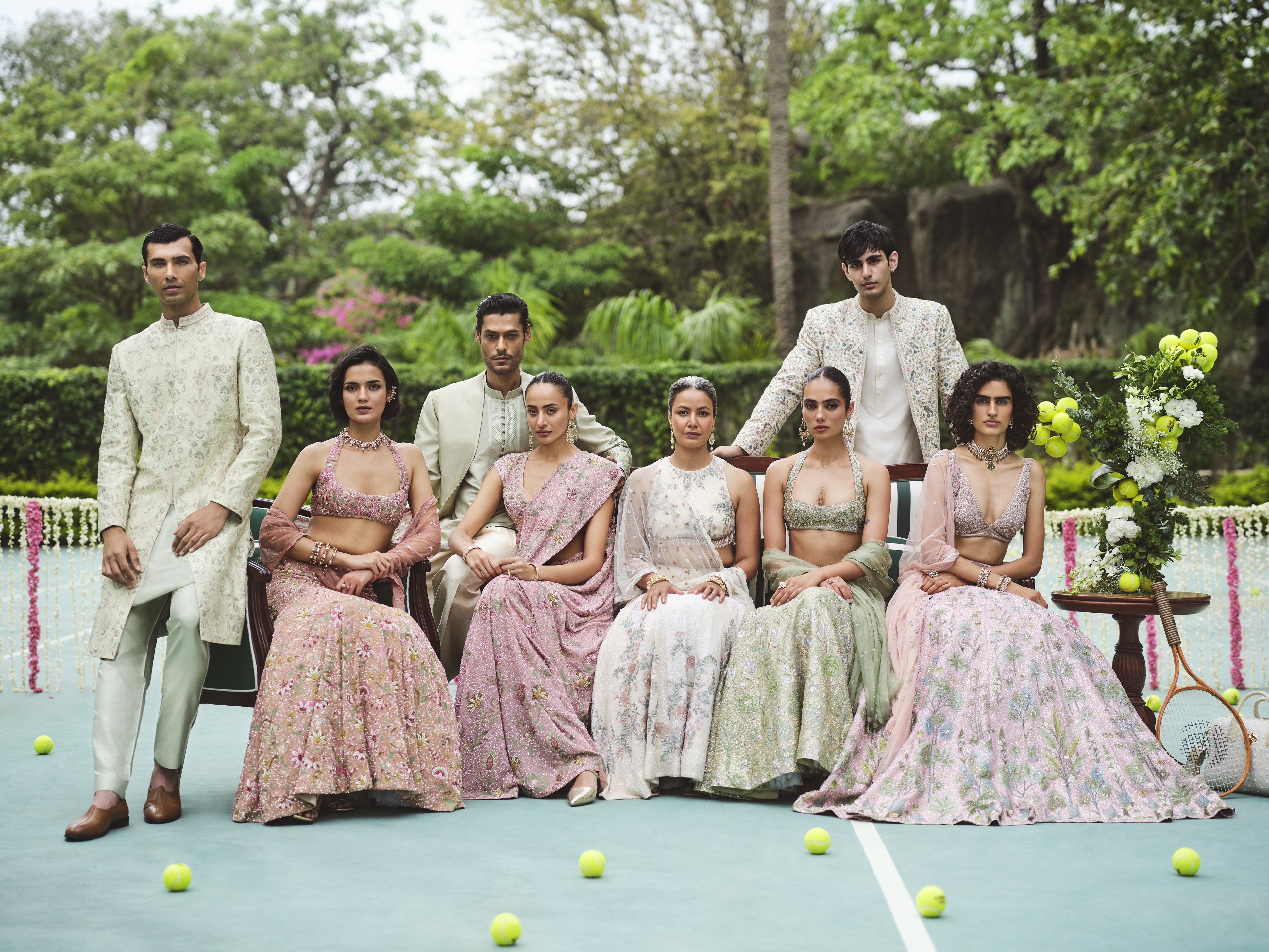
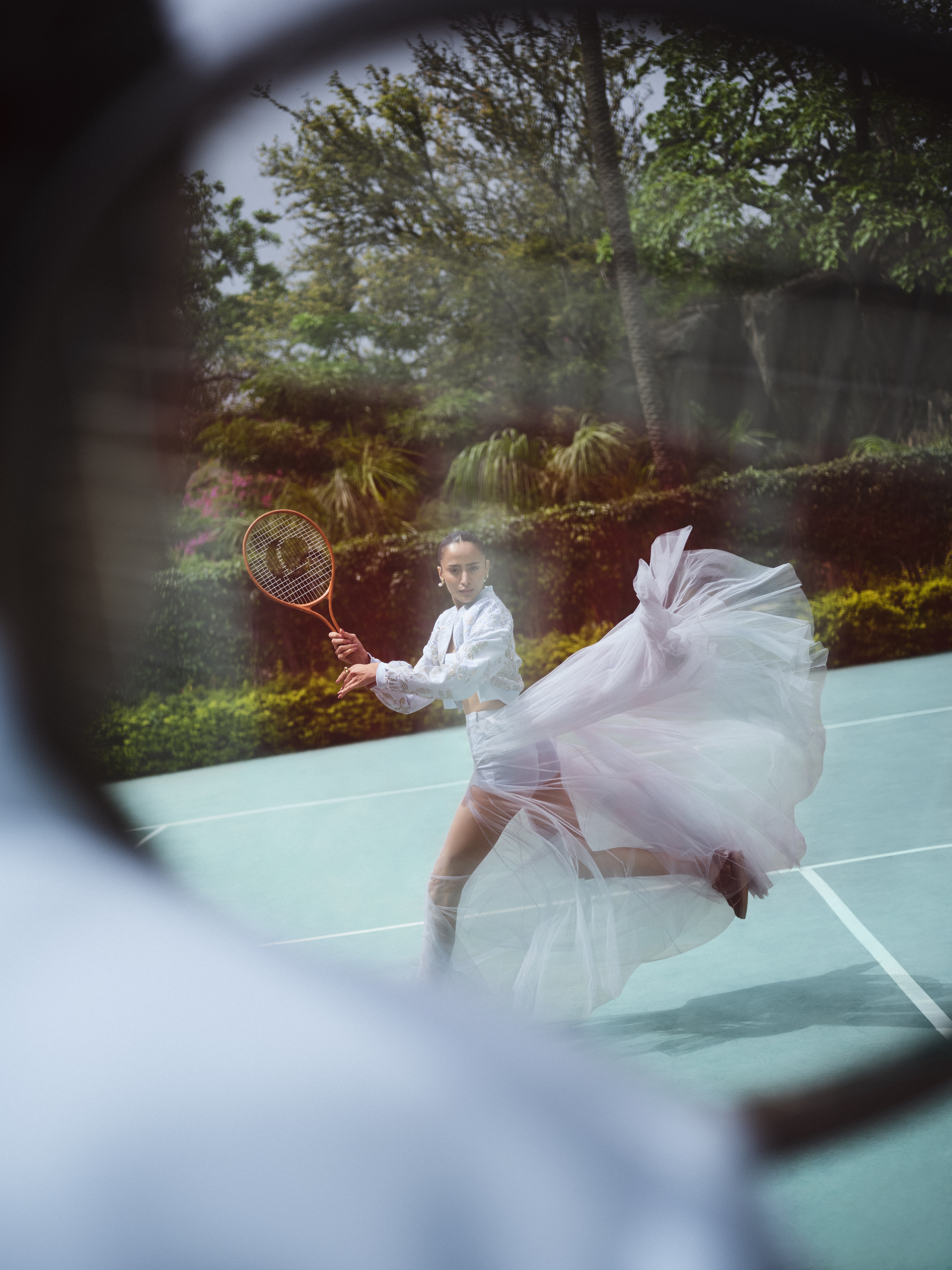
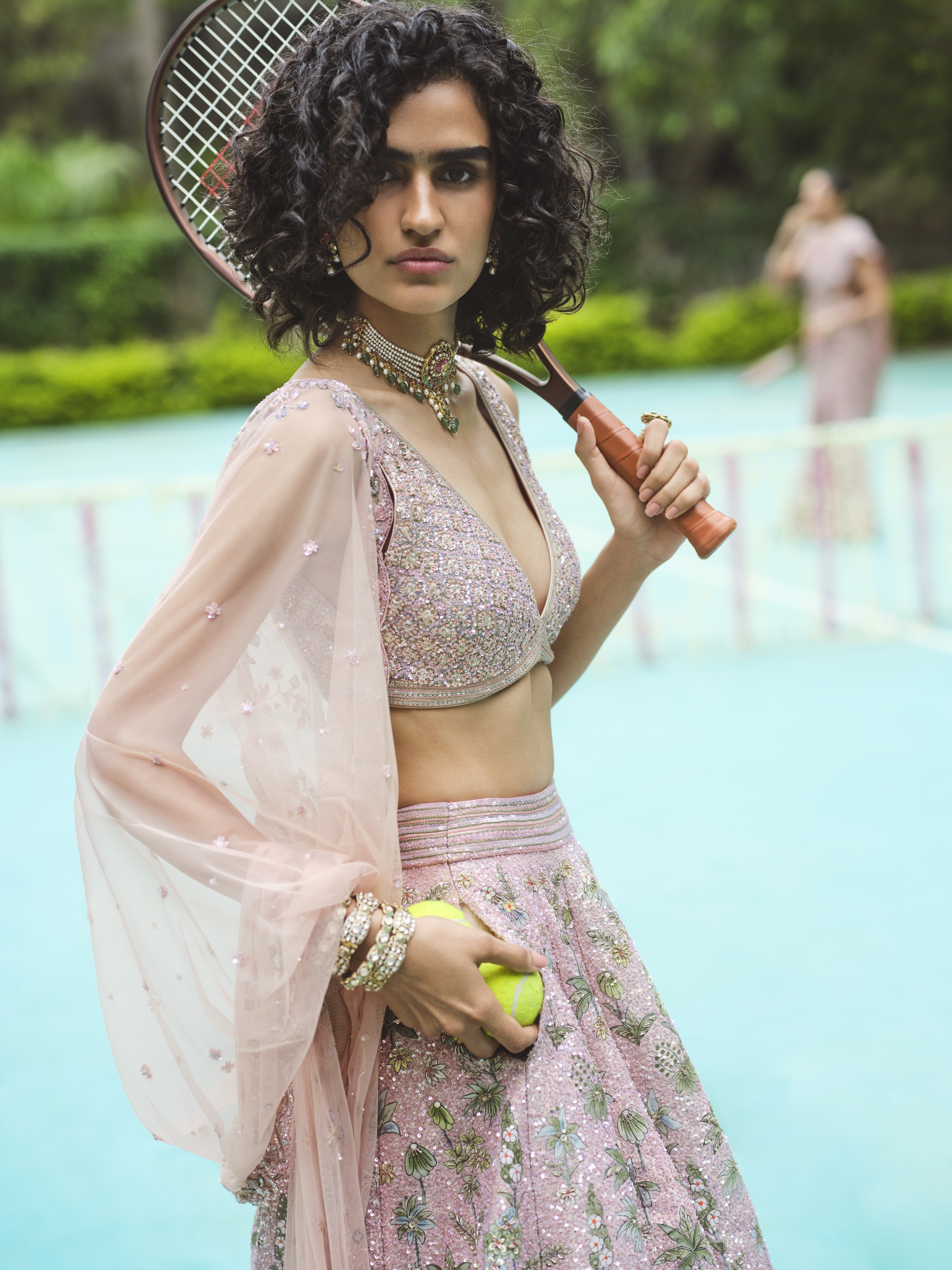
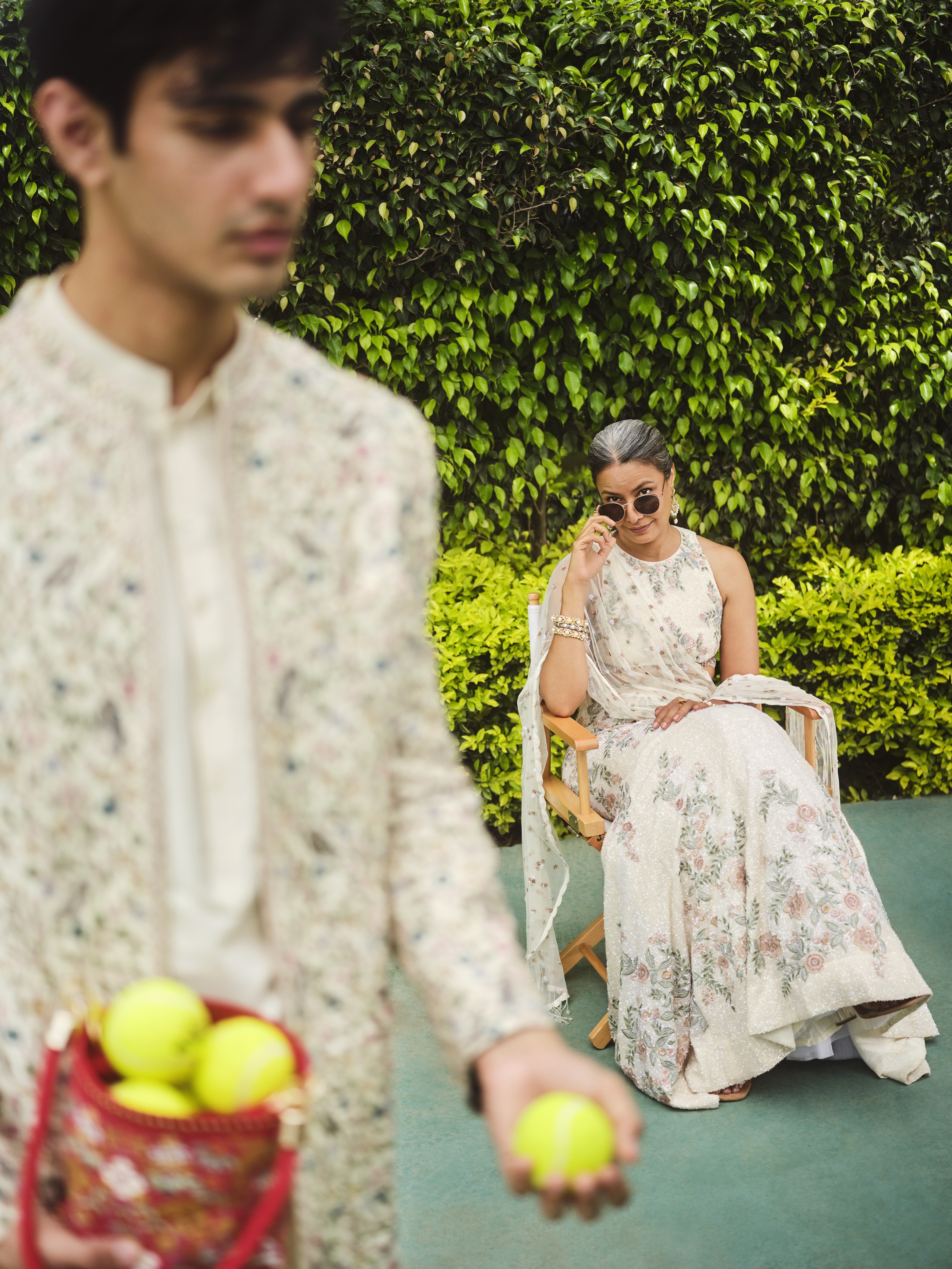
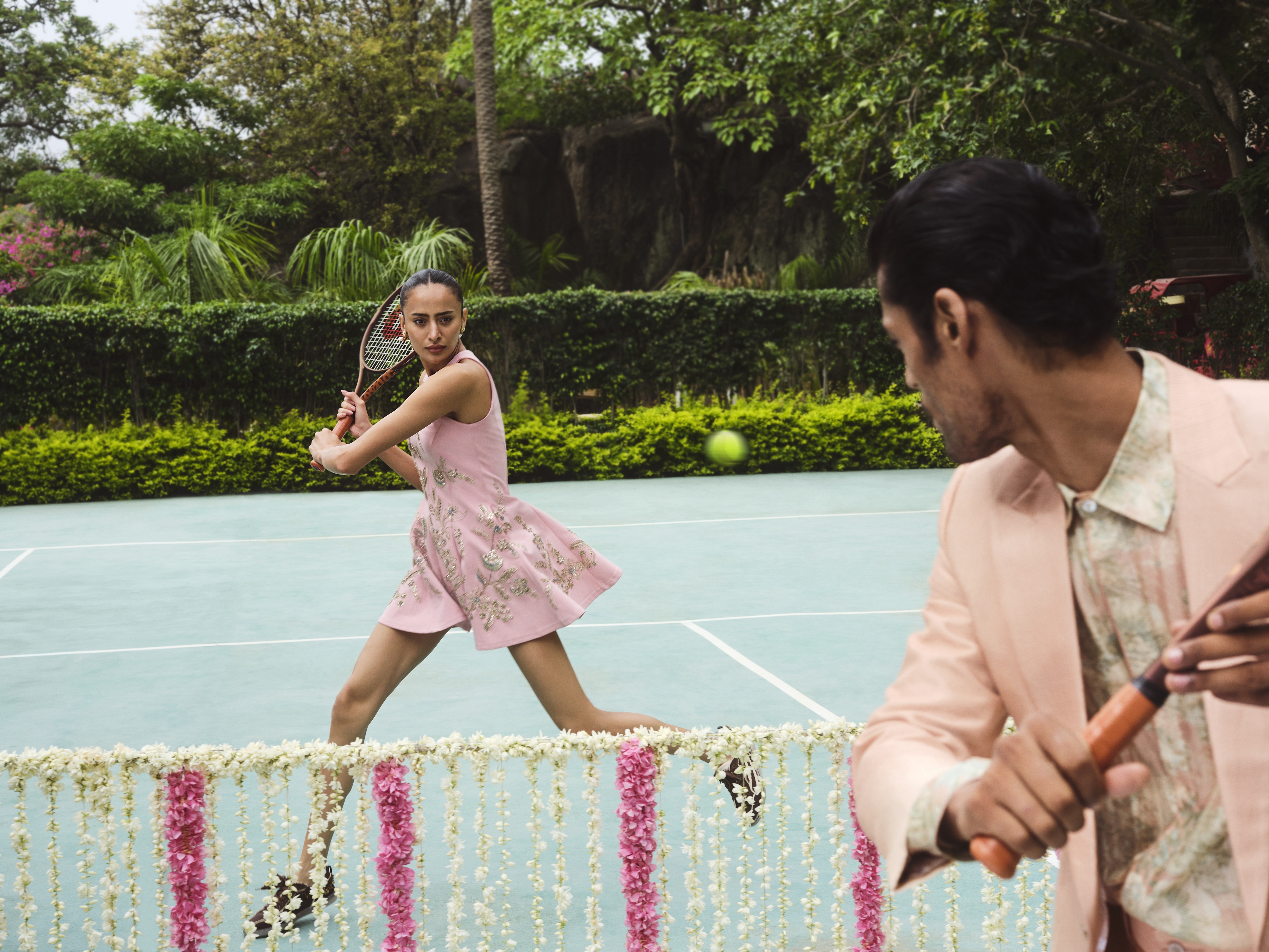
The collection opens with a visual world drawn from the tennis court: two players, a net strung with flowers, an elder in silk presiding from the umpire’s chair. It is a starting point that is both playful and precise. Love All, in tennis, is the score at the beginning of everything, the moment before anything has been won or lost, when the game is entirely open. As a philosophy for a bridal collection, it carries a more intentional weight. What does it mean to stand across from someone and choose them, fully? What kind of love allows two people to remain entirely themselves?
The clothes that follow ask these questions through colour, craft, and the particular intelligence of a house that has spent three decades understanding what Indian women actually want to wear, as opposed to what the occasion has historically told them they should.
The Palette
The colour story opens in sun-kissed pastels: the softest blush, ivory warmed toward afternoon, amber that does not hurry. These are colours that settle rather than announce, that photograph beautifully in natural light and sit against a range of Indian skin tones with the generosity of a palette chosen from observation rather than precedent. Into these, the house’s craft vocabulary moves with characteristic restraint: Gota Patti that catches the light the way joy catches a room, embroidery laid across silk with the unhurried confidence of something made entirely by hand.
It is a palette that understands something the louder end of bridal fashion occasionally forgets: that confidence does not require volume, and that the most beautiful thing a bride can wear is a colour chosen for joy rather than obligation.

The Craft
At the centre of Love All are the hand-painted Pichhwais, and they are, by any measure, the collection’s most extraordinary achievement. Pichhwai is a temple-hanging art form that originated in Nathdwara, Rajasthan, over 350 years ago, traditionally used to depict scenes from the life of Krishna. Each motif is illustrated stroke by stroke, master artisans bringing alive the harmony of nature and its inhabitants on cloth once meant only for sacred shrines.
What Anita Dongre has done here is both reverential and quietly radical: she has invited these artists to turn the gaze inward, to paint nature itself as the protagonist. Birds in conversation. Trees that lean towards each other. A world at gentle, unhurried play. The result, the Bloom Lehenga, named after the tender flowering of love, represents 90 to 120 days of work, passing between studios in Mumbai, Rajasthan, and Gujarat before it is whole. Finished in zardozi and sequins across a light fabric, it is made, as the house notes, for a bride who is conscious and makes her own choices. That is not marketing language. It is a design philosophy made visible.
The Luminous Lehenga carries the zardozi tradition, a form of metal-thread embroidery whose name comes from the Urdu words for gold and handwork, and whose history reaches back to the Mughal court. The gold-thread work has always had a quality of quiet indulgence, its nature-inspired motifs catching the light with the confidence of something that does not need to be looked for. Finished by master artisans in threadwork and sequins, it is made for a bride who does not need the room’s light to shine in it. The distinction matters.
The Serendipity Gown introduces cord embroidery, raised thread work rooted in the royal courts of the Mughal and Rajput eras, scrolling and blooming across fabric with the particular luxury of a technique that rewards proximity. Made for twilight celebrations, it is named for a love that arrives entirely by chance, and it wears that name honestly.
The Aglow Suit Set brings Maheshwari into the bridal conversation, the heritage weave spearheaded during the Holkar dynasty and kept alive by master weavers across generations. Crafted in a considered blend of silk and cotton, its diaphanous quality and subtle sheen make it the collection’s most quietly wearable piece, finished in cord embroidery, threadwork, sequins, and beadwork for a bride who glows quietly and unmistakably all day long.
The Afterglow Lehenga celebrates Gota Patti, the four-century-old Rajasthani art of transforming metallic ribbon into something that catches the light the way joy catches a room. The motifs are botanical and buoyant: florals and vines finding their own expression across the panels, worn against sun-kissed blush, for a bride who is joyful and fully herself.
The Vegan Line
Among Love All’s most considered offerings is a dedicated vegan lehenga line built on regenerative fibres, anchored by a decade-long partnership with Bemberg, the Cupro yarn made from cotton linter through a closed-loop process powered by renewable energy. When these garments complete their life, they return to soil and marine ecosystems, completing the circle rather than breaking it.
The Kindness Lehenga, named for a virtue that has a beauty of its own, is made from Bemberg Cupro that drapes with the unforced elegance of a fabric that knows exactly how to fall. Finished in thread and sequins, it is made for a bride who chooses comfort and moves through her own day entirely at ease. The choice of name is not incidental: kindness, in the context of this collection, is positioned as a bridal quality as significant as beauty.
The Larger Argument
Collections arrive and collections are reviewed, and the language applied to them tends toward the superlative regardless of whether the work has earned it. Love All earns it, but what makes it worth examining beyond the quality of the individual pieces is the coherence of the argument it is making.
This is a bridal collection built on the premise that the finest love is found between equals. That the bride who wears these clothes is not being dressed for an audience. She is being dressed for herself and for the person she has chosen, who has chosen her in return. The craft that goes into each garment, the 120 days of Pichhwai painting, the hand-applied Gota Patti, the Zardozi worked in gold, exists not as embellishment but as evidence: evidence that the occasion is serious, that the making matters, and that the woman who receives this garment is someone whose choice deserves this quality of attention.
That is not a small thing to say through a collection. It is, in the most literal sense of the phrase, what it means for fashion to mean something.
Love All. Score: everything to play for.
Follow Best List India for the culture, conversations, and ideas worth paying attention to.