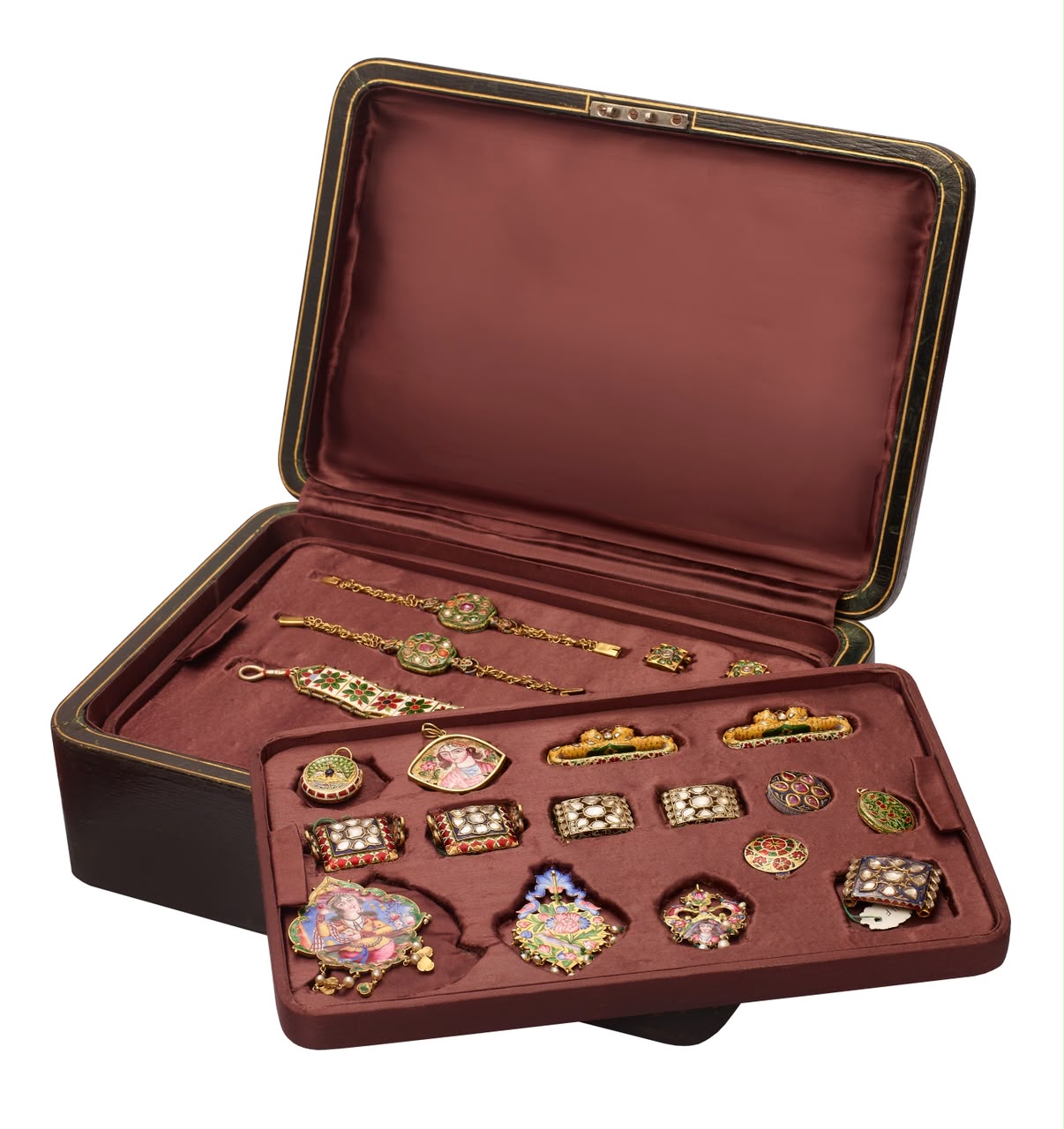
There is a difference between owning a jewel and understanding it. For Shreyans Gandhi, Executive and Creative Director of Gazdar, that difference is the work of a lifetime, and the work of five generations before him. Founded in 1933 and ninety years resident at The Taj Mahal Palace, Gazdar has built its name on connoisseurship, and its latest undertaking asks the house to do something quieter than selling: to document. The subject is an exceptional single-owner collection of eighteenth- and nineteenth-century Indian jewellery, rooted in Rajasthan but spanning the subcontinent, housed together in a specially fitted multi-tiered case and studied alongside historian Dr. Usha Balakrishnan. We spoke to Gandhi, a sixth-generation jeweller, about custodianship, the diamonds that glow rather than glitter, the armband that doubled as a talisman, and why the world should be paying attention.
Ninety years at The Taj Mahal Palace is not just an address; it’s a legacy. What does it mean to be custodians of Indian jewellery history for nearly a century?
Ninety years at The Taj Mahal Palace is a lot more than just another anniversary. There is a certain sense of responsibility in it, which has been passed to us from generation to generation. Being a jeweller of the sixth generation, we consider ourselves not just owners of unique pieces of jewellery but custodians of the stories and the traditions which our latest 18th and 19th century collection of jewellery embodies.
For us, preserving history involves understanding where the pieces come from, respecting the artistry and techniques behind it, and making sure that their value continues to be acknowledged by future generations. Our long journey from the establishment in 1933 to the present day has been shaped by a relentless commitment to quality, hard work and connoisseurship.
Working alongside my father and grandfather has instilled in me a certain sense of responsibility. Their focus on ensuring quality, perseverance and cultivating meaningful relationships has helped shape the way I approach Gazdar today. Ultimately, being custodians means honouring what has been entrusted to us while continuing to build a future worthy of that legacy.
Every collection tells a story before you even open the case. What drew you to this particular single-owner collection, and what did you see in it that made you want to document it properly?
What drew me to this collection was not just the exclusivity of the individual jewels, but the story which develops when one sees them together. It is an exceptional single-owner collection of eighteenth- and nineteenth-century Indian jewellery, bringing together diverse regions, traditions, techniques and forms. It is primarily rooted in Rajasthan but extends across the subcontinent, capturing the many languages of Indian adornment within one collection.
What made it important to document was that these are not just beautiful objects, but expressions of craftsmanship, cultural exchange, symbolism and history. From Golconda diamonds, Burmese rubies and Colombian emeralds to kundan and meenakari, every piece carries a sense of time and tradition. Having grown up within Gazdar and learned from my father and grandfather, I believe that preserving the story behind a jewel is just as important as preserving the jewel itself. This collection gave us the opportunity to create a record of that craftsmanship and cultural memory for future generations.

A specially fitted, multi-tiered jewellery case housing the entire collection, that’s provenance made physical. What does an object like that tell you about the person who once owned it?
What drew me to it was the sense of continuity it represents. The specially fitted case highlights the fact that these jewels were not just collected but have been carefully preserved and lived with as a unified whole. It provides a rare glimpse into the owner’s appreciation for craftsmanship, heritage and the meaning attached to each piece.
Working with Dr. Usha Balakrishnan brings scholarship into what could easily have stayed simply beautiful. What does her lens add that yours alone couldn’t?
For me, this is particularly what makes our collaboration so meaningful. My connection with jewellery is rooted in a sixth-generation understanding of the craft, its visual language, its legacy and, importantly, the way these pieces have been experienced as objects of beauty and desire. I can look at a jewel and understand its craftsmanship, the materials, the sensibility of the period and the emotion that it evokes.
But Dr. Usha Balakrishnan brings another layer to this experience: she provides it with historical and cultural vocabulary. Her perspective helps in understanding not just what one is looking at but why it looks the way it does, where a technique or motif has been derived from, how different regional traditions come together, and what the object tells us about the society which produced and wore it. In a collection that spans diverse regions, periods and traditions, that context is invaluable. She can place something as seemingly simple as a flat-cut diamond or a piece of meenakari within a much larger story of Indian craftsmanship, trade, patronage and cultural exchange.
For me, her scholarship ensures that we never reduce these jewels to their visual magnificence alone. It makes us pause and recognise the knowledge embedded in every setting, gemstone, enamel surface and symbolic motif. My role is to carry the legacy forward creatively and make it relevant to a contemporary audience; her role helps us understand that legacy with greater depth and precision. Together, those perspectives allow the collection to be seen not simply as beautiful jewellery, but as a record of Indian artistic history, craftsmanship and cultural memory.
Golconda diamonds, Burmese rubies, Colombian emeralds, kundan, meenakari, this collection speaks in many languages of craft. Which piece, for you, says the most?
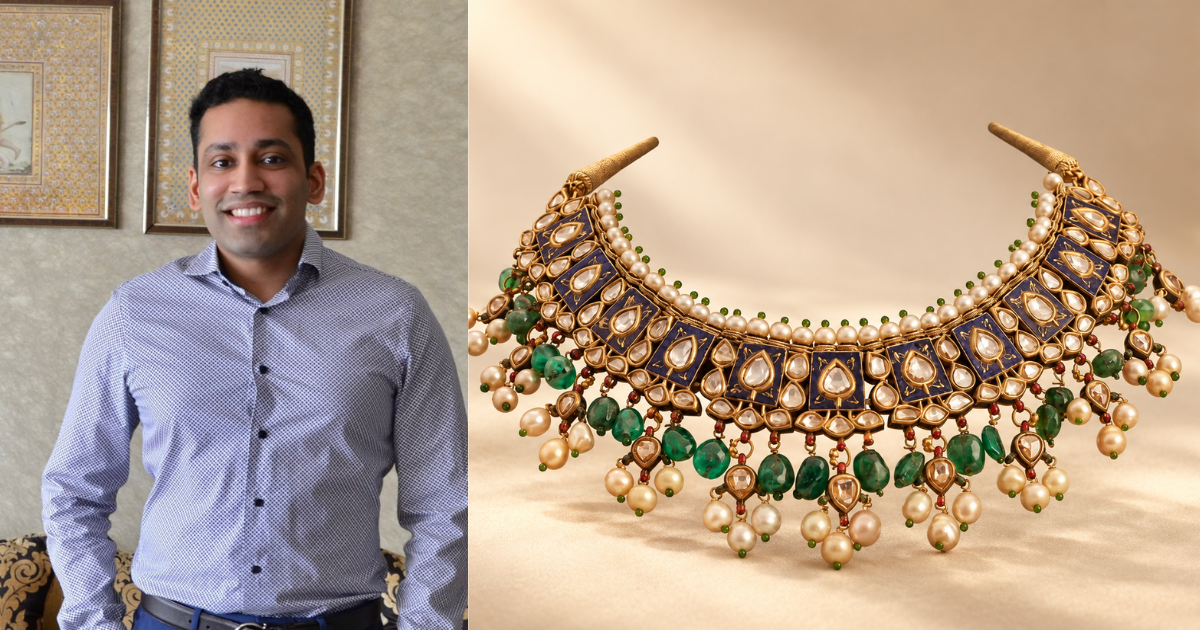
For me, the piece that says the most is the one where the language of the gemstone can’t be separated from the language of the craft. I have always been particularly drawn to jewels which bring together old Indian table-cut diamonds, the precision of kundan and the richness of meenakari, as they represent a lot of what makes Indian jewellery distinctive.
A flat-cut diamond does not seek the sharp brilliance of a contemporary brilliant cut; it has a softer, quieter lustre and a presence that allows the craftsmanship to speak for itself. When those stones are closely fitted into kundan, surrounded by finely worked gold, and complemented by the luminous colours and natural motifs of meenakari, you begin to see how many disciplines come together in a single jewel.
For me, that is what makes such a piece particularly compelling. It is not simply about the rarity of a Golconda diamond, a Burmese ruby or a Colombian emerald, but about how the jeweller has transformed these materials into something that carries history, symbolism and human workmanship. The collection itself brings together jewels from different regions, periods and traditions, and that diversity is precisely what I find most meaningful: each technique has its own vocabulary, yet they coexist within a distinctly Indian aesthetic.
Having grown up within Gazdar and learned from my father and grandfather, I have come to value that continuity deeply, the understanding that a jewel can be beautiful in the moment, while also carrying the knowledge, relationships and craftsmanship of generations before it.

Take us into the making of the catalogue itself. What does it take to move from “we have a beautiful piece” to “we understand exactly what this piece is, where it came from and what it meant”?
The journey of the making of the catalogue started long before the photography or the writing. It began with looking at the jewels as objects of history. We shifted from simply appreciating their beauty to understanding their provenance, period, materials, craftsmanship and the cultural language behind their shape. That meant examining details like the cut of a diamond, the intricacies of kundan or meenakari, the gemstones used, and even the symbolism of motifs and forms.
Each piece has then been placed within a larger story of the collection, so that the catalogue becomes more than a record of beautiful objects; it becomes a document of the traditions, techniques and histories which have shaped Indian jewellery. For us, this depth is what allows a jewel to be understood and not just seen.
Indian jewellery has always carried more than adornment: protection, symbolism, courtly power, devotion. What’s a piece in this collection that carried a meaning you didn’t expect to uncover?
One piece that has particularly stayed with me is the bazuband, as its importance extends beyond ornamentation. What appears to be a beautifully crafted armband could also serve as a form of personal protection, sometimes concealing a talisman, mantra or other protective element. I find this duality especially fascinating as it speaks to how Indian jewellery was not simply worn to be seen, but was deeply connected to belief, identity and a sense of safeguarding the wearer.
Techniques like kundan and meenakari are centuries old, yet still define luxury today. What do you think modern jewellery has lost, or still chases, from this era?
I think what modern jewellery sometimes loses is the patience and the sense of purpose behind the craft. Techniques like kundan and meenakari are not just about embellishment; they bring together exceptional hard work, material knowledge, symbolism and a deeper sense of connection to regional traditions. Modern jewellery continues to chase the same sense of individuality and permanence, the ability of a piece to feel not just luxurious but meaningful and enduring.
At Gazdar, we believe the challenge is to carry that craftsmanship and cultural depth forward while allowing jewellery to speak to a contemporary audience.
If this collection could speak to a bride wearing jewellery today, what would you want her to understand about the weight, history and hands behind what she wears?
I would want a bride to understand that the weight of a heritage jewel cannot be measured in grams, but in the history, craftsmanship and the human hands it carries. Each piece in this collection reflects generations of technical mastery, from the precise setting of kundan to the delicate work of meenakari and the characteristics of the historic gemstones. Behind every jewel are artisans who have preserved these techniques through patience and extraordinary skill.
When a bride wears such a piece, she is not just wearing something beautiful but becoming a part of a much larger story of Indian craftsmanship, grandeur, culture and continuity.
What happens to this collection and this research next, and why should the world be paying attention?
In the upcoming time, what happens is just as important as what has already been preserved. We want this collection and the research surrounding it to continue as a living archive, strengthening our understanding of the techniques, the regional influences, materials, and the histories which are embedded within each jewel.
The world needs to be paying attention because these pieces are not just objects of beauty; together, they document the extraordinary diversity, craftsmanship and cultural exchanges that shaped Indian jewellery over centuries. Our responsibility is to preserve that knowledge, make it accessible to future generations, and ensure that this heritage continues to inform how we understand and create jewellery today.
What lingers from this conversation is a reframing of what it means to be a jeweller. Gandhi speaks less like a seller of beautiful things than a steward of knowledge, someone for whom a flat-cut diamond, a concealed talisman and a fitted case are all evidence in a much longer argument about how Indian craft came to be. The catalogue, the research and the collaboration with Dr. Balakrishnan are an attempt to make that argument legible to people who were never in the room. In an era when luxury is so often measured in carats and price, Gazdar is making a quieter case: that the real weight of a jewel is in its history and in the hands that made it, and that both deserve to be preserved with the same care as the stones.
Follow Best List India for the culture, conversations, and ideas worth paying attention to.