The wedding photography industry has a volume problem. Fifty, seventy-five, a hundred weddings a year, each delivered with the efficiency of a production line, is considered a sign of success. Shrey Bhagat built Raabta Studios in 2022 on the opposite instinct: that a photographer who has genuinely known a couple, sat with their families and felt the wedding alongside them will notice what a machine never could. Four years and more than 100 weddings later, across Italy, Greece, the Maldives, the UAE and some of India’s most private families, the studio has been named among Vogue India’s Top 5 Wedding Photographers and won Wedding Photographer of the Year at the 2026 WeddingSutra Photography Awards. Behind the lens is Shrey. Behind the structure is his wife and co-founder, Manveen Ahuja Bhagat, who brought 14 years of advertising and brand strategy to the business. We spoke to both about quality over quantity, the discipline of becoming invisible, and what it means to build something that lasts rather than something that merely grows.
Take us back to 2022. What was the spark that made you want to build Raabta Studios, and what did you want it to stand for from day one?
Shrey: I started Raabta because I wanted to give my 100% to every client we took on. I never wanted to build a company that was photographing 50, 75 or 100 weddings a year and producing work almost like a machine. For me, it was never about how many weddings we could do. It was about how deeply we could be a part of each one.
I wanted to know the couple, understand their story, spend time with their families and really experience the wedding alongside them. Every wedding is a new Raabta, a new set of relationships and emotions, and I wanted us to have the time and headspace to genuinely celebrate each one.
That naturally shaped the way we photograph. When you are truly present, you notice the tiny things: a glance between two people, a parent quietly watching from the corner, a friend trying not to cry, the chaos and laughter in between the big moments. Those are the things that make a wedding belong to that particular couple.
So from the very beginning, Raabta was built around one principle: quality over quantity. We wanted to create fewer, more meaningful bodies of work, and give every wedding the attention, energy and emotion it deserves.
Manveen, you brought 14 years of advertising and brand strategy into a world built on cameras and candid moments. What did the industry get wrong about structure before you stepped in?
Manveen: I wouldn’t say the industry got structure wrong. I think a lot of creative businesses simply begin with the craft, and everything else gets built around it as they grow.
Coming from 14 years in advertising and brand strategy, I naturally looked at Raabta slightly differently. I knew that great work could get you noticed, but building a brand required consistency in everything around that work too. How you communicate, how you present yourself, how you manage a client, how your team functions and, most importantly, whether you can deliver the same experience every single time.
My role was to bring that structure behind Shrey’s creativity without ever interfering with it. In fact, the stronger the systems became, the more freedom the creative team had to focus entirely on what they do best.
I think that balance has become a big part of Raabta. Shrey protects the soul of the work, and I make sure we build a business strong enough to protect that soul as we grow.

“It truly takes a village to build something meaningful, and even more to build something that lasts.” What has that village looked like for the two of you, and what has it cost you to build something that lasts rather than something that simply grows?
Shrey & Manveen: We have always said that we are no one without our team. Some of the people who work with us today have been with Shrey for 10 or more years. They have seen us through the thick and thin, through the early days of Raabta and everything we have built since. There is a trust there that cannot be created overnight.
But our village extends far beyond our own team. One of the most beautiful things about this industry is the camaraderie between photographers and studio owners. We have never really looked at each other as rivals. Over the years, we have built friendships and relationships that are far more meaningful than competition. There are times when you don’t even realise who has become whose guardian angel until you need someone and they are there.
It is such a wonderful industry to be a part of because it feels enormous from the outside, but is actually such a small, closely connected world. Everyone knows someone who can help, everyone has each other’s backs, and ultimately we are all working towards the same thing: making the most important days of someone’s life as magical as they can be.
And perhaps that is also what building something that lasts has meant to us. It has never been about growing at any cost. It has been about building relationships, earning trust and creating a community of people who genuinely care about the work and about each other.

In four years, Raabta has documented over 100 weddings across destinations like Italy, Greece, the Maldives and the UAE. Is there one wedding, one destination, one family that changed the way you work?
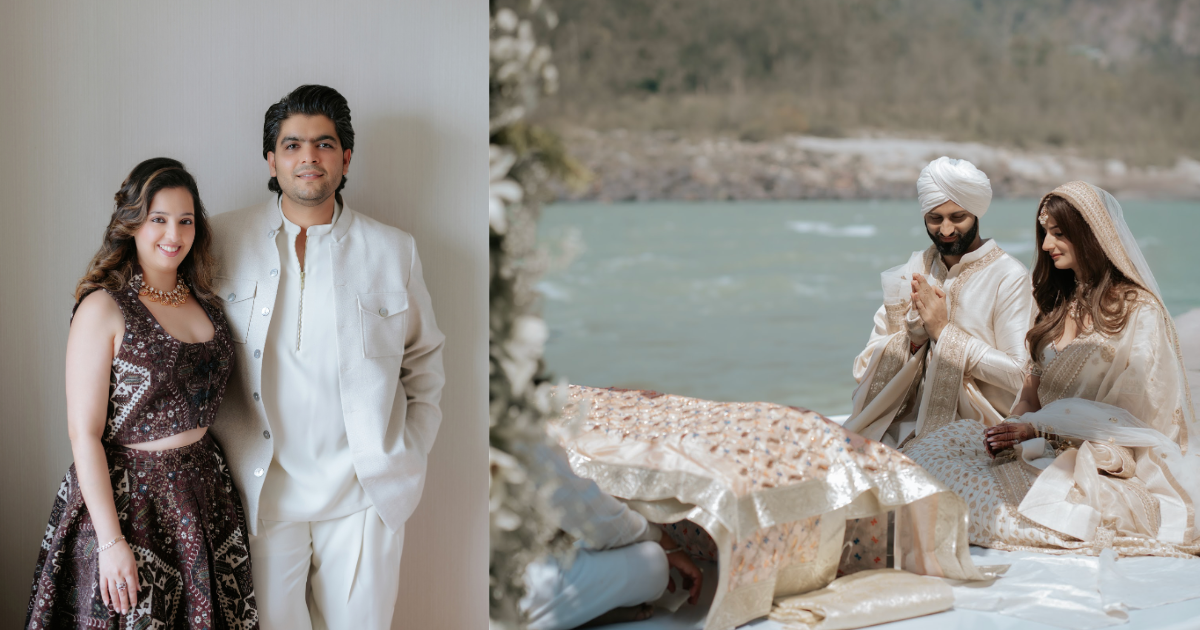
Shefali and Krish’s wedding in Rishikesh was rooted in spirituality and family. Set along the banks of the Ganges, the ceremonies were deeply personal, with rituals that felt calm, reflective, and grounded rather than performative. The couple consciously created space for togetherness, choosing moments of silence, prayer, and connection over spectacle. Visually and emotionally, the river became a constant presence, anchoring the wedding in meaning and tradition.
Shrey, your approach is built on documenting moments as they unfold rather than staging them. What do you have to give up, creatively, to let a moment simply happen instead of directing it?
Shrey: I don’t think you have to give up direction entirely. That is also the beauty of weddings. There are moments where you can create something beautiful with a couple, direct them, play with light and composition and really explore your creativity. And then there are moments where the best thing you can do is become invisible and simply observe.
A wedding is incredibly versatile, and the real skill is knowing which approach a moment needs. You have to know when to direct and when to step back, when to click the shutter and when to just let the moment pass. I actually think that is one of the true tests of a seasoned photographer. Not everything needs to be documented.
You also have to remember that you are not photographing models. You are photographing a couple, their relationship and their story. Sometimes your creative instinct tells you to do something, but the moment doesn’t need it. That awareness has to take precedence over your own creative whims and fancies.
For me, the photograph is never more important than the moment itself. If I have to choose between creating a great photograph and allowing something genuine to happen uninterrupted, I will always protect the moment. And ironically, those are often the photographs that end up meaning the most.

You’ve worked with the Birlas, the Salgaocars and some of India’s most private families. How do you earn the trust of people who have spent their whole lives being watched?
Shrey & Manveen: I think the first thing is understanding that access is a privilege, not an entitlement.
We work with families who have spent their entire lives being watched, photographed and spoken about, so the last thing we want to do is make them feel like they are being observed at their own wedding. We try to become a very unobtrusive presence. We understand the family dynamics, we read the room, we know when to step forward and when to disappear.
Discretion is a very important part of what we do. We don’t share names or details of our clients casually, and we are extremely conscious of what is private and what is ours to tell. For us, the trust continues long after the wedding too. It is about how we handle their photographs, their stories and everything we were privileged enough to witness.
But ultimately, I think people trust us because they know we care about the people before we care about the photograph. We aren’t there simply because it is a prestigious wedding or because the family is well known. We are there because they have invited us into one of the most intimate chapters of their lives.
The greatest compliment for us is when, after a few hours, people stop noticing the cameras. They laugh, cry, hug, dance and behave exactly as they would if we weren’t there. That is when we know we have earned their trust.

Manveen, you’ve said what truly builds a brand is delivering with the same intent every single time. What does that discipline look like on the one day no one is allowed to go wrong?
Manveen: We always tell our couples, “Don’t hide anything from your doctor, your lawyer and your photographer.” Because the more we know, the better we can prepare.
After years of doing this together, Shrey, our team and I know the structure a wedding needs. We know the protocols, the pressure points and the things that can potentially go wrong. So we discuss contingencies, backups and sometimes even the backup of the backup. The idea is that by the time we reach the wedding, we have already thought through as many possibilities as we possibly can.
Our pre-production meetings are a huge part of that. We have thorough PPMs with all the stakeholders involved, and by the time we arrive, we are often 80% prepared for what to expect. We work very closely and in sync with planners, production teams, makeup artists, designers and everyone else involved because the wedding is not happening in isolation. Everyone has a role to play in making the day magical for the couple.
Then, on the actual day, our job is to make all of that preparation invisible. Things will inevitably happen that nobody could have predicted, but because the foundation is strong, our team can stay calm, adapt and keep doing what we are there to do.
I think that is what consistency really means to us. It isn’t about making every wedding identical. It is about having the discipline and preparation to give every couple the same level of care, attention and intent, regardless of what the day throws at you.
You should be able to look at a Raabta wedding and feel the creativity. You shouldn’t have to see the hundreds of decisions and hours of preparation that made that creativity possible.
Raabta has grown to include still frames that blend photography with motion, alongside cinematic storytelling. What pushed you to keep evolving the format instead of perfecting one language and staying there?
Shrey: For us, evolving the format was never about trying to do something new simply for the sake of being different. It came from wanting to tell the story in the most honest and complete way possible.
Photography and cinematography have their own languages. A photograph can hold a single expression or a fleeting glance forever, while motion can bring back a voice, a laugh, the way someone moved or the energy of an entire room. Sometimes a moment needs stillness and sometimes it needs movement.
That is what led us to experiment with still frames that blend photography with motion. We wanted to explore that space between the two without losing what makes each medium powerful.
We also don’t believe that a wedding should have to fit into one visual language. Every couple has a different story, every family has a different energy and every wedding has its own rhythm. Our job is to find the language that serves that story best.
For us, evolution is really about staying curious. The moment we feel we have perfected one way of telling a story is probably the moment we should start asking ourselves what else is possible.

From Vogue India’s Top 5 Wedding Photographers to the Condé Nast Destination Wedding Guide 2025, the recognition has followed quickly. Which moment made you both pause and realise how far Raabta had come?
Shrey & Manveen: There have been a few moments that have made us stop and take stock, but being named among Vogue India’s Top 5 Wedding Photographers was certainly one of them.
When you start something from scratch, you are so consumed by the work that you rarely stop to look at what you have built. You are thinking about the next wedding, the next client, the next challenge. So when a publication like Vogue recognises you in that way, it makes you pause for a moment and realise that something you started with a very clear but very personal vision has travelled much further than you imagined.
The Condé Nast recognition was another one of those moments, and the WeddingSutra Photography Awards have been particularly special to us because they recognise the work itself. Winning Wedding Photographer of the Year in 2026 was an incredibly meaningful milestone.
But perhaps the recognition that means the most is still much quieter. It is when a couple comes back to us years later and tells us that a photograph or a film took them straight back to how they felt on that day.
Awards tell you that the industry is noticing your work. Those moments with couples tell you that the work actually meant something.
And for us, that has always been the bigger measure of how far Raabta has come.
Where is Raabta headed next, creatively and as a business, and what does the next chapter of “Raabta” mean to the two of you now?
Shrey & Manveen: When we think about what is next for Raabta, we don’t actually think about it in terms of how many more weddings we want to do or how big we want the company to become. We think about what we want Raabta to feel like 10 or 20 years from now.
When we started, we were simply trying to build a company that we ourselves would want to work with. A company where every couple mattered, where the work was never rushed and where our team could take pride in what they were creating. Somewhere along the way, Raabta became much bigger than the two of us.
Today, our ambition is to keep growing, but without losing that intimacy. We want to keep experimenting creatively, keep surprising ourselves and keep finding new ways to tell people’s stories. At the same time, we want to build a team and a culture that can carry the Raabta philosophy forward.
There is something quite special about building a company with your partner. We have grown alongside Raabta, and in many ways, the company has grown alongside our relationship too. We have had our share of difficult days, disagreements, risks and moments where we have wondered if we were getting it right. But we have always come back to the same thing: why we started.
And that is probably what the next chapter of Raabta means to us. Not becoming the biggest, but becoming better. Not just building a successful photography company, but building something with a soul, something our team feels proud to belong to and something that, years from now, still makes a couple feel exactly what they felt on the day we photographed them.

There is a quiet paradox at the centre of Raabta’s success: the studio has become one of India’s most in-demand names by deliberately refusing to chase demand. Shrey protects the moment, Manveen builds the structure that lets him, and between them they have made a business out of a simple, unfashionable conviction, that presence cannot be scaled, only chosen. In an industry that rewards volume, the Bhagats keep betting on depth. If the photographs that return a couple to the exact feeling of their wedding day are the real measure, then Raabta, whose name means “connection,” has been honouring its promise all along.
Follow Best List India for the culture, conversations, and ideas worth paying attention to.