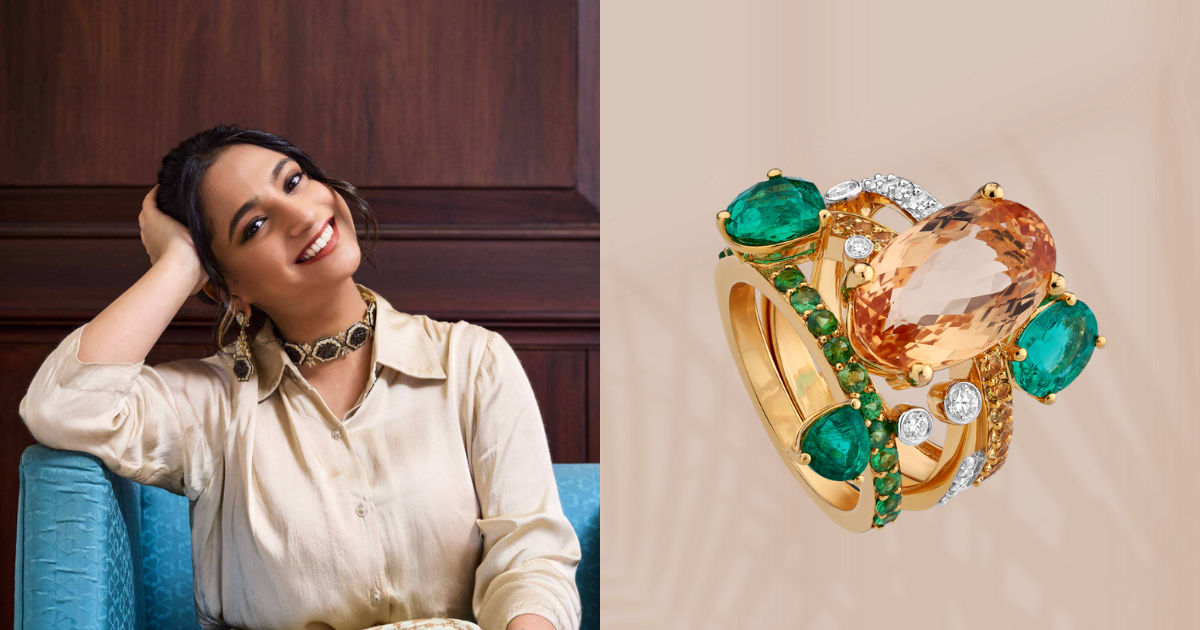
Most jewellery begins with a diamond, a ruby, an emerald, a sapphire: the established vocabulary of preciousness, chosen first and designed around second. Rhea Poddar Loyalka begins somewhere else entirely. She begins with a stone nobody has asked her to use, and waits to learn what it wants to become.
As Creative Director of Deshya by Ma Passion, she carries forward twenty-five years of a carving philosophy summed up in four words: Never Before. Never Again. She grew up inside Ma Passion, among master craftsmen and gem experts, wandering her parents’ exhibitions among stones in every colour, texture, and form, and had memorised the names of dozens of gemstones before she turned eight. What stayed with her, though, was not the catalogue but the transformation: a stone in its natural form, a master carver’s hands, and the moment it became something completely unexpected while retaining everything that made it extraordinary.
Deshya, launched last October, is her expression of that inheritance: a design language built on Sugilite, jade, opal, mandarin garnet, and other materials that sit outside the conventional jewellery rulebook, designed for a person rather than for a gender, and unafraid of contrast.
We spoke with her about what it means to let the gemstone lead, the tsavorite that did not go quite as planned, and where an Indian carving tradition can go on a global stage.
You grew up inside Ma Passion, around master craftsmen and gem experts, long before GIA Carlsbad made it official. What is the earliest memory you have of a gemstone that made you fall in love with this world?
I do not think there was one defining moment, because gemstones were simply part of the world I grew up in. Some of my earliest memories are of wandering through my parents’ exhibitions, surrounded by stones in every imaginable colour, texture and form. I was fascinated enough to memorise the names of dozens of gemstones before I turned eight.
What stayed with me most, though, was seeing a stone in its natural form and then watching what happened when it reached the hands of a master carver. It could become something completely unexpected, while still retaining everything that made the stone extraordinary in the first place.
Growing up at Ma Passion, I was able to witness that transformation again and again. I think that is where fascination gradually became something deeper, and that same curiosity continues to shape the way I look at gemstones and jewellery today.
Deshya carries forward 25 years of Never Before Never Again carvings. What does that philosophy actually demand of you, creatively and technically, every single time?
Never Before. Never Again. sets a very high bar because it means there can be no formula.
Creatively, it demands that we keep questioning what a gemstone can become. At Deshya, that often begins with stones that are rarely seen in jewellery, or with familiar stones approached through an unexpected cut, carving, colour combination or form. The gemstone leads the design, rather than being chosen to fit a predetermined idea.
Technically, that freedom comes with its own challenges. Carved and unusual gemstones cannot simply be designed around in conventional ways. Their proportions, structure and individual character have to be understood, and the setting, craftsmanship and engineering have to respond to them. Sometimes that means months of refining a piece until everything feels resolved.
For me, carrying this philosophy forward is not about recreating Ma Passion in jewellery. It is about carrying forward the same spirit of discovery and giving it a distinct Deshya expression.
Most jewellery brands work backward from diamonds, rubies, emeralds and sapphires. You start somewhere else entirely. Walk us through how you choose a raw, exotic gemstone and decide what it wants to become.
For me, it always begins with curiosity. I am drawn to gemstones that have something unexpected about them, whether it is an unusual colour, an interesting origin, a natural inclusion or simply a character I have not encountered before.
Once I find a stone, I spend time understanding it before deciding what it should become. Its colour, structure, translucency and natural form all influence the direction. Sometimes the stone lends itself to carving; sometimes an unusual cut reveals something completely different. The design develops from there.
That is also why I enjoy working with gemstones such as Sugilite, jade, opal, mandarin garnet and other materials that sit outside the conventional jewellery vocabulary. They give you the freedom to approach jewellery without a predetermined rulebook.
I never want the gemstone to feel like an element that has simply been placed into a design. The most exciting pieces, for me, are those where the gemstone and the design feel inseparable, as though one could not have existed without the other.
Carving is unforgiving. There is no undoing a cut. Tell us about a piece where the stone did not go the way you planned, and what it taught you.
One experience that really taught me something was with a parcel of rough tsavorite garnet I had bought to create a pair of earrings. Tsavorite is a relatively expensive stone, and when I gave it to our kaarigar, he immediately pointed out that the rough had several internal cracks and could potentially fall apart during carving.
I decided to take the risk and go ahead. Thankfully, the stone held together, but because the kaarigar was understandably cautious about damaging it, the final carving was more restrained than I had envisioned. It was less sculptural and not as deeply carved as I had imagined.
What it taught me was that carving is as much about trust and conviction as it is about technical skill. As a designer, I need to push an idea, but I also need my kaarigar to believe in it and feel confident taking that risk with me. When that conviction is shared, I think that is when you get the best work.

Deshya moves fluidly between statement, couture and fine jewellery. How do you decide when a piece should whisper and when it should be the loudest thing in the room?
I do not necessarily think of it as whispering or being loud. For me, it is about presence, and presence can come from many different things.
Sometimes an extraordinary gemstone needs scale and a bold silhouette to fully express its character. At other times, the most interesting decision is restraint: allowing an unusual colour, a beautiful carving or an unexpected detail to become the focus.
I think the key is knowing when to stop. A piece can be intricate without feeling excessive, and it can be minimal while still being impossible to overlook.
You have made a deliberate choice to design without gender as a boundary. What changed in your process once you stopped designing for a woman or for a man and started designing for a person?
It actually made the design process much more instinctive. Once you remove the idea that certain forms, colours or gemstones belong to a particular gender, you give yourself a much wider creative vocabulary.
I began thinking less about who a piece was traditionally meant for and more about the person who might connect with it. What would draw them to it? The colour, the scale, the form, the gemstone, or simply the way it makes them feel when they wear it.
It also allows us to challenge some very established ideas in jewellery. A bold gemstone does not have to be feminine, just as restraint does not have to be masculine. For me, jewellery becomes far more interesting when it is about individuality rather than convention. The piece has its own character, and the person wearing it brings the rest.
Colour is central to everything you make. If you had to describe Deshya’s world entirely through colour, with no jewellery in the sentence at all, what would you say?
For me, colour is about instinct more than rules. The most interesting combinations are often the ones you would not immediately think to put together.
So, if I had to describe Deshya entirely through colour, it would be a world that is vibrant, unexpected and completely unafraid of contrast.

Bridal and festive dressing in India has its own grammar: heirloom, heavy, traditional. Where does Deshya choose to honour that grammar, and where does it deliberately break it?
There is so much about Indian bridal and festive dressing that I would never want to lose: the sense of occasion, the richness of colour, the craftsmanship, and the emotional significance jewellery carries.
Where Deshya departs from tradition is in the idea that occasion jewellery has to follow a particular formula. It does not always have to mean familiar gemstones, familiar settings or a certain idea of grandeur.
We might take the richness and scale associated with Indian celebration, but express it through an unexpected gemstone, a sculptural form, an unusual colour combination or a piece that can be worn in more than one way.
For me, it is not about breaking with tradition for the sake of being different. It is about allowing tradition to evolve. You can honour where you come from without being limited by what has come before.
What is the most technically demanding piece Ma Passion’s carvers and your design eye have created together, and what did it take to get there?
Since launching Deshya last October, I have been constantly thinking about how we can push our carvers and their incredible skill even further. I am working on a few ideas that are quite out of the box, but so far, I think our carved opal pendants and brooches have been some of the most technically challenging pieces we have created.
Opal is a very delicate stone to carve. It is relatively soft, and because its beauty comes from its play of colour, you have to be incredibly precise. Carve too much, or in the wrong place, and you can completely change how the colour comes through.
The process became a real collaboration between the carver and me. We had to constantly understand the stone together, knowing when to push it further and, more importantly, when to stop.
For me, that was the biggest learning: sometimes the skill is not carving more, but in knowing when to let the stone speak for itself.

Where do you see Deshya five years from now, still rooted in carving, but pushing toward what?
I would like to see Deshya on a truly global stage, recognised for bringing a different perspective to coloured gemstones and gemstone carving.
Carving will always remain an important part of our language, but I want to keep pushing what can be done with it through new forms, unexpected gemstones, innovative techniques and a more global design vocabulary.
There is an extraordinary depth of skill and knowledge in India, and I believe it deserves a much larger place in the global conversation around design and craftsmanship. At the same time, I want Deshya to continue challenging conventional ideas of preciousness and introducing the world to gemstones and expressions it may not have encountered before.
Five years from now, I would like Deshya to be recognised internationally, not simply for where it comes from, but for the point of view it brings to the world.
Follow Best List India for the culture, conversations, and ideas worth paying attention to.