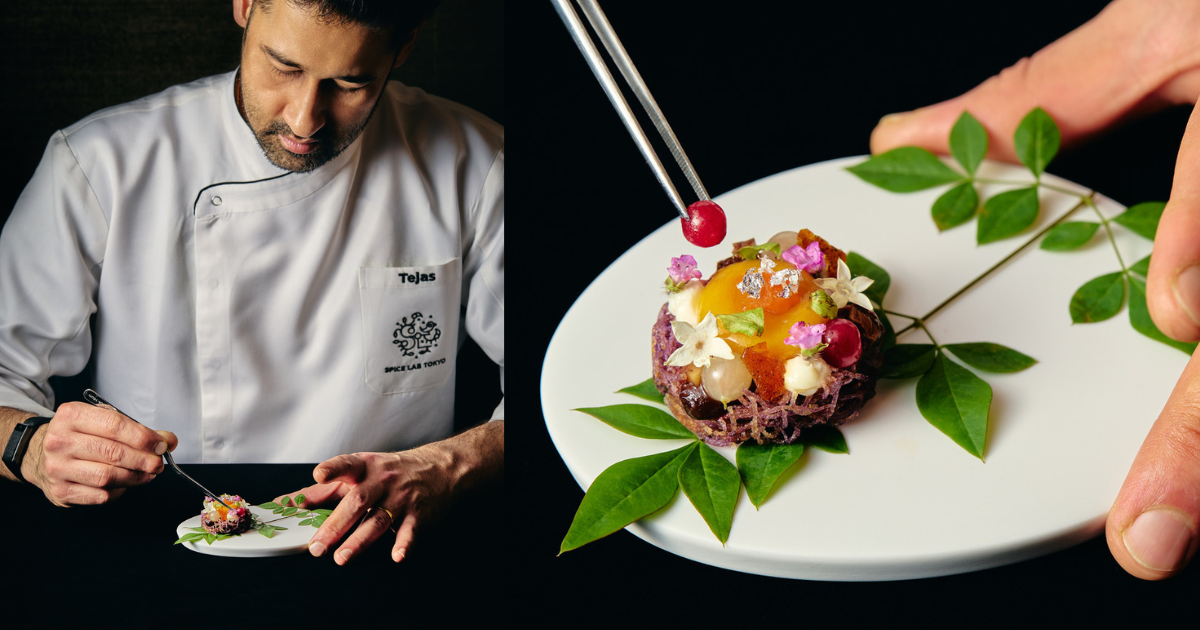
There is a version of ambition that looks outward from the very beginning, that does not wait for permission or precedent, that plants itself somewhere entirely new and proceeds to build from the ground up. Chef Tejas is that version of ambition, made flesh and put to work in a kitchen in Ginza. Trained at noma in Copenhagen and forged at The Oberoi in India, he took the road less travelled in Indian culinary circles and moved to Tokyo, a city with almost no frame of reference for Indian food beyond kare raisu, and proceeded to turn that absence into one of the most compelling dining propositions in Asia. Spice Lab Tokyo, his restaurant in Ginza, is not Indian food transplanted to Japan. It is two great culinary civilisations placed in genuine, respectful, and endlessly surprising conversation with each other. We spoke to him about how that conversation began, what it costs, and why khichdi explains everything.
THE ORIGIN STORY
You trained at noma, cut your teeth at The Oberoi, and then planted your flag in Ginza. Most chefs go to Paris or New York. Why Tokyo, and why now?
My path to Tokyo began in New Delhi. Working alongside Japanese chefs at Aman Resorts was my first real encounter with a culinary culture built on precision, devotion, and a deep reverence for seasonality, and it stayed with me long after.
When the opportunity to move to Japan came, I took it, nervous, excited, and fully aware that I had never worked outside India. The market had almost no awareness of Indian cuisine. I was not walking into an existing conversation. I had to start one, from the ground up, in one of the world’s most demanding food cultures.
What followed were years of learning, cross-cultural collaboration, and building something I genuinely believed in. At Spice Lab Tokyo in Ginza, that work continues, not as Indian food transplanted to Japan, but as two great culinary traditions in honest conversation. That conversation is the work.
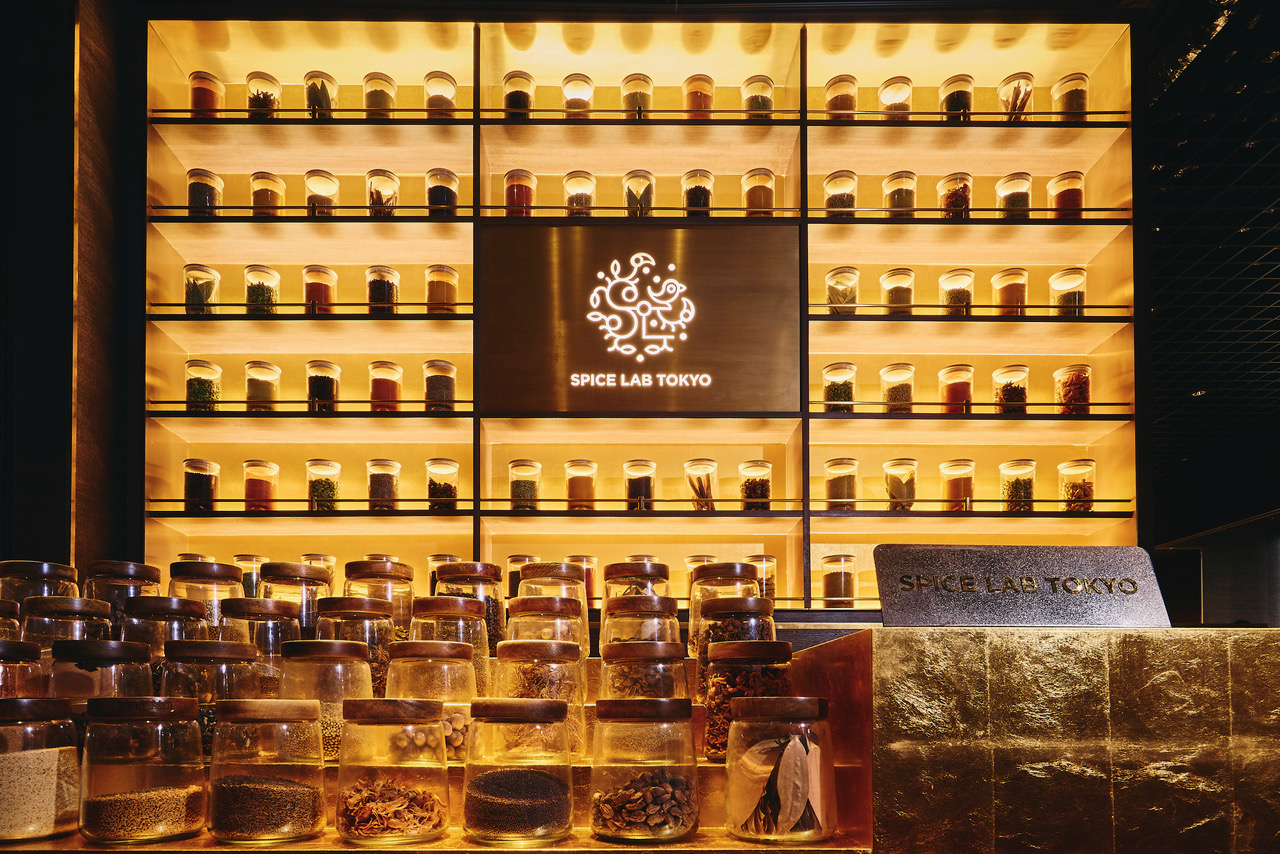
Spice Lab Tokyo was conceived as a genuine cultural conversation between two civilisations, not simply Indian food abroad. When you first heard the brief, what did you think it would take to actually pull that off?
The belief that it was achievable was enough. That, and the self-belief to back it, and the faith that the team around me could pull it off together.
I did not overthink the brief. A cultural conversation between two civilisations sounds grand on paper, but in practice it comes down to daily decisions, what goes on the plate, how it is explained, whether you are cooking with conviction or compromise. We chose conviction.
The food at Spice Lab Tokyo has evolved considerably since we opened. It is more refined, more sophisticated, more mature. That evolution was not planned in a document, it happened through the work itself, through the feedback of the city, and through a team that kept pushing the idea further than where we started.
You have said that established concepts create nothing. Where did that conviction come from?
It is easy to ride an existing wave. Established concepts create nothing. The real challenge is confronting your own potential, staying ahead of the curve, not chasing it.
I remember opening the El Bulli cookbook. Then Noma. Both were exciting and almost immediately, deeply demotivating. The ingredients, the techniques, the equipment, all of it felt out of reach. And I realised you could not understand it from a book. You had to be there.
That feeling never left me. And it pushed me to build something of my own rather than decode someone else’s.
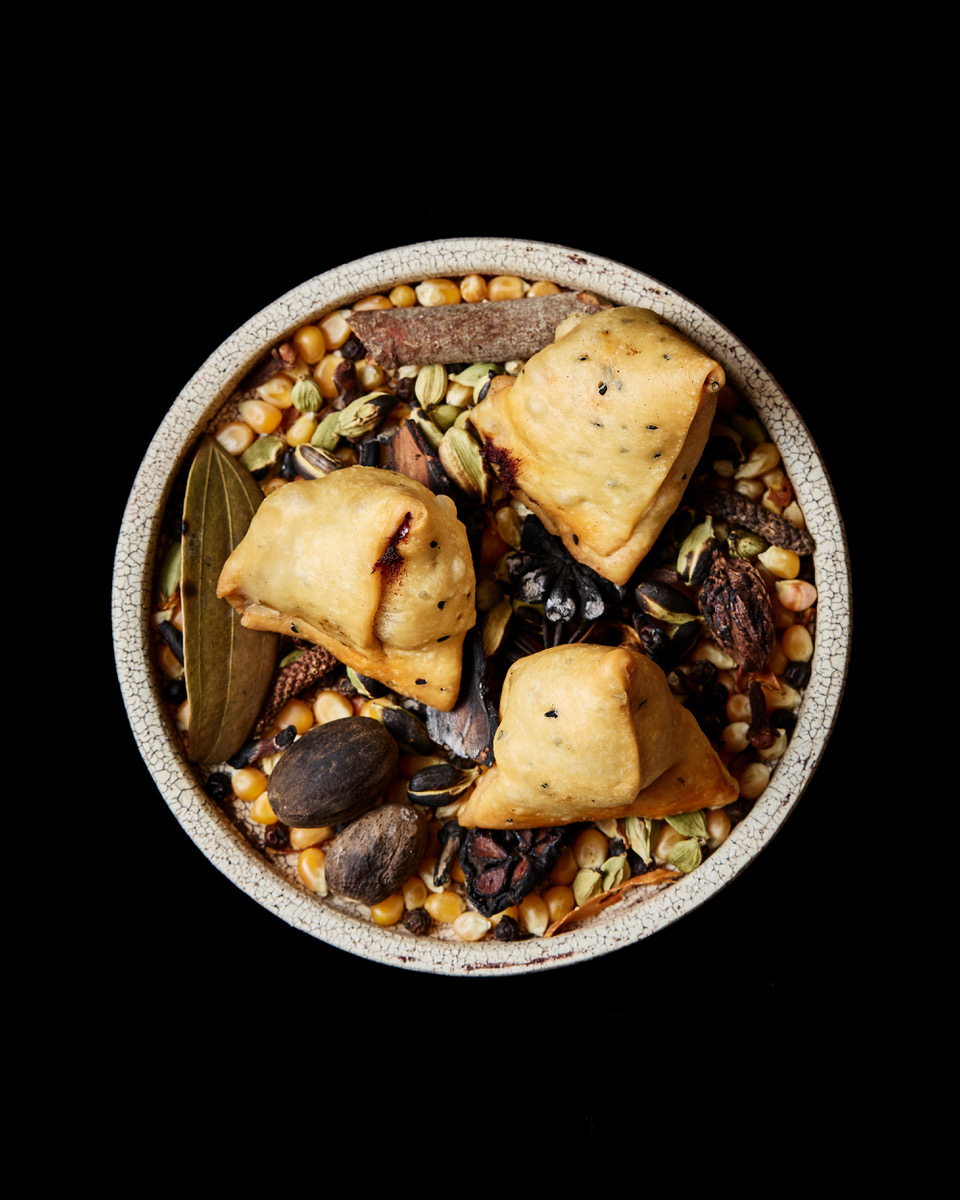
THE CRAFT AND THE KITCHEN
Indian cuisine is maximalist, layered, loud, unapologetically bold. Japanese cuisine is about restraint, negative space, silence on the plate. How do you negotiate that tension without either tradition flinching?
People assume the tension between Indian and Japanese cuisine is a problem to solve. I do not see it that way. Both traditions, at their core, are about balance. Indian cuisine achieves it through layering, Japanese cuisine through restraint. The destination is the same. The journeys just look different.
Take our golgappa water. Traditionally it is mint, coriander, green chilli, tamarind, bright, sharp, unapologetically Indian. At Spice Lab Tokyo, we make it with a kombu stock as the base, sake and mirin for depth and sweetness, umeboshi for that sourness that tamarind would normally carry. The herbs and chilli stay. The soul stays. But the conversation is now happening in two languages simultaneously.
That dish did not almost break the balance. It taught me what balance actually means. It is not compromise. It is precision. You are not asking either tradition to flinch. You are finding the note they were both already reaching for.
Is there a Japanese ingredient that completely rewired how you think about spice?
Miso. Without question.
It is the most versatile ready-to-use ingredient I have encountered, something that can go into anything and everything and simply make it more of itself. It does not announce its presence. It deepens it. For a cuisine like mine, built on complexity and layering, that quality is extraordinary.
What miso taught me is that umami is not a technique. It is a philosophy. Indian cooking has always understood depth, we build it through spice, through slow cooking, through tempering. Miso arrives at the same place through fermentation and patience. Different route, same conviction.
At Spice Lab Tokyo, we make our own miso from Chana Dal and White Urad Dal, pulses that are completely native to the Indian pantry, fermented using the logic of Japanese miso-making. We use them in our tamarind dressing and in our Rasam. The Rasam especially, a dish that is already one of the most umami-rich things in Indian cooking, becomes something else entirely when that miso is folded in. Deeper. Rounder. And yet completely, unapologetically itself.
The dal makhani has become something of a signature obsession for diners. What does a perfect dal makhani mean to you?
There is no such thing as a perfect Dal Makhani.
Perfection is a fixed point. What we strive for is consistency, serving it at the standard we believe in, every single time, without compromise.
The evolution at Spice Lab Tokyo happens in the technique, how we cook it, how we refine the process, what we learn along the way. But the end result always returns to the same standard we have set for ourselves. That standard does not move. The pursuit of it does.
For me, that is the difference between a dish that is finished and a dish that is alive.
INDIA, SEEN FROM TOKYO
Has cooking Indian food in Japan changed what India means to you as a chef?
Distance does not diminish India. It magnifies it.
Being away, cooking Indian food in Japan, for Japanese diners, explaining every ingredient and every intention, has made me admire the culinary heritage I grew up with far more deeply than I ever did when I was inside it. You do not always see the scale of something when you are standing within it.
Take ghewar. A deep-fried shortcrust pastry that sounds straightforward until you try to make it. I have been attempting ghewar since I first started cooking. The oil temperature has to be exact. The batter consistency has to be exact. Both, simultaneously. Miss either by a fraction and it is gone.
That pursuit, of a dish I grew up knowing but have spent years truly learning, tells you everything about Indian cuisine. It is endlessly complex beneath its familiarity. The more you know, the more you realise you do not.
Japan taught me to look at India differently. India, in return, keeps humbling me.
Japanese diners arrive with kare raisu as their mental map of Indian food. What is the single biggest misconception you dismantle, and how do you do it on the plate?
Dismantling that quietly, on the plate, starts with the why before the what. Not explaining what a dish is, but why it exists, the civilisation behind it, the philosophy that shaped it, the journey it took to arrive on that plate. Once a diner understands the why, the dish stops being unfamiliar and starts being inevitable.
That is where education becomes experience. We are not correcting a misconception. We are opening a door. And in my experience, Japanese diners, once that door is open, walk through it with more curiosity and sensitivity than almost any other audience I have cooked for.
The plate does the final convincing. But the why is what gets them to taste it properly.
From Tokyo, how do you see the next chapter of Indian fine dining being written?
The F&B scene in India is at its peak, and I say that having watched it transform over the last five to seven years from a distance, which in some ways gives you a cleaner view of just how remarkable the shift has been.
The number of experiential dining concepts that have opened is extraordinary. And more importantly, they are working, which means it is not just ambition, it is proof of concept. Indian diners are demanding more, and Indian chefs are more than delivering.
The global recognition is real and it is earned. These chefs are not being celebrated because Indian food is having a moment. They are being celebrated because they have built a new language for it. One that is confident, contemporary, and deeply rooted at the same time.
India’s time has come. Not to explain itself. Not to adapt itself for foreign palates. But to present itself, fully and unapologetically, to the world.
THE PERSONAL AND THE PHILOSOPHICAL
What does success taste like when you are an Indian chef building something extraordinary outside India?
Bittersweet. That is the most honest word for it.
Building something like Spice Lab Tokyo, giving it a story, a philosophy, an identity that goes beyond just the food on the plate, takes everything you have. The recognition is gratifying, but it does not slow you down. If anything, it raises the stakes.
As a chef, the work never arrives at a destination. Something works, something does not, but what never stops is the process itself. The constant work in progress. That is, in many ways, the only honest definition of success I know.
The Young Chef of the Year title means something to me. But what means more is walking into that kitchen every day knowing that what we have built here, in Ginza, in Tokyo, as an Indian chef far from home, is still becoming. Still pushing. Still unfinished in the best possible way.
If a young cook from Mumbai walked into your kitchen tomorrow and asked what it actually takes, what would you tell them?
Three words. Discipline. Consistency. Temperament.
Not the Instagram version, the real one. The version that looks like showing up when you do not want to. Cooking the same dish five hundred times until it stops being a task and becomes a reflex. Keeping your head when the service falls apart around you.
Discipline gets you in the kitchen. Consistency keeps you relevant. But temperament, that is what separates the ones who last from the ones who burn out. This industry will test your patience, your ego, your relationships, and your body, often on the same night.
The rest, the creativity, the recognition, the story, comes after those three. Never before.
You use fruit peels, seeds, and every trim. Is zero-waste a philosophy, a practice, or just the way you were taught?
Sustainability for me is not a philosophy I arrived at. It is a practice I have always lived inside.
We use vegetable peels, trimmings, seeds, turned into stocks that become the base of soups and sauces. Nothing leaves the kitchen without purpose.
But my real idea of sustainability is different from how the industry usually frames it. It is not about rescue, taking what is left over and finding a use for it. It is about optimum yield from the start. If a vegetable or a cut of meat gives very little on the plate and the rest ends up in a stock pot or a staff meal, I question whether it belongs on the menu at all.
The plate should reflect the ingredient at its fullest expression. Not what survives the process, but what the process was designed to honour. That is not a trend. That is just how I was taught to cook.
Last question: if Spice Lab Tokyo were a dish, not on your menu but a hypothetical one, what would it be and why?
Khichdi.
I know. It does not sound like much. That is exactly the point.
Khichdi is the most humble thing in the Indian kitchen, rice, lentils, a little warmth. Nothing to prove, nothing to announce. And yet in the right hands, with the right intention, it becomes something extraordinary. Layered, considered, endlessly reinterpretable.
That is Spice Lab Tokyo. Something that could so easily be misread as simple, Indian food, in Japan, in Ginza. But look closer and there are layers. History, technique, cross-cultural conversation, years of refinement, a team that believes in something bigger than the plate.
Simple on the surface. Extravagant in everything beneath it.
That is the restaurant. That is the khichdi.
Chef Tejas is the Head Chef of Spice Lab Tokyo, Ginza.
For India’s most essential chef profiles, dining destinations, and the culinary voices shaping what Indian food means to the world: Follow The Best List India