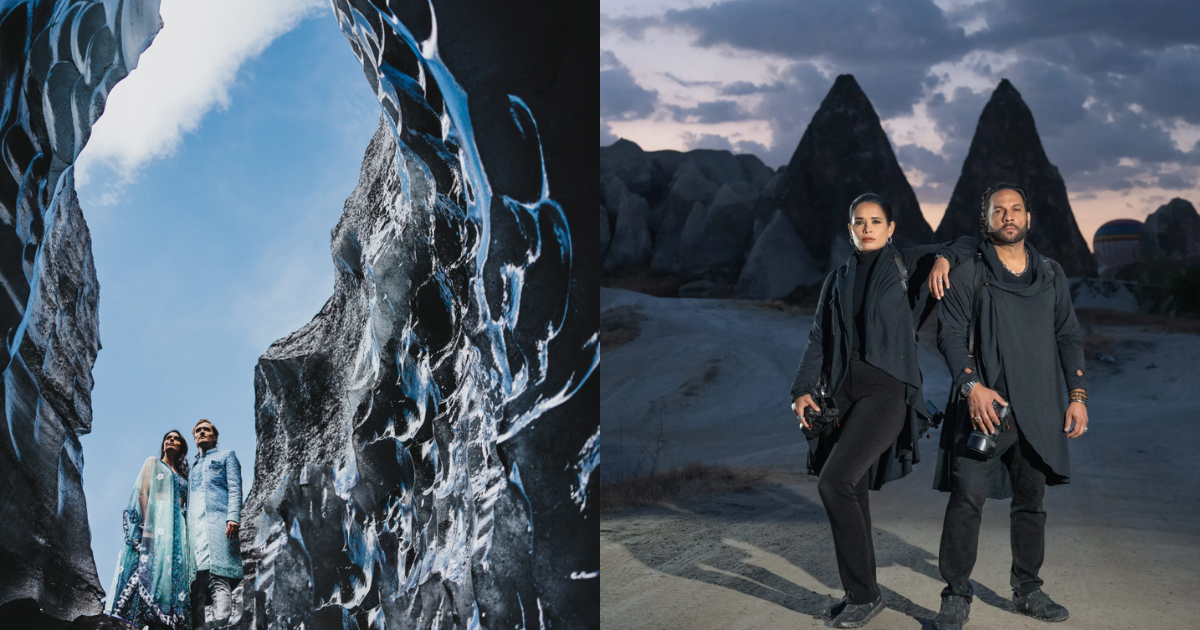
Some careers change direction. Pervez Taufiq’s, by his own telling, simply changed instruments. Once the lead singer of the Boston rock band Living Syndication, he now leads PTaufiq Photography, the international luxury wedding photography and cinematography studio he founded with his wife and creative partner, Nicole Taufiq, a former fashion model with a background in visual arts. Together they have built a studio with offices in Mexico, Paris, Madrid and India, active teams across the United States, and a reputation for documenting multi-day celebrations of exceptional scale. According to the studio, it has been featured on Netflix and Bravo and in Vogue, Elle, People and Us Weekly, and graced the cover of Harper’s Bazaar. We spoke to the pair about reading a room, protecting taste at scale, and what it means to make photographs that feel before they impress.
Pervez, you began as the frontman of the Boston rock band Living Syndication before turning to weddings, first photographing friends’ celebrations. What pulled you toward the lens, and what made you commit to it full-time?
Pervez: I don’t think I ever really changed careers creatively. I just changed instruments.
Music taught me to understand rhythm, emotion, anticipation, and probably most importantly, how to read a room. When you’re performing, you can feel when an audience is with you. Photography is strangely similar.
I started photographing friends because I loved photography, not because I had some grand plan to become a wedding photographer. But I became obsessed with the challenge of it. A wedding gives you absolutely no control over what happens next, and yet you’re expected to create something extraordinary from it.
Eventually I realized I was chasing the same thing with a camera that I had been chasing onstage: a feeling. Once I understood that, there was really no turning back.
Nicole, you came to photography with a background in visual arts and fashion. How has that eye shaped the studio’s editorial aesthetic?
Nicole: Fashion taught me to notice the details that completely change an image: how fabric falls, what a hand is doing, posture, negative space, the relationship between a person and the environment.
But I never want a wedding to feel like we’ve turned it into a fashion shoot. The editorial influence is there in the composition, lighting and intentionality, but the emotion still has to belong to the couple.
I think that’s where Pervez and I complement each other really well. We notice different things. Sometimes we’re standing in the same room looking at completely different photographs. Together, those perspectives have become the visual language of the studio.


You’ve said that when people ask about your equipment, the answer is “my eyes and my heart.” How would you describe your visual language in your own words?
Pervez & Nicole: We want photographs to feel before they impress.
Of course we care about composition, lighting, fashion, architecture and technique. We are obsessive about those things. But technical perfection without feeling doesn’t interest us very much.
Our visual language lives somewhere between editorial and emotional. There can be a beautifully composed portrait that feels almost cinematic, followed by a completely imperfect frame of a father looking at his daughter that destroys you emotionally.
Both belong.
Our eyes tell us where the photograph is. Our hearts tell us when to press the shutter.
Your studio defines luxury as preparation and discretion rather than excess. What does that look like on the ground during a multi-day wedding?
Pervez & Nicole: To us, luxury is when the client never has to think about us.
They shouldn’t be wondering where the photographer is, whether we know what’s happening next, whether we’ve spoken to the planner, or whether we’re prepared for a ceremony we’ve photographed dozens of times.
The work happens before the wedding: understanding the family, the schedule, the rituals, the spaces, the lighting, the personalities and the priorities. At a multi-day celebration, there may be hundreds or even thousands of moving pieces. Our job is to absorb that complexity without transferring it to the client.
Real luxury is making something extremely difficult look effortless.
You shoot both photography and cinema. How do you decide what becomes a still and what becomes a film moment, and how do the two come together into one narrative?
Pervez & Nicole: We don’t really think of photography and cinema as competing mediums. They’re different languages telling the same story.
Some moments want to be frozen. A glance can become more powerful when you remove everything around it and hold it forever in one frame.
Other moments need time. A father’s voice breaking during a speech. Fabric moving in the wind. The sound of a baraat approaching. The silence immediately before a bride walks into a ceremony.
Our photo and cinema teams are taught to understand both languages. The goal isn’t to produce two separate versions of the wedding. When you experience the photographs and film together, they should feel like chapters from the same story.

Indian weddings are a cornerstone of your work, spanning Hindu, Sikh, Muslim and fusion celebrations. How do you prepare, culturally and technically, for their rhythm, ritual and scale?
Pervez & Nicole: You have to begin with respect.
You cannot photograph these celebrations properly if you’re simply waiting for something visually interesting to happen. You need to understand what is happening, why it matters and what is about to happen next.
That knowledge changes where you stand, which lens you choose and, more importantly, where your attention goes.
Technically, these weddings can be extraordinarily demanding. You’re moving between intimate ceremonies, enormous productions, rapidly changing lighting, multiple locations and hundreds of guests. But cultural preparation is just as important as technical preparation.
And after doing this for so many years, anticipation becomes instinctive. You start recognizing the moment before the moment, and that’s often where the best photograph lives.
The studio photographs and films hundreds of weddings a year across regional teams. How do you protect a single creative signature at that scale?
Pervez & Nicole: This has probably been one of the hardest and most important things we’ve built.
You cannot scale taste with a manual.
We can teach camera settings, lighting systems and workflows, but the real work is teaching people how we see. What do we consider a PTaufiq photograph? When do you intervene? When do you disappear? What makes an image emotionally important rather than simply technically good?
Our teams study our work, shoot alongside us, receive constant critique and learn the standards behind the finished image.
But we also don’t want clones. A strong creative culture gives people a common language while still allowing talented photographers and filmmakers to bring something of themselves to the work.
That’s ultimately how you protect a signature without turning it into a formula.


From Tulum to Iceland to Spain, you’ve shot celebrations across very different landscapes. How does a location change the way you see and shoot a wedding?
Pervez & Nicole: We don’t want to fly halfway around the world and make the destination irrelevant.
Every place gives you something different: the light, architecture, weather, landscape, color and even the pace of life.
Iceland might make us think about scale and isolation. Spain might pull us toward architecture, shadow and texture. Tulum gives you an entirely different relationship between people, nature and light.
But the destination should never overpower the people.
The most interesting challenge is finding the intersection between the couple and the place, so when they look at those photographs years later, they remember not only what the destination looked like, but what it felt like to be there.
You work alongside planners and vendors and aim for a calm, unobtrusive presence. How do you stay invisible while still capturing everything that matters?
Pervez & Nicole: Ironically, becoming invisible requires a tremendous amount of preparation.
If you don’t know what’s happening next, you’re constantly reacting: running around, asking questions, interrupting people and putting yourself in places you shouldn’t be.
When you’re prepared, you can anticipate.
We also believe strongly that we’re part of a larger creative ecosystem. The planner, designer, entertainment team, cinematographers and photographers are all contributing to the same experience. Our job isn’t to disrupt what everyone else has created just to get our photograph.
The best compliment we can receive is when a client looks at an image and says, “I had no idea you were there.”


Is there a wedding you consider a personal masterpiece? One that still stays with you?
Pervez & Nicole: It’s difficult for us to choose one, because the weddings that stay with us aren’t always the biggest or most elaborate.
There are certainly celebrations where everything aligned, the people, design, location, light and emotion, and we walked away knowing we had created something special.
But “masterpiece” feels almost too final.
We’re still chasing it.
That’s part of what keeps this exciting after so many weddings. There are photographs we’ve made that we’re incredibly proud of, but we never want to believe the best photograph of our career is already behind us.
As celebrations grow larger and more immersive, how do you keep intimacy in the frame?
Pervez & Nicole: By remembering that scale and intimacy aren’t opposites.
You can have a thousand people in a room and still find two people communicating entirely through their eyes.
The spectacle is incredible to photograph, the architecture, production, florals, fashion, performances, but we’re always searching inside that spectacle for the human moments.
Sometimes the most important photograph at a multi-million-dollar celebration is happening six feet away from the thing everyone else is photographing.
A mother’s hand. A private joke. Someone trying not to cry.
Our job is to see both worlds.


Looking ahead, what does the future of wedding photography and film look like through your lens?
Pervez & Nicole: We think technology is going to change this industry dramatically. AI will change workflows. Cameras will become smarter. Production will become faster. Things that once required enormous technical skill will increasingly become accessible.
Which means being technically good will no longer be enough.
The future belongs to photographers and filmmakers who actually have something to say.
Taste will matter. Perspective will matter. Storytelling will matter. Human connection will matter.
And strangely, the more technology enters the process, the more valuable the genuinely human parts of the work become.
We don’t want the future to be about creating more content.
We want it to be about creating work that still means something when the content is gone.
There is a pleasing symmetry in the way Pervez and Nicole Taufiq describe their work. One came from a stage, where reading a room is a survival skill. The other came from fashion, where a fold of fabric can change a frame. Together they have built a studio that scales across continents while insisting that taste cannot be written into a manual, only taught, critiqued and shared. In an industry about to be reshaped by faster cameras and smarter software, their answer is reassuringly unhurried: the more the machines do, the more the human parts of the work will matter. If a photograph can still make a stranger feel something once the content around it has disappeared, they will have done what they set out to do.
Follow Best List India for the culture, conversations, and ideas worth paying attention to.