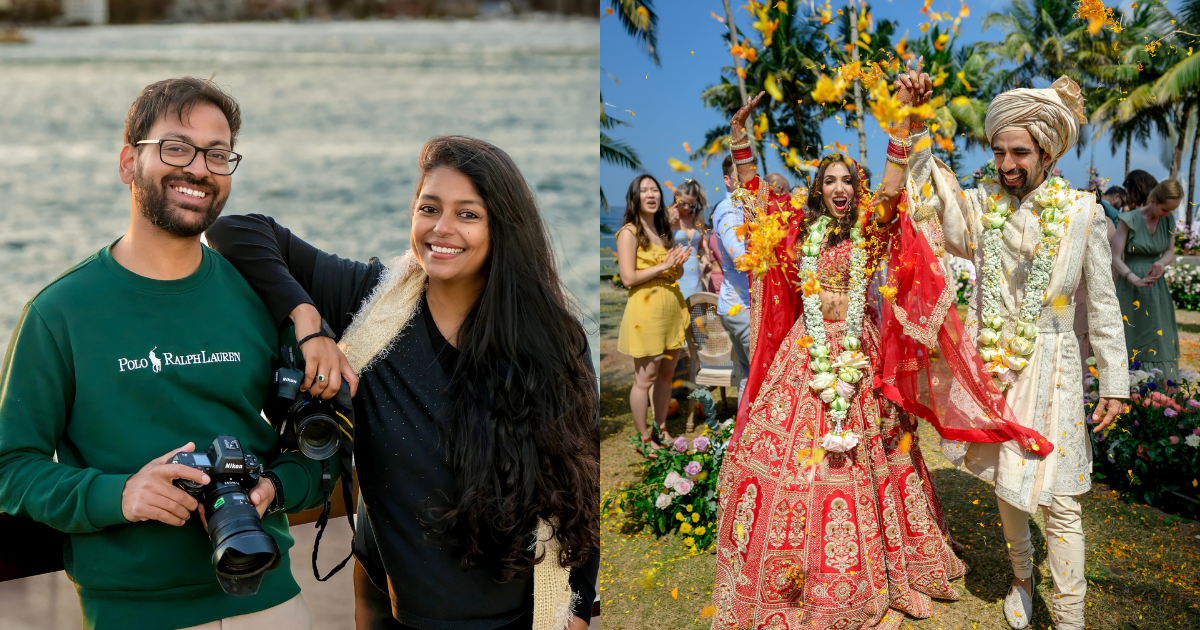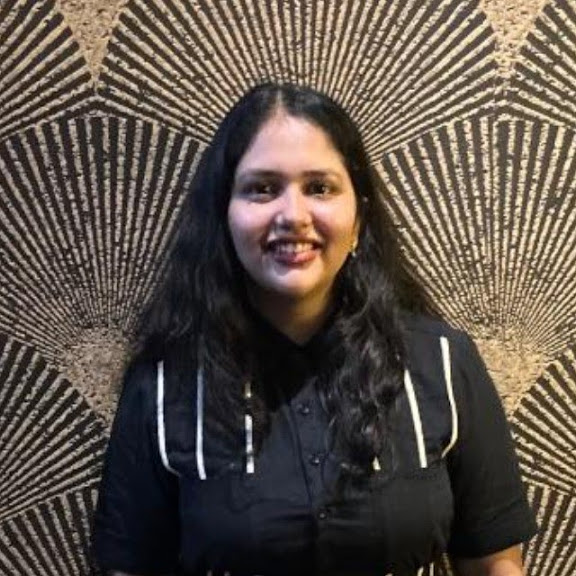
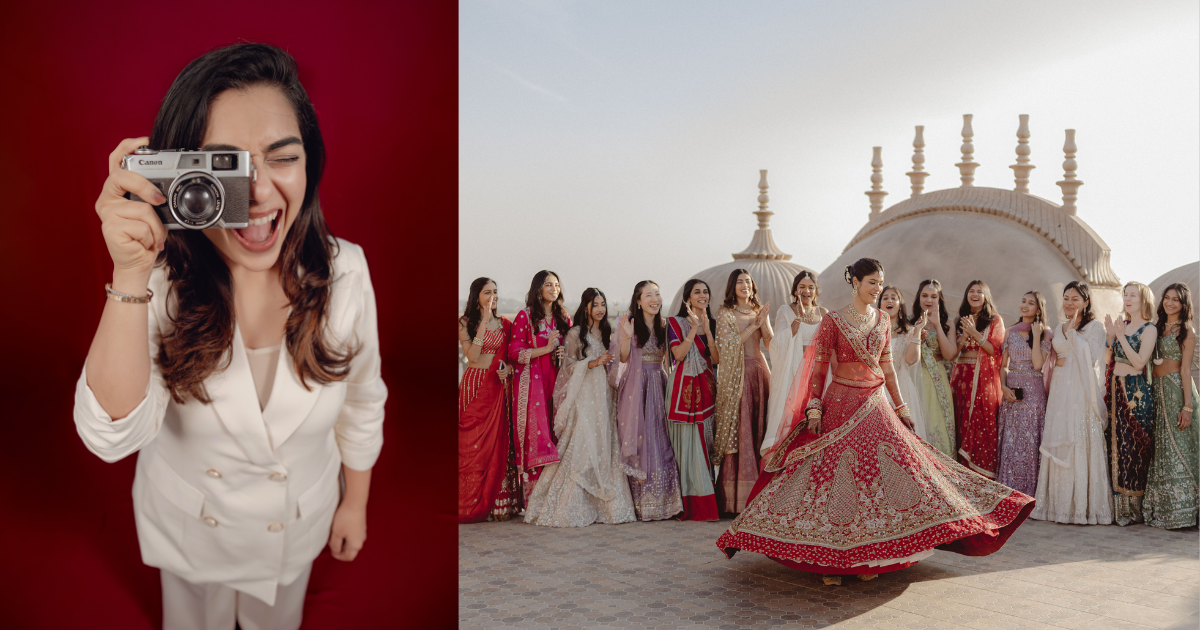
Camera Crew was founded in 2008 as a studio devoted to documenting weddings. When Soniya Dembla Balwani joined in 2017, she arrived from the worlds of advertising and branding, with an instinct for people, motivation and the details that make a story resonate. She did not so much step into her father’s studio as grow into its creative voice.
Today, Camera Crew has documented more than 500 weddings across 12 countries, with an in-house team and a collective of over 50 artists and associates spanning India, the United States and Europe. Recognised with a WeddingSutra win in Friends & Family and named a WOW Woman of the Year in 2025, Soniya leads a studio that has chosen, deliberately, not to settle into a signature look. Here, she speaks about what a legacy asks of its heir, the sound that brings a wedding rushing back, and why the most ordinary photographs often become the most precious.
Your father started Camera Crew in 2008, and you arrived from the world of branding. Take us back to the moment you decided to step into the studio, not as his daughter, but as its creative voice.
I don’t think there was one defining moment when I decided to step in as the creative voice. It was more of a gradual realisation that I had something to contribute to a world I had grown up around, but wanted to explore in my own way.
My background in advertising and branding has taught me to look at stories through the lens of people, their motivations and the details that make something resonate. When I joined Camera Crew in 2017, I began to see how much of that thinking could translate into wedding photography and filmmaking. Every couple brought a different world with them, and I was fascinated by how we could tell their stories without making them fit into a predetermined mould.
Being my father’s daughter gave me an understanding of the business, but finding my own voice meant learning to question things, experiment and trust my instincts. Over time, my role evolved from contributing to the business to shaping its creative direction. I wanted Camera Crew to grow while retaining the honesty and sensitivity that made it what it was in the first place.
Every legacy asks its heir two questions: what to protect and what to dare to change. What did you leave untouched at Camera Crew, and what did you rewrite?
The one thing I never wanted to change was the way we look at people. My father built Camera Crew around documenting weddings, and at the heart of that was an understanding that a wedding is so much more than a series of ceremonies. It is a coming together of families, relationships, histories and emotions. That remains our foundation.
What I wanted to evolve was how we approached the process of storytelling. I wanted us to spend more time understanding the couple before the wedding: who they are, what matters to them, the relationships they hold close and the kind of memories they want to return to. That understanding influences how we observe a wedding and what we choose to preserve.
I have also pushed us to keep questioning our own work, embrace new technology and explore different ways of seeing and telling stories. For me, protecting a legacy doesn’t mean keeping everything the same. It means understanding why something worked in the first place, preserving that essence and giving it room to grow.


Over 500 weddings across 12 countries. What have you learned about how families celebrate differently, and what is it that makes them all cry in exactly the same place?
Every culture has its own language of celebration. Some weddings are loud, elaborate and full of movement; others are intimate, understated and deeply ritualistic. Even within the same culture, the way a family celebrates can change dramatically from one community to another. The traditions, the music, the rituals, the roles people play and the way emotions are expressed can all be so different.
But after documenting hundreds of weddings, you begin to recognise the things that transcend those differences. It is often the moments when the celebration pauses and something deeply personal takes over. A parent watching their child begin a new chapter. A sibling trying to hold back tears. A grandparent being included in a ritual. Two families realising that their lives are now intertwined.
I think weddings bring time into perspective. They remind us of where we come from, the people who brought us here and the people we are choosing to move forward with. And somewhere in all the music, the colour and the chaos, there is usually a moment when that realisation catches up with everyone. That is often when the tears arrive.
You say the best photographs take us back to how it felt, not what happened. How do you photograph a feeling, and how do you know when you have caught one?
I think it begins with paying attention to what is happening beyond the obvious. A wedding has plenty of big, visible moments, but some of the most meaningful things happen just outside them. The way someone looks at their partner when nobody else is watching, a mother quietly fixing her daughter’s outfit, or a group of friends sharing a joke that makes absolutely no sense to anyone else.
You cannot manufacture those moments, and you cannot always predict them. You have to understand the people, anticipate what might unfold and remain observant enough to recognise something meaningful when it happens. That comes from experience, but also from being genuinely interested in the people in front of your camera.
For me, a photograph has done its job when it brings back more than a visual memory. When you look at it years later and remember the noise in the room, the person standing next to you or the way your heart felt at that exact moment, something has been preserved beyond the frame. We may not always know immediately that we have captured it. Sometimes, we realise it only when we revisit the images ourselves.
Many studios build a signature look. You have chosen to resist one. What does it cost to stay open to every couple in an industry that rewards a recognisable style?
It requires you to keep reinventing yourself, and that is not always the easiest path. A recognisable style gives people an immediate visual shorthand for your work. When you choose not to build everything around one aesthetic, you have to work harder to communicate what makes you different.
For us, the consistency lies less in how our photographs look and more in how we approach the people we photograph. We want our work to be observant, unscripted, honest and deeply human. The visual language can change depending on the couple, their personalities, their surroundings and the energy of their wedding.
One couple might have a very contemporary, editorial sensibility, while another might be deeply connected to tradition and family rituals. Both deserve to see themselves reflected authentically in their photographs and films. It would be unfair to ask either of them to fit into a style that we have decided defines us.
Of course, this approach means constantly adapting, thinking and making creative decisions rather than relying on a formula. But I would rather our work be recognised for how thoughtfully we tell each story than for making every story look the same.


A wedding is also sound: a mother’s laugh, a familiar song, a voice breaking mid-vow. Which sound from a wedding you documented has never left you?
I find it difficult to single out one sound because I think what stays with you is often the feeling attached to it. It could be a parent’s voice breaking during an emotional moment, the spontaneous laughter of friends who have known each other for years, or the way an entire room comes alive when a familiar song begins to play.
What fascinates me about sound is how quickly it can transport you back in time. A photograph can bring a moment back visually, but hearing someone’s voice, their laughter or the way they said something can make the memory feel incredibly immediate. You suddenly remember not just what you saw, but the atmosphere around you.
That is one of the reasons filmmaking is so special to me. We are not simply documenting what happened; we are preserving fragments of a day that might otherwise exist only in people’s memories. Years later, a couple may forget the sequence of events, but hearing a loved one’s voice or the sound of their family celebrating can bring the entire day rushing back. And that, to me, is an extraordinary thing to be able to give someone.
Your world spans an in-house team and a collective of over 50 artists and associates across India, the United States and Europe. How do you keep a single sensibility alive across so many hands and time zones?
For me, it starts with making sure everyone understands what we are trying to achieve, rather than simply what they are expected to deliver. We work with a network of photographers, cinematographers and creative professionals across different geographies, and each person brings their own perspective and strengths. I see that diversity as an advantage.
The challenge is to create consistency without taking away individuality. We invest time in understanding the couple before the wedding, sharing the context behind their story, discussing the important relationships and identifying what matters most to them. This gives the team a shared understanding of what we are looking for, while leaving room for individual observation and instinct.
Our in-house team also plays an important role in maintaining continuity across planning, shooting and post-production. But ultimately, the sensibility comes down to a shared belief: we are there to observe and document, not to impose our own version of a wedding onto someone else’s experience.
I don’t expect every photographer to see a moment in exactly the same way. I want everyone to understand what makes that moment worth seeing in the first place.


Two generations, one studio. What does your father see that you have learned to trust, and where do you gently disagree?
My father founded Camera Crew in 2008, and although he hasn’t been actively involved in the studio since 2017, the foundation he built continues to influence how I approach the business today.
What I have learned most from him is the importance of relationships, integrity and being dependable. He has always believed that the trust a family places in you is just as important as the photographs you deliver, and that is something I have carried forward.
At the same time, taking over the creative direction and running the studio independently has given me the freedom to build my own perspective. My background in advertising has shaped how I think about storytelling, communication and the evolution of a brand. I have been keen to challenge conventional ways of working, experiment creatively and build a studio that reflects how weddings, couples and their expectations are changing.
I think our differences are less about agreeing or disagreeing and more about belonging to two different generations. He built Camera Crew with the vision and instincts of his time, and I have had the opportunity to take that foundation in a direction that feels true to mine. To me, carrying forward a legacy isn’t about doing everything the same way. It’s about knowing what is worth preserving while having the courage to make it your own.
You are interested in how technology can make the memory of a wedding more immersive. Twenty years from now, how will a family relive a wedding, and what must never be lost along the way?
Having grown up around photography and now leading the creative direction at Camera Crew, I’ve seen how technology has transformed the way we capture and revisit memories. From developing your photographs to physical albums, to digital galleries and now AI, I think we’re only beginning to explore what’s possible.
Twenty years from now, I imagine families being able to experience a wedding in ways that go far beyond photographs and films. Imagine revisiting a celebration through your parents’ perspectives, hearing conversations you missed, or your children experiencing a day they were never part of.
At Camera Crew, we return from weddings with thousands of photographs and hours of footage, often filled with little moments that don’t make it into the final film or album. What excites me about AI is its potential to connect these fragments, uncover stories within stories and help families rediscover moments they didn’t even know existed.
But I also believe there’s a difference between bringing a memory to life and creating something that never happened. Over the years, I’ve realised that the most ordinary photographs often become the most meaningful with time. A grandparent sitting quietly during a ceremony or a parent’s laughter in the background can mean so much more twenty years later.
My father began Camera Crew with the idea of preserving people’s most meaningful moments, and while the tools have evolved, that purpose hasn’t changed. I hope AI helps us experience memories in extraordinary new ways, but what must never be lost is the ability of a photograph or film to take us back to how it truly felt to be there.
A WeddingSutra win in Friends & Family and the WOW Women of the Year 2025 title. Beyond the recognition, what does the next chapter of Camera Crew look like, and what does “Cherishing Forever” mean to the next generation?
Recognition is always encouraging, particularly when it comes from an industry you have spent years learning from and contributing to. But for me, the more important question is what we do with the trust and momentum that recognition brings.
The next chapter of Camera Crew is about evolving thoughtfully. We are looking at how we present our work, how we build relationships with couples, how we use technology and how we create an experience that feels as considered as the photographs and films we deliver. We want to continue documenting weddings across India and around the world while staying curious about the people, cultures and stories we encounter.
I also want to keep building a team that believes in the value of what we do. Wedding photography can sometimes be reduced to aesthetics, trends or deliverables, but there is a much deeper responsibility in being invited into a family’s most personal moments. I want that understanding to remain at the centre of Camera Crew as we grow.
For me, Cherishing Forever has never simply been about making something timeless. It is about recognising that the things we may take for granted today can become the things we treasure most tomorrow. A familiar face, a voice we miss, a moment we didn’t realise was significant until years later.


In an industry that so often prizes a recognisable look, Soniya Dembla Balwani has chosen something harder and more lasting: a studio defined by how it sees people rather than how its pictures appear. Her belief that a photograph must carry the noise of the room, the laughter of a parent and the weight of a moment is, in the end, a belief in memory itself. And as technology offers ever more ways to revisit the past, she holds firmly to what matters most: preserving how it truly felt to be there.
Follow Best List India for the culture, conversations, and ideas worth paying attention to.