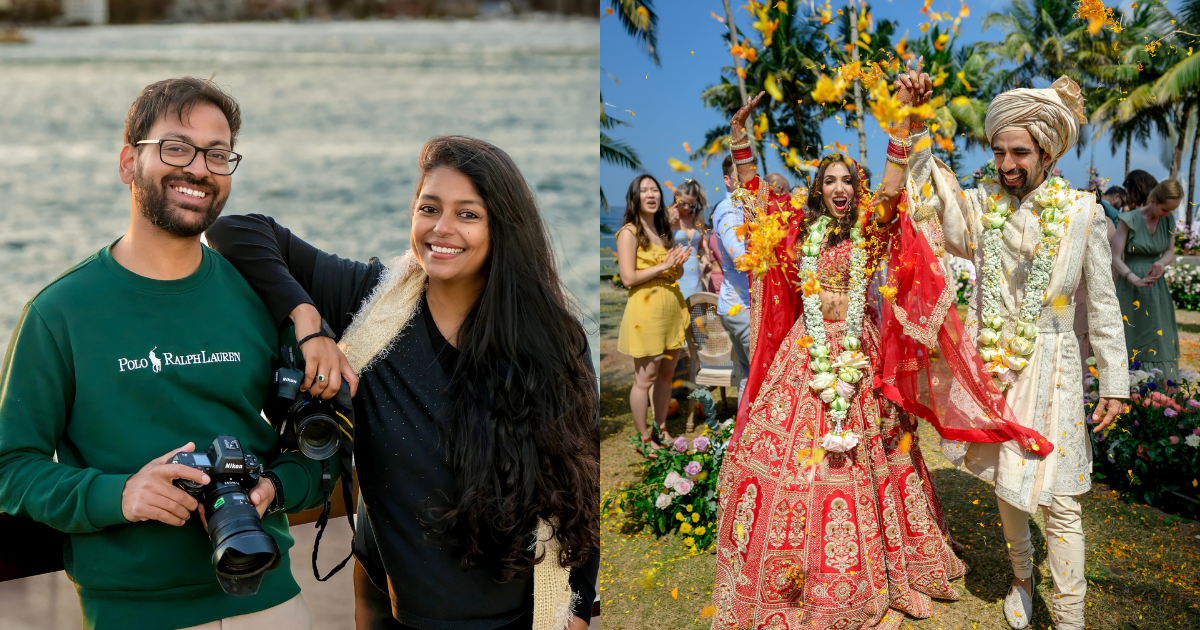
Some of the most enduring wedding images are not the grandest. They are a father adjusting his daughter’s dupatta, a grandmother mouthing the words to a song, a groom’s trembling hands before the varmala. Capturing these fleeting, unplanned moments is the quiet obsession of WeddingNama, the husband-and-wife studio founded in 2013 by Ankita Asthana and Akash Agarwal.
She trained as an architect and holds a master’s in photography from NID. He spent years as a derivatives dealer before leaving the trading desk for the camera. Together, with an in-house team and only around twenty weddings a year, they have built a practice rooted in friendship, discipline and feeling. Here, they speak about the art of being invisible, the weddings that stay with them, and why honesty may become the ultimate luxury.
You founded WeddingNama as a couple. What first drew you to documenting weddings, and how has building a creative practice together shaped it?
Ankita Asthana: After training as an architect, I did my master’s in photography at NID and explored almost every genre before choosing to specialise in weddings. I grew up in a family that loved taking photographs and making memories together, so the idea of becoming part of someone’s family for a few days, and capturing their most precious moments, felt deeply meaningful. There was also a gap in the market. Not many people were picking up wedding photography as a career path.
I found myself through these weddings and figured out life through them. They are a great learning space; you understand people through them. These are photographs that live in people’s homes. They are revisited on anniversaries, shown to children and grandchildren, and treasured as legacy pieces for generations. That timelessness is what drew me to this world. Growing up in south India, and later living in Nagpur, Ahmedabad, Delhi and Mumbai, gave me a wider view of the world. I caught the travel bug early, and Indian weddings have taken me around the globe.
At heart, I’ve always been someone who chases love stories. Every couple has one, and no two are ever the same. Finding that story, feeling it and giving it a form that a family will hold onto forever is the most beautiful job I can imagine.
Akash comes from a very different universe, and I think that’s exactly what makes us work.
Akash Agarwal: I was a derivatives dealer with a career in finance I was genuinely proud of, but I was always an artist at heart. As a child I loved sketching but, like so many of us, was steered towards maths instead. At one point I had two jobs: finance during the week and photography on weekends. Ankita asked me to help edit her very first wedding film, and something about it stayed with me.
The real turning point came when I filmed my CEO’s daughter’s wedding. In meetings they used to joke about when I would quit and do this full time. I quit right before that wedding, and standing there with a camera, I realised I felt more alive than I ever had on a trading desk. I took the leap, and I’m grateful I did, because WeddingNama has risen to heights I couldn’t have dreamt of in a corporate career.
We’re probably one dreamer and one builder, and we swap roles more often than people think. Since 2013, every frame and every film at WeddingNama has passed through two very different minds. As a married couple, we understand marriage from the inside, and that quietly shows up in how we see other couples. People often ask how we stay married after working together. It is simply love, deep respect and a very active mutual admiration club. Call it cheesy, but it is most rewarding to work with your life partner. Your goals are aligned in a way no other business partnership could manage.


Your philosophy is that “photography is a feeling.” How would you describe your visual language, especially the balance between contemporary portraiture and photojournalistic storytelling?
If a photograph doesn’t make you feel something, it has failed, no matter how beautiful it looks. For us, a great wedding photograph has three things: a story, strong composition and light, and truckloads of emotion.
Our visual language lives between two instincts. The photojournalist in us wants to disappear and let the day unfold honestly. The portraitist in us wants to give couples a few frames of stillness where they are seen with intention. The documentary work tells the story, and the portraits are the pauses that let you breathe within it. We always photograph for timelessness, not trends.
“Unscripted. Raw. Authentic.” is how you describe your work. How do you find genuine emotion at a luxury wedding where so much is carefully planned?
The irony is that a lot of preparation goes into being unposed. The décor, the timings and the outfits are planned, but the emotions never are. Couples are often at their most real and most vulnerable around their friends, when they forget they are the centre of attention. That’s when their most human emotions surface.
The first step is to become a friend first and a photographer later. There are unsaid emotions that pass around a room, and if you are present, they pass through you too. Even amid the scale and grandeur of the luxury weddings we do, we are constantly searching for the in-between moments: a father adjusting his daughter’s dupatta, a grandmother mouthing the words to a song, a groom’s hands trembling before the varmala. None of that is on a run sheet, and that’s exactly what we’re there for. We like to be the eyes of our couple and document moments they may not even have witnessed themselves.


You aim to blend into the background so that families can fully immerse themselves in the celebration. How do you stay invisible while capturing everything that matters?
It’s a shooting style, and a discipline. A good wedding photographer knows when to step in and gently direct, and when to step back and be a pure observer. There’s an idea in physics called the observer effect, which says that the act of observing something changes it. Weddings work the same way. The moment a family becomes aware of the camera, the moment shifts.
So invisibility is planned. We choose discreet gear, keep the number of people around the couple to a minimum, do recces, plan exact team positions in advance and work closely with planners. We also spend a lot of time educating the industry. Not every vendor needs their own social media team at a wedding. Your wedding should be lived, not turned into content.
You work as an in-house team of photographers, cinematographers and editors. How do you keep one creative voice across stills and film?
It takes years, and there are no shortcuts. Our entire team is in-house and trained in the same philosophy, and Ankita and I personally sit down and review every photograph and every film together before it reaches a couple. It’s slow and demanding, but that’s how a shared sensibility gets built. It’s also why we take on only around twenty weddings a year, so we can stay deeply involved in each one.
Coming from finance, I’ve learnt that consistency is what builds trust, in markets and in art. Stills and film aren’t two separate deliverables for us. They’re two ways of telling the same story, and a couple should feel that their album and film were made by the same heart.
Couples often speak of the time you spend getting to know them before the wedding. How do you build that trust, and how does it change what you capture?
We simply become friends with our couples, over many meals and coffees. Time is the most valuable thing we invest, and experience has taught us how to build real rapport. We learn how they met, who they are closest to, what makes them laugh and which relationships in the family matter most. On the wedding day, that means we know whose arrival will make the bride cry and which quiet friend has been there since school.
Trust also comes from consistency. Couples come to us knowing that every WeddingNama couple before them has had a wonderful experience, so they let their guard down, and that’s when the real photographs happen.


You’ve photographed weddings across India, Europe, Africa, Southeast Asia, the Middle East and the Americas. How does a location change the way you tell a wedding story?
A location changes everything: the culture, the backdrop and, most importantly, the light. A ceremony in Europe breathes differently from one in Rajasthan or Sri Lanka. We study a place the way we study a family, so that it becomes a character in the story rather than just scenery.
At the same time, we’re careful not to let a destination overpower the people. Years later, a couple should look at their photographs and remember how it felt, not just where it was.
Indian weddings are rich with ritual and unfold over several days. How do you prepare so that no fleeting moment is missed?
By going into detail. Indian weddings are many weddings in one, and every family celebrates differently. Before each wedding, there are many meetings and discussions with the family and planners to understand the rituals, who performs them and what they mean. Clear communication within our team means everyone knows where to be and what to watch for. Knowing a ritual’s significance helps us anticipate when emotions will run high, so we’re already in position before the moment arrives.
But the biggest thing of all is simply being present. No amount of planning replaces paying attention.
Your portfolio includes quieter couple sessions and black-and-white work alongside wedding coverage. What do those formats reveal that the big day cannot?
At the end of the day, it should never be about the photographs. It should be about the moments unfolding in real time. Couple sessions give us that space. On the wedding day, a couple belongs to everyone. In a quiet session, they belong only to each other, and we get to see who they really are without an audience.
Black and white does something similar. It strips away colour and spectacle so that only emotion, gesture and light remain.
Is there a wedding you consider a personal masterpiece, one that still stays with you?
It’s impossible to choose just one, because every wedding leaves something with us. But as I write this, I think of Mitali and Ali. Theirs was an inter-faith wedding that brought two communities together, surrounded by so much love. We did so many things with them that photographed beautifully, but the moment everyone remembers is their save-the-date with five dogs. Pantu, their indie dog, is truly Mitali’s first baby, and Mitali even matched her outfits with hers. Pantu was the ring bearer, too. It became one of the first viral moments from any wedding we’d seen, long before virality was even a thing. You can still find their video on YouTube.
What stays with me most, though, is that we’re still friends. They visit us, we visit them, we share meals and attend each other’s kids’ birthdays. That’s what I love most about our work. We don’t just document families; we become part of them.

As celebrations grow larger and more elaborate, how do you keep intimacy in the frame?
By noticing the unsaid and the unseen. Scale is just distance, and intimacy is about closing it. Even at a wedding with a thousand guests, there are always small circles: a mother and daughter in a corner, or the couple stealing a glance across a crowded mandap. Because we take the time to understand relationships, we can often sense which moment will lead to a teardrop or the most special hug, and we’re there when it happens.
Looking ahead, what does the future of wedding photography and film look like through your lens?
Akash: It’s bright. In a world increasingly shaped by AI, where perfect-looking images can be made in seconds, even more value will be placed on what is real. A real tear, a real hug, a real moment can’t be generated. I think honesty will become the ultimate luxury, and storytelling will matter far more than spectacle. Film in particular is moving away from glossy, over-produced edits towards work that feels lived in.
Ankita: Through WeddingNama School, we’re also passing this way of seeing on to the next generation of photographers, because the future of this craft depends on who carries it forward.


In an industry that often rewards spectacle, Ankita Asthana and Akash Agarwal have built WeddingNama on something quieter: presence. Their work asks couples to stay in the moment and trust that the most telling frames are the ones no one planned, a trembling hand, a glance across a crowded mandap, a grandmother quietly singing along.
As wedding imagery grows more polished and, increasingly, more artificial, their belief feels especially timely. What lasts is not the grandeur of the setting but the feeling it leaves behind. And through WeddingNama School, that way of seeing is now being handed to the next generation of storytellers.
Follow Best List India for the culture, conversations, and ideas worth paying attention to.