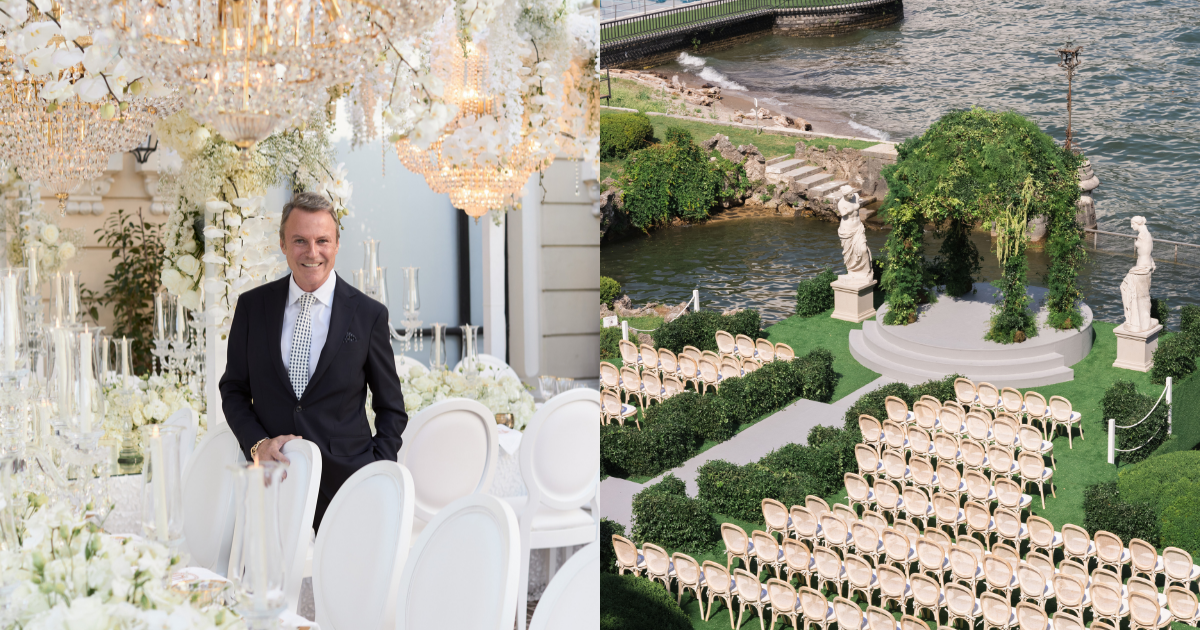
Long before “experiential luxury” entered the vocabulary, Colin Cowie was already designing celebrations the way a novelist builds a story: with a beginning, a middle and an end, and with the senses as his narrators. Four decades on, with offices from New York to Florence, his work spans Lake Como’s grand villas, the barefoot sands of the Bahamas and guest lists that include heads of state and global icons.
His signature is not a look but a discipline. Every celebration begins with the couple, builds towards a single unforgettable moment at each stage of the evening, and is held together by an unseen hand that never lets the effort show. Here, Cowie speaks about the five senses audit, the rituals he would happily retire, the swan-like calm of a flawless evening, and what he would borrow from the Indian wedding.
Forty years ago, the world did not yet speak of “experiential luxury.” Take us back to the very first celebration you produced. When did you know that making people feel something was a calling and not a job?
For me, it has always been about how you make people feel. Long before we called it experiential luxury, I was using the senses to tell a story and create an experience that people would remember.
Everything begins with the client’s DNA. One of the first things I ask is, “How do you want your guests to feel, and what do you want them to take away with them?” Every couple has a different answer, and that becomes the foundation of the celebration.
You cannot tell a compelling story through a single dimension. You have to engage the senses, capture someone’s attention, and then keep that story unfolding throughout the evening. That instinct has been with me from the very beginning. A beautiful room is wonderful, but the feeling you create inside it is what people carry home.


You have long championed the idea that a celebration should engage all five senses, unfolding with a considered beginning, middle and end. How did this philosophy take shape, and what does it mean to design an experience rather than simply a beautiful setting?
I have always designed through the five senses. At every stage of a celebration, from the arrival to the ceremony, cocktails, dinner and the party afterwards, I want one big WOW moment. It could be one of the senses on steroids. It’s a statement piece, and the intention is for guests to stop and say, “Oh my goodness, I can’t believe they did this.”
That does not necessarily require an enormous budget. Sometimes an abundance of one beautiful thing makes the strongest statement. What matters is knowing where to place it and how it contributes to the experience.
Wherever I go, I do what I call a five senses audit. It could be a hotel room, a reception or a friend’s Christmas party. What do I see? What do I smell? What am I touching, tasting and hearing? Is the music appropriate for this moment? Is the volume allowing people to enjoy a conversation?
Then I think about how those elements evolve. The energy of an arrival should be different from the energy of the dance floor. You are guiding people through an evening, building anticipation and giving them something new to discover. That is how a setting becomes an experience.
Four decades, countless trends, one constant eye. What did the weddings of your early years get gloriously right that you would bring back tomorrow, and what would you quietly retire?
I have always taken a modern approach to weddings. Some traditions have meaning and deserve to stay. Others have simply outlived their usefulness.
The receiving line is one I would happily retire. The couple stands greeting every guest while everyone else waits desperately to get to the bar. There are far more gracious ways to welcome people without creating a bottleneck.
I have never been particularly fond of the little bride and groom on top of the cake, either. And smashing cake into one another’s faces? After a bride has spent hours getting dressed and looking fabulous, I cannot imagine why anyone would want to do that.
What I would always preserve is thoughtful hosting. Timing is a huge part of that, and it does not cost a dollar. I ask every bride to walk down the aisle no more than fifteen minutes after the time printed on the invitation. Respecting your guests’ time is part of welcoming them.
I keep cocktails to forty-five minutes because, by the time everyone moves into dinner, it is an hour. I like a three-course dinner served in ninety minutes or less. If someone looks at their watch, you have lost them.
Of course, that rhythm changes with the culture and the celebration. Indian weddings often involve more people and a more fluid timetable. My job is to understand that rhythm while keeping the guests engaged. Nobody should feel that they are simply waiting for the next thing to happen.

The finest planners are felt, never seen. What is the hardest part of being the person who makes everything look effortless, and what does a flawless evening cost behind the curtain?
We have all seen the planner with a clipboard, shoes in hand, two phones ringing, looking as though they have just run the New York Marathon. I have never believed that the guests should see that version of the story.
I am a very proactive producer. The schedules and the planning happen weeks, often months, in advance. By the time we are on site, every person on the team should understand the plan and be working towards the same goal.
I like to think of myself as a swan. On the surface, completely calm. Under the water, my legs are moving at a hundred miles an hour. I am watching the sound, the food service, the empty glasses and the mood of the room. I am completely present, but the guests and the team need to feel that everything is in hand.
That is the hardest part: being aware of everything without transferring the pressure to anyone else. If the planner is shouting and running around, that energy travels straight to the bartender, the waiter and, ultimately, the guest.
Behind the curtain, I invest in the right people, and enough of them. If we need to make a change, we have the team to respond quickly and discreetly. That extra investment in staffing is what allows us to protect the guest experience.
Heads of state, global icons, Fortune 500 boardrooms, and a title that calls you the number one wedding planner. At five o’clock on the wedding day, is a famous client any different from anyone else?
At five o’clock, we are all people. Fame does not remove the nerves, the anticipation or the desire for everything to go beautifully.
Whether you are the bride, the groom or one of their parents, you have spent months, sometimes a year, imagining this moment. There is an enormous amount of emotion and expectation in the room.
Most brides have studied and trained for all sorts of things, but planning the single biggest celebration of their lives is rarely one of them. By the time they are in hair and make-up, there is a lot on their minds.
That is why our role is so personal. Whatever their public profile, they need to feel understood, supported and able to enjoy what is about to unfold.


Lake Como’s grand villas, the barefoot sands of the Bahamas, a flock of flamingos in place of bridesmaids. How do you decide where a place ends and a couple’s story begins?
If you look at my body of work, no two events look the same. What you will always recognise is the attention to detail and a sense of elegance at every touchpoint. But the design begins and ends with the couple.
I want to understand their joint DNA. Who are they as individuals, and who do they want to be together? Are they Mr. and Mrs. Got It Going On? Mr. and Mrs. Got It Together? What do they love? What do they dislike? What are those wonderful little idiosyncrasies that make them who they are?
The setting gives us a beautiful starting point, but the couple gives us the story. My job is to take what I learn about them and edit it thoughtfully across the celebration, whether that is one evening or a three-day weekend.
Every choice should feel true to their vision. I am there to bring that vision to life. It is all about them.
You believe dining should be part of the entertainment. What is your philosophy of food at a wedding, and why do animated stations tell a better story than a seated plate?
It depends on the experience the couple wants to create. A seated dinner and immersive food stations tell two different stories, and neither is automatically better than the other.
With a seated dinner, we can guide a very considered culinary journey. We decide the portions, the sequence of the courses and the wine served with each one. From the appetiser to the main course, dessert and the late-night bite, we have control over how the culinary story unfolds.
Immersive stations create a more relaxed experience, with the pleasure of moving around and discovering something new. But let me be clear: I am not talking about a buffet. I cannot stand a buffet. It brings out the vulture instinct in everyone. People pile everything onto one plate as though it might disappear before they return.
I prefer a beautifully curated seafood station, a pasta station, a caviar station or a cheese station. Each should offer its own complete experience, with three or four elements on the plate and the wine or beverage that belongs with them, served right there.
You should not have to wander off in search of the wine that goes with your food. When the food, the service and the pairing come together, dining becomes part of the entertainment.


You have travelled close to seventeen million miles, and you still pack with discipline. What has a life in motion taught you about elegance, and how does it show up in the way you design?
After seventeen million miles and almost a hundred countries, I have become a very edited traveller. I travel with purpose. Every shoe, outfit and accessory has a reason to be in that bag.
I plan a wardrobe for those three or four days, with pieces I can wear in different ways. If I need black tie for one evening, I will FedEx it ahead and send it home in the same box so I can continue travelling with my carry-on.
Accessories are invaluable. A belt, a watch, dark glasses, jewellery or a hat can completely change an outfit without requiring another suitcase.
I believe in dressing elegantly, fabulously and appropriately. That same discipline applies to design: edit thoughtfully, understand the occasion, and make sure every element has a purpose.
Indian weddings are the most exuberant celebrations on earth: days of rituals, colour, music and family. What would you steal from them for a wedding in Lake Como, and what would you never touch?
I grew up in Central Africa and South Africa, where I was surrounded by the richness of Indian culture. I have always found it enormously inspiring.
The colour, the music, the energy, the family involvement. Everything is happening at a hundred and twenty miles an hour and counting. I live for that. There is permission to be exuberant, to be loud and to have a fabulous time.
I would take that spirit of celebration with me. But I would not pick out a ritual simply because it would look beautiful in another setting. The story has to belong to the people celebrating.
As a storyteller, I have to remain open. In the West, I might plan cocktails for forty-five minutes and dinner for ninety. An Indian celebration asks me to understand a different rhythm. I am completely open to telling the story through that lens, with respect for the traditions and the family at its heart.
With offices from New York to Florence and forty years behind you, what is the next chapter for Colin Cowie Lifestyle, and what do you hope a couple remembers of your work forty years from now?
I rarely have time to sit and look back because I am so focused on what comes next. I am enormously proud of the body of work we have created, across events, licensing, hospitality, consulting, furniture and products.
Through forty years in media, I have also had the privilege of touching and inspiring so many people. That journey continues. I am as excited about my next event as I was about my first.
I am surrounded by an extraordinary group of dedicated, talented professionals. They allow me to tell each story with care and to run the business in a way that gives me the freedom to function as a true artist.
Forty years from now, I hope a couple remembers how they felt, how their guests felt, and how unmistakably the celebration belonged to them. That is what I want the work to leave behind.


In an industry that so often measures success in scale, Colin Cowie’s philosophy is refreshingly exact: a celebration is remembered not for what it cost or how large it was, but for how it felt. The swan’s calm, the single statement moment, the perfectly timed aisle walk: each is in service of one idea, that the evening should belong entirely to the people at its heart.
Visit: Colin Cowie Lifestyle
Follow Best List India for the culture, conversations, and ideas worth paying attention to.