Before “candid” became a category in Indian wedding photography, Arjun Kartha was wondering why so much of a wedding had to stop for the camera. Couples waited for instructions, relatives assembled on cue, and somewhere between the carefully arranged portraits, the celebration carried on.
He began photographing weddings in 2008 with a documentary photographer’s interest in what happened between those instructions. Eighteen years and more than 700 weddings later, that instinct remains at the centre of Twogether Studios, the wedding photography and films studio he founded in Gurgaon, Delhi NCR.
The work has evolved from those early photographs into a shared practice across photographers, filmmakers, editors, and writers, documenting celebrations across India and internationally. So has his attention: beyond the couple and towards the relationships that make a wedding theirs.
We spoke to Kartha about helping shape an industry, giving wedding films their own voice, and knowing when the most useful thing a photographer can do is let everyone get on with getting married.
In 2008, candid wedding photography was not yet the norm. Take us back to the beginning. What did you see in the in-between moments that the industry around you was missing?
Back then, an extraordinary amount of wedding photography involved interrupting the wedding. People would be having a perfectly lovely time, and the photographer would summon them to stand in a row, arrange their limbs and smile on cue. Everyone briefly became a mannequin in very expensive clothes.
There was also a hangover from the film era: every frame had to justify its existence before you pressed the shutter. The result was a lot of carefully organised photographs and surprisingly little sense of what being at that wedding actually felt like.
Coming from documentary photography, I found that quite baffling. The bride was laughing with her friends, her father was quietly taking everything in, something hilarious was happening behind the mandap. Why were we stopping all of that to manufacture something less interesting?
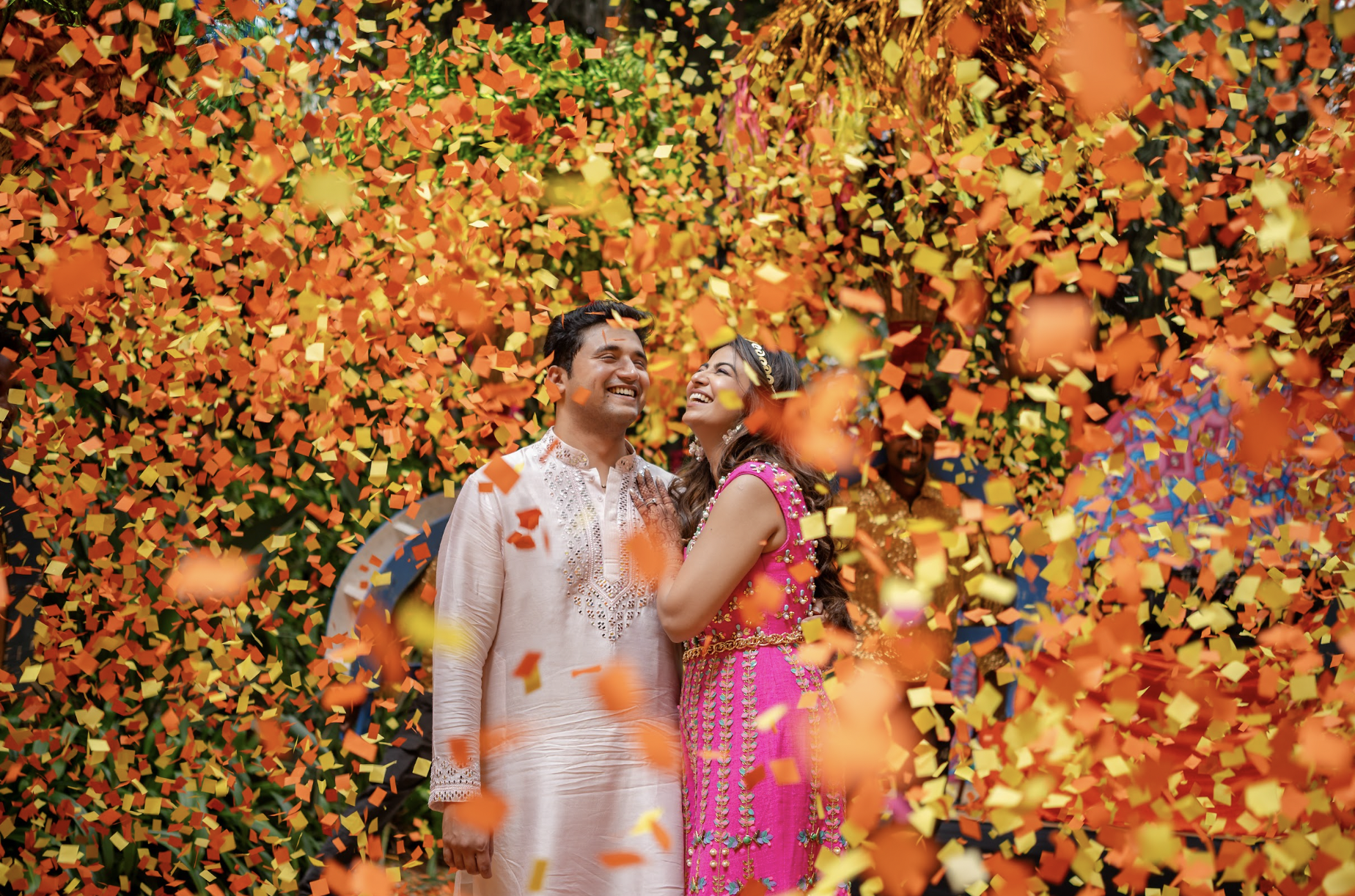
So I started photographing what was happening. People being themselves, with all the affection, chaos and questionable dancing that comes with an Indian wedding.
I certainly did not arrive in 2008 announcing that I was going to help change an industry. I just thought there had to be a better way. Looking back, I am proud to have been part of that early shift towards what became known as candid wedding photography in India.


Eighteen years, over 700 weddings. How has your eye changed since the first wedding you shot, and what do you know now that you could not have known then?
My creative appetite changes every year. Thank goodness, really. Eighteen years would be a very long time to keep making the same photograph.
In the beginning, I was very occupied with making beautiful pictures of the couple. I still love doing that, but I have become much more interested in the people around them. Who does the bride turn to when she is nervous? Who can make the groom laugh without saying anything? Who has quietly done everything needed to get these two people to this day?
Those relationships are where I spend much more of my attention now.
Trends come and go. Colours change, editing styles change, and every few years there is a new pose or something every couple suddenly wants to try. But a photograph that holds a real moment, a hug, a helpless fit of laughter, the expression on someone’s face, can take you straight back to how it felt. That has a much longer shelf life.
What I know now is that the significance of a picture keeps growing. You love a photograph of your parents laughing together on the day you receive it. Twenty years later, it holds twenty more years of knowing and loving those people. The picture stays the same; everything you bring to it grows.
Posed portraits ruled Indian weddings when you started. What was it like to build a documentary studio in a market that was not yet asking for one?
I think people wanted it. They just did not necessarily have the vocabulary to ask for it.
They knew they disliked being dragged away from their own celebrations. They knew their wedding photographs did not always resemble their memories of the day. But the accepted process was the accepted process.
You could see it during the jaimala. A couple would stand with their garlands raised, looking expectantly at the photographer, waiting to be told they could go ahead. Or they would place the garland and then hold that position, faces turned towards the camera, until someone released them. The photographer had somehow become the master of ceremonies.
I had to explain that they could simply get on with getting married. I would keep up.
But building Twogether was never about abolishing portraits. A proper family photograph matters. So does a beautiful picture of the couple. You can make those thoughtfully and still leave plenty of room for the wedding to happen.
Once people saw photographs of themselves laughing properly, or discovered something they had completely missed on the day, the approach made sense. The pictures explained it much better than I could.


You say you anticipate moments without manufacturing them. How do you learn a family well enough to know when something is about to happen, and where is the line you will not cross?
A lot of it begins with listening. You can learn an enormous amount from how someone talks about the people they love.
The family tree gives you the official version. The conversations give you the useful version. A cousin might be the bride’s closest person. An uncle might have practically raised her. Someone described as a family friend might be central to the entire story.
Once you understand those relationships, you know where to look. Experience helps you recognise the small changes: someone going quiet, a parent watching from the edge of a room, the friend who starts laughing before the joke has even been told.
The boundary is someone’s comfort. If a bride is overwhelmed and needs a few minutes alone with her mother, we give her that space. If a family tells us something is private, we respect it. Having access to a moment does not automatically mean you are entitled to photograph it.
Being invited into a family’s most personal moments comes with a responsibility to behave like someone they were right to trust.
A father’s expression before his daughter walks down the aisle. Tell us about a frame that stopped you, and the story behind it.
There is a photograph from Kanchan’s destination wedding at The Savoy in Mussoorie that comes to mind immediately. She was absolutely the apple of her father’s eye. He was an emotional man to begin with, so maintaining a poker face at his daughter’s wedding was always going to be an ambitious project.
In the frame, Kanchan is in the foreground, slightly out of focus, with her family facing her. What draws you in is that lovely collection of reactions: broad smiles, hands coming up to faces, everyone responding in their own way. Her father’s emotion belongs to that whole scene of people who clearly adore her.
What stays with me is how much a reaction can tell you about a relationship. You see his daughter dressed as a bride, and then you see what that means to him. There is years of love behind that expression.
It is also why I am always watching the people watching the bride. Everyone quite rightly wants to photograph her entrance. Sometimes, turning your attention towards the family gives you the other half of the story.
Your films are built around real voices and conversations, not just visuals. Why was sound so central to the way you tell a wedding story?
When we started, a lot of wedding videos were essentially visuals with Bollywood songs laid over them. The songs were doing a heroic amount of emotional heavy lifting.
You could see the people, but you rarely got to hear what that moment in time actually felt like.
We started by recording on-camera conversations with couples and the people closest to them. The couple’s meet-cute was central to that: how they met, what they first thought of each other, who made the first move. Occasionally, you would get two rather different accounts of the same love story, which was excellent material.
I then started drawing on my filmmaking experience to record audio at weddings: the dhols, the exuberant hooting and cheering during the bride’s dance performance, and the panditji’s voice when he made them make seven promises.
Suddenly, the film had its own voice. You heard how they teased each other, what their parents remembered, the stories their friends probably should not have told but very helpfully did.
As the technology improved, we could also capture more of the wedding’s actual sound. And that matters enormously, because video without sound gives you only half the experience.
Think of everyone erupting when a particular song comes on. You want to see the dancing, but you also want to hear what they were dancing to, the cheering, the hooting, someone enthusiastically getting every lyric wrong. The same goes for the catch in a father’s voice during a speech, or laughter turning into tears.
Those sounds tell you what it was like to be in that room. They give the pictures their full meaning, and make the film unmistakably yours.


Documentary and editorial are rarely spoken of in the same breath. How do you hold honesty and beauty in the same frame without letting either one win?
Think of a Vogue fashion spread: deliberate poses, sculpted light, carefully arranged clothes, perhaps that wonderfully serious expression that says absolutely nobody is here to discuss the weather. That is the fashion sensibility people usually mean when they talk about editorial wedding photography.
Documentary photography follows what is happening: the laughter, the interactions, the things nobody could have planned.
Both have a place at a wedding. You have put quite a lot of thought into what you are wearing; we should probably make a few excellent photographs of it.
During portraits, I can give direction, work with the setting and light, and create something with that editorial polish. When the couple are with their families or in the middle of a ceremony, the approach changes. I am paying attention to what is unfolding.
And documentary photographs can be beautifully composed. An honest moment does not require you to abandon everything you know about light.
A good wedding photographer should be able to do both. Some couples love the full fashion treatment; others feel most themselves laughing together. Often, the same couple wants a bit of each. The skill is understanding them well enough to make both feel natural to their wedding.


Palace celebrations in India, destination weddings across the world. What does each place ask of you as a storyteller, and what stays the same wherever you are?
A destination should earn its place in the story. If you have brought everyone to Rajasthan, Bali or somewhere halfway around the world, I want you to feel that place in the photographs and film.
That means paying attention to its light, architecture, landscape and atmosphere, and to how people experience it. A courtyard filling up for a ceremony, a seagull interrupting a speech, everyone squeezing under one umbrella on a sunny day: those details give the wedding a particular character.
The location should be woven through the story, from the way we photograph the celebrations to the spaces we choose for portraits. The couple chose to bring their favourite people there for a reason. I want the work to reflect that.
What stays consistent is our attention to the people. A palace gives you an extraordinary setting, but you still need to notice the grandmother watching her grandson get married.
The setting helps tell you where you were. The people help you remember why being there mattered.
You still direct weddings yourself, and you now lead a full team of photographers, filmmakers, editors and writers. How do you keep one sensibility alive across many hands?
That is a large part of what directing means. A Christopher Nolan film involves hundreds of talented people, but you still recognise his vision in the finished film. Everyone brings their expertise, and there is a clear creative direction connecting the work.
I have a strong sense of what I want a Twogether wedding story to feel like: personal, observant, visually considered and full of the people who matter to that couple. That vision has to guide the work from the first conversation through to the final edit.
It also starts with bringing the right artists into the studio. Having an established name helps attract talent, but technical ability is only part of it. I am interested in curiosity, judgment and how someone behaves around people. You can be an extraordinary photographer and still be the wrong person to have in a bridal room.
I want talented people to bring their own ideas and notice things I might miss. My job is to give those perspectives a common direction, so the finished work feels like one family’s story, thoughtfully told.
As a Fujifilm Global Brand Ambassador and a World’s Best Wedding Photos Artist in 2023, you have been recognised by the world. What does the next chapter of Twogether look like, and what do you hope a family finds in these pictures decades from now?
I am very proud and grateful for the recognition. Having your work appreciated by people whose judgment you respect is a lovely thing. It also gives you a standard to keep living up to.
For a couple, that standard becomes very practical. Are these people going to understand us? Will we feel comfortable around them? Can we enjoy our wedding knowing they are paying attention? Those are the questions we have to answer through the experience we give them.
The next chapter, for me, is about becoming more ambitious with the work: more perceptive photographs, more personal films, and a team that keeps finding fresh ways to tell a family’s story. Eighteen years in, I still want to make something that surprises me.
Decades from now, I hope the pictures set off a very lively conversation. That is exactly what your grandfather was like. I had forgotten she used to do that. You have absolutely no idea what happened just after this.
If the family ends up laughing, remembering and telling stories long after they have opened the album, I will be very happy.
Kartha returns often to the people around the couple: the cousin whose importance no family tree could explain, the parent watching quietly, the friend who knows exactly what will set everyone laughing. Across eighteen years of changing cameras, styles and destinations, those relationships have kept giving him something new to photograph.
Perhaps that is what gives a wedding story its longest life. Years later, a family opens an album, recognises an expression, and the conversation starts all over again.
Follow Best List India for the culture, conversations, and ideas worth paying attention to.