There is a particular kind of founder who refuses the tidy origin story. Ask Jai Hiranandani for the moment menswear stopped being a curiosity and became a company, and he will tell you, with a candour that is rarer than it should be, that he would be inventing one if he offered it. There was no epiphany. There was a gap.
For the better part of a decade, his world was real estate, corporate deals, and the fine print, and it remains a very large part of his life. What he also had, over those years, was a long education in the world’s great menswear rooms: Kith in Paris, END. in London, Cueva in New York, Dover Street Market. Spaces that were destinations rather than corners of a boutique, where a man could spend an afternoon discovering something new without once feeling that he was being sold to. Mumbai had the talent. What it did not have was the room.
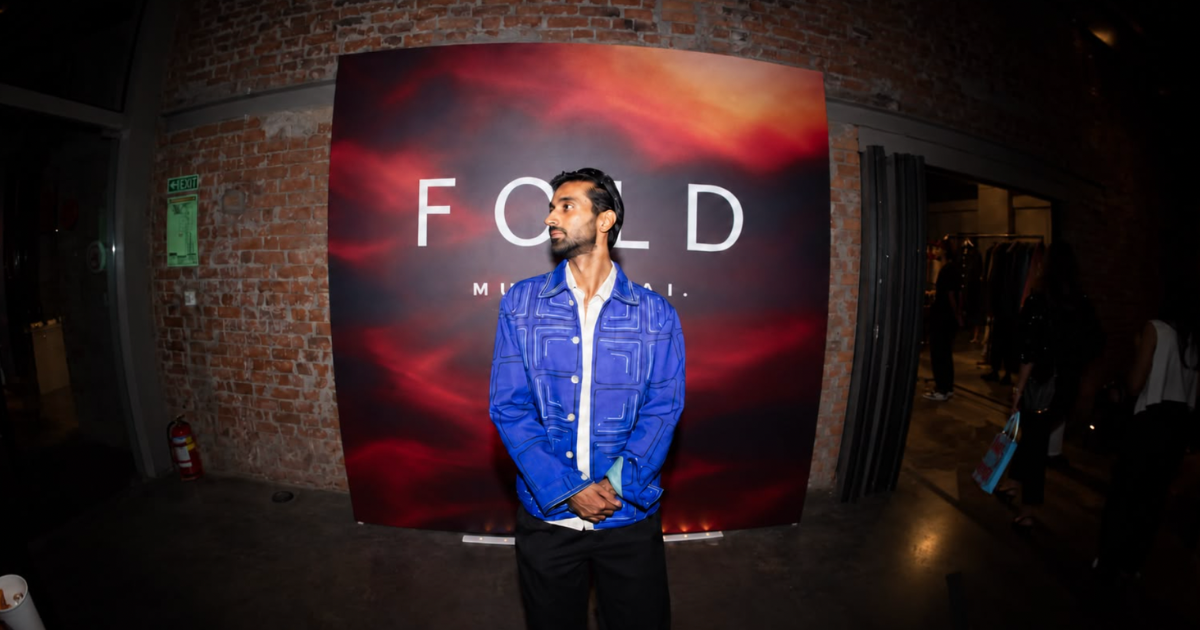
FOLD is his answer: a multi-brand menswear experience built around homegrown designers, staged in its first edition as a pop-up at IFBE, and conceived as the first chapter of a year-round community across lifestyle, grooming, and wellness. It is not trying to copy the rooms that inspired it. It is trying to rebuild the format for Mumbai, with the aim of doing it better: less exclusive, more open.
We spoke with Hiranandani about the need that became a company, what makes a label earn its place on the floor, and why a man should remember his first visit as pleasure rather than purchase.
For the better part of a decade, your world was real estate, corporate deals and the fine print. Take us back to the moment a conversation about menswear stopped being a curiosity and became FOLD.
There was not one singular moment. I would be inventing one if I said so. My professional life is still a very large part of my world, and FOLD was not built out of a change of heart but more out of a need: a need for a multi-brand retail experience dedicated to menswear. It is less curiosity, more the need which I am trying to fulfil, and one I am fairly sure a lot of other men share. At some point, the only honest response was to build it rather than keep wishing someone else would.
You have said menswear has always been an afterthought, a corner of the boutique and never the focus. When did you first notice that gap, and why do you think it stayed unfilled for so long?
I noticed the gap over the last decade, while I got to experience dynamic spaces across the world that had so much to offer for men’s fashion. They were not just a part of someone’s shopping list, but more a destination to spend time at and discover something new.
You have spent time in the rooms that inspired you: Kith Paris, END. London, Cueva New York, Dover Street Market. What did those spaces understand about men and clothes that Mumbai had yet to see?
All those spaces have a feeling attached to them. You never feel out of place. It is always exciting, and at the same time you do not find it overbearing. Most importantly, you never feel like you are being sold to.
I think in India all of that exists. We just do not have one space to see and feel it, especially for men. Homegrown menswear as a segment is actually full of amazing artists and creatives, and FOLD is also there to spotlight the work that deserves it.


You do not want to copy them, only rebuild the format for Mumbai, with the aim of doing it better: less exclusive, more open. What does that look like on the ground at IFBE?
With IFBE, the decision was purely based on the stunning architecture the venue offers. For a pop-up, especially being the first edition, there is only so much one can achieve in terms of design, but IFBE just enhances that.
On the ground, we have made it more of an experiential weekend, or at least we have tried to. A brick and mortar store has time to establish itself and set the mood, whereas with a pop-up, it is gone before you know it. So we had to look at this as an inclusive weekend activity to find our audience. The store format of FOLD would be a little different for me.
Curation is a deliberate act in your hands. Every label has to earn its place through design, fit, fabric, finishing and value. What is the quiet detail that tells you a brand belongs, and what makes you say no to one that is merely good?
I myself am discovering brands and their craft as I go along on this journey. It is not necessarily a quiet detail, but it is the brand’s ethos, craftsmanship, utility and value that come into play while curating.
A group of individually interesting brands does not automatically make a complete shopping experience, you say. How do you compose a room, from the vignettes to the way a man moves through it, so that one discovery leads naturally to the next?
The room should have varied options but not feel overwhelming. You might be in a big space, but you should be able to identify your calling.
In our first edition, we move from contemporary artisanal fashion to lifestyle and accessories, which serves as a more interactive space allowing FOLD’s community to gather. We also have a grooming experience with Truefit & Hill, followed by a dedicated space curated by a pioneer in bespoke menswear, Mr. Osman Abdul Razak. It is aimed at being an experiential-led retail journey.
VIXII, Unscene and Oshin are meeting their customers in person for the first time. What did you see in their faces, and in the customers’, when a screen-first label finally became something you could touch?
VIXII is playful and at the same time versatile, and I think it fits in every man’s and woman’s wardrobe. Oshin’s collection is perfectly suited for city life as I see it. Unscene is the first Indian eyewear brand I have enjoyed in terms of quality. We also have Draft, a year-old label, doing some great elevated casualwear.


The Indian man is dressing with more intention than ever. Who is he, what is he looking for, and why do you think he has been waiting for someone to simply show him where to start?
I think the definition of that man is varied. Some are maybe lost and looking for where to start. Some know what they want but do not know where to go. And a few have been waiting for a space like FOLD, or at least I would like to believe so.
You have argued that the joy of shopping deserves as much attention as the product itself. Why does pleasure sit so close to commerce, and what does a man feel when it is done right?
Shopping should never feel like a chore to tick off a list. It should feel like an experience. When a space is done right, it engages every sense: the lighting, the textures, the music, the scent, the way the pieces are arranged. It creates a mood, and that mood is what makes one linger, explore and come back.
FOLD is meant to be the first chapter, growing into a year-round community across lifestyle, wellness and grooming. What does the next chapter look like, and what do you hope a man remembers about his first visit?
The eventual goal would be for FOLD to reimagine spaces and build something unique every single time. I hope the customer thoroughly enjoys the experience, and that the value proposition of shopping at FOLD feels almost worth it every single time, one that he or she cannot wait to come back to.
Follow Best List India for the culture, conversations, and ideas worth paying attention to.