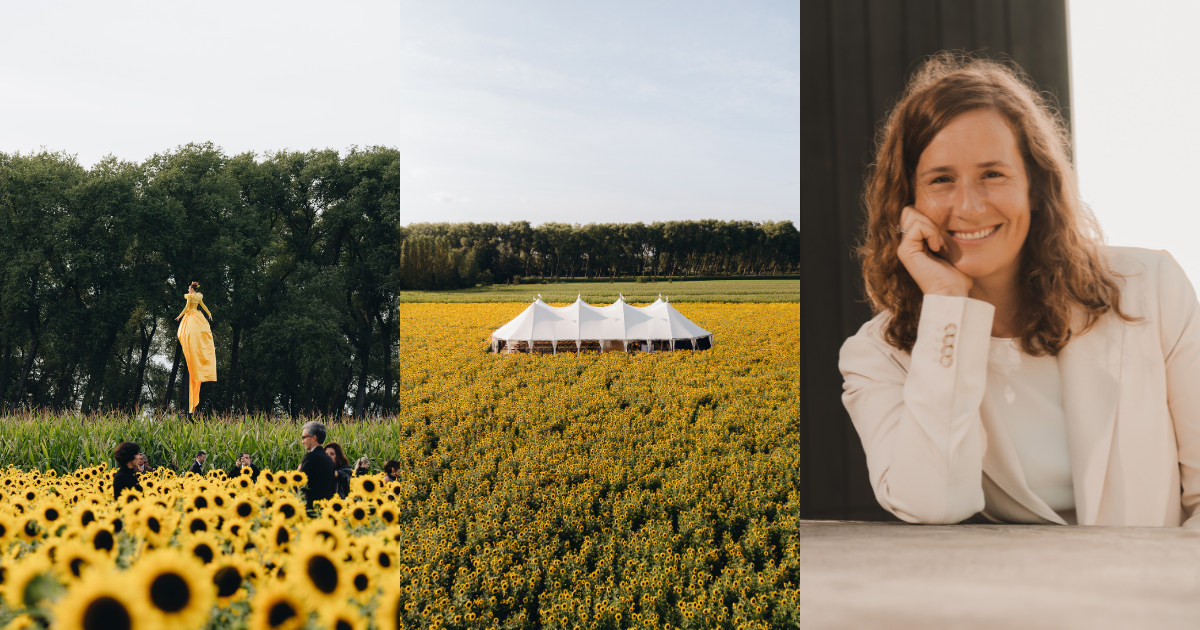
There are event designers who work with what exists, and there are those who grow what they need. Margot Laporte, founder, CEO, and General Manager of Tabloo Margot, Belgium’s most quietly extraordinary luxury event studio, belongs firmly to the second category. She has hung 37 Christmas trees from a ceiling and lit them individually to Mariah Carey. She has grown a four-hectare sunflower field from genetically modified seeds for a September wedding that went viral across the world. She spent six years as a physiotherapist before she spent a career making people feel things through spaces, light, and the particular quality of a moment that nobody present will ever quite forget. Just do not mention Napoleon chairs. We spoke with Laporte about where that imagination comes from, why she does not like to say no, and what Belgian hospitality has taught her about the difference between spectacle and feeling.
Before Tabloo Margot, you spent six years as a physiotherapist, and even massaged Will.I.Am before a concert. It is not the most obvious origin story for a luxury event creator. Looking back, what was it about that chapter that was quietly preparing you for this one?
I grew up looking up to my parents, who were both physiotherapists. I liked the variety of the job and the contact with people, helping them. I was also attending evening classes in pastry and have always loved cooking. My business started with me doing the catering services myself, combining that with the organisation and creative aspect of the event. It soon became too much to do it all on my own, and I started working with very good caterers so I could focus more on the overall organisation and creative event design.
And when we were little, my parents used to throw us the most amazing birthday parties: crazy themes, we were allowed to invite our whole class. So this is definitely in my genes.
Your manifesto talks about twinkling trees hanging from ceilings, fine dining on tennis courts, picking oysters with water up to your hips, dancing in a field of gold. Where does that imagination come from, and how do you protect it from becoming ordinary?
I honestly do not know where the inspiration always comes from. I sometimes have these things very clear in my mind and will do everything in my power to accomplish these settings. I do not like no for an answer, just as I do not like to tell my clients no. When someone tells me this has not been done before, I am always triggered and want to prove we can make it work.
I also love experiencing these kinds of things myself, so I basically love to organise and design everything that would make me excited to be there as a guest. To create unique settings you will never have the chance to experience anywhere else. That is the standard I hold everything to.
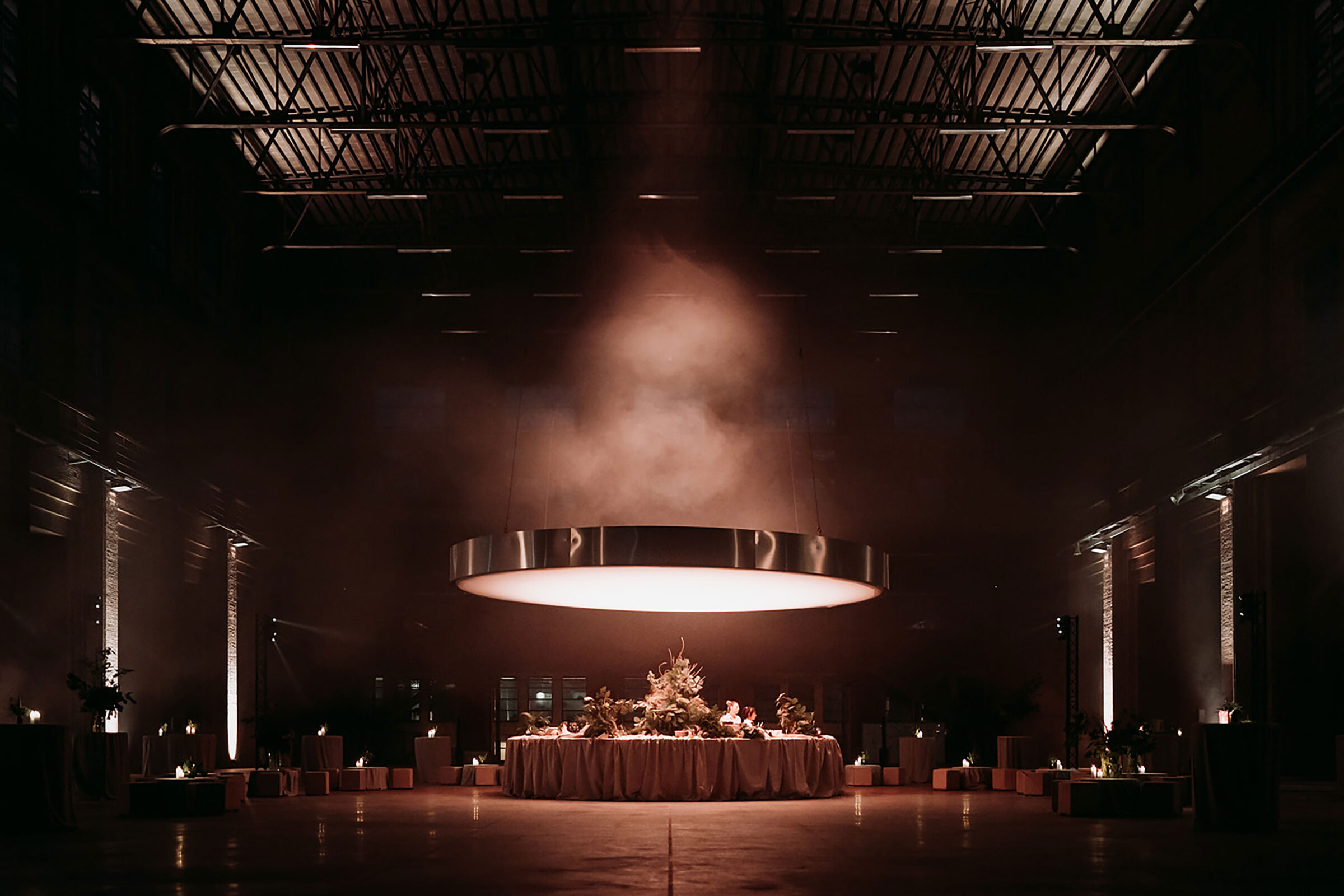
Tabloo Margot works across weddings, private events, and corporate gatherings. How do you keep your creative standard consistent across such different worlds?
We are very lucky with our clients. They usually come to us specifically when they are searching for something different, which is why we often get creative freedom to design what we want, whether it is for a wedding or a corporate event. Everyone essentially wants the same thing: they want people to remember this event forever. They want people who could not attend to feel like they genuinely missed something. They want to be the talk of the town. So we are lucky to let our creativity run free across every type of event.
There is always a gap between what a client imagines and what is truly possible. How do you manage that conversation, and where do you draw the line?
As I mentioned, I do not like to say no or say that things are not possible. So we will always try to find a way to make things work, although some things come with very high costs of course. I would only draw the line if I know the outcome will never be as good as the client’s or our own imagination. That is the only reason to stop.
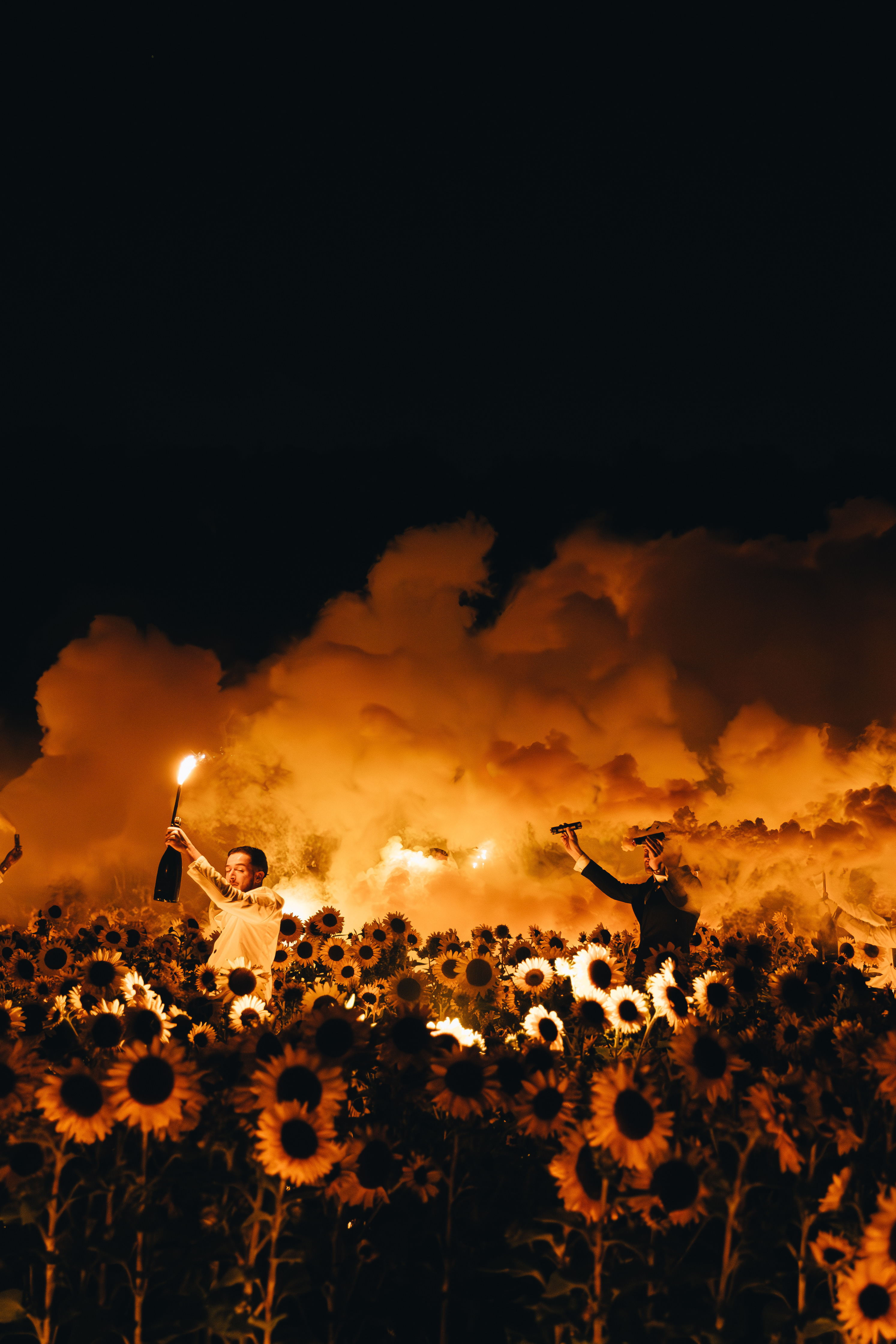
The sunflower field wedding. A celebration that started in a corn maze and ended in a candlelit sunflower field grown specifically for the occasion. Walk us through that concept, whose idea it was, how it came to life, and what the moment felt like when the candles were lit.
The client came to us in January. It was for their wedding and they loved a wedding we had done before in a hay field. They wanted something similar, in the middle of nowhere, in a field. They were living in Brussels at the time but coming from France, with friends flying in from all over the world. He told me his friends would expect them to get married somewhere posh and chic like Capri, but he wanted to surprise them by doing the opposite.
They wanted to get married in September, but not many crops are still in bloom in September. We had suggested a sunflower field to another client before, who had not chosen it in the end, and we knew the season was typically mid-August. After a long search for a proper field and a farmer with experience sowing sunflowers, we found a perfect plot in the middle of nowhere. The farmer knew a company selling genetically modified sunflower seeds that produce five flower heads per stem instead of one, which lowered the risk of having a field that was not fully in bloom.
We sowed four hectares of seeds and waited. Patiently.
In the end, all the flowers were in bloom during the wedding weekend and we had clear blue sky and sun all day. Guests were brought in by shuttle. From the outside, the field looked like corn. There was a small maze before they arrived at the sunflowers, and every single guest was completely amazed at what they walked into. The couple arrived a little later in a hot air balloon, one of their very first requests back in January, which was entirely weather dependent and which, miraculously, worked.
As the sun went down and the candles were lit inside the tent, we had a wonderful dinner and a live performance and danced until early morning. Guests were handed sunflowers cut from the field at that exact moment and wrapped in personalised paper. It truly was one of the most memorable events we have ever organised.
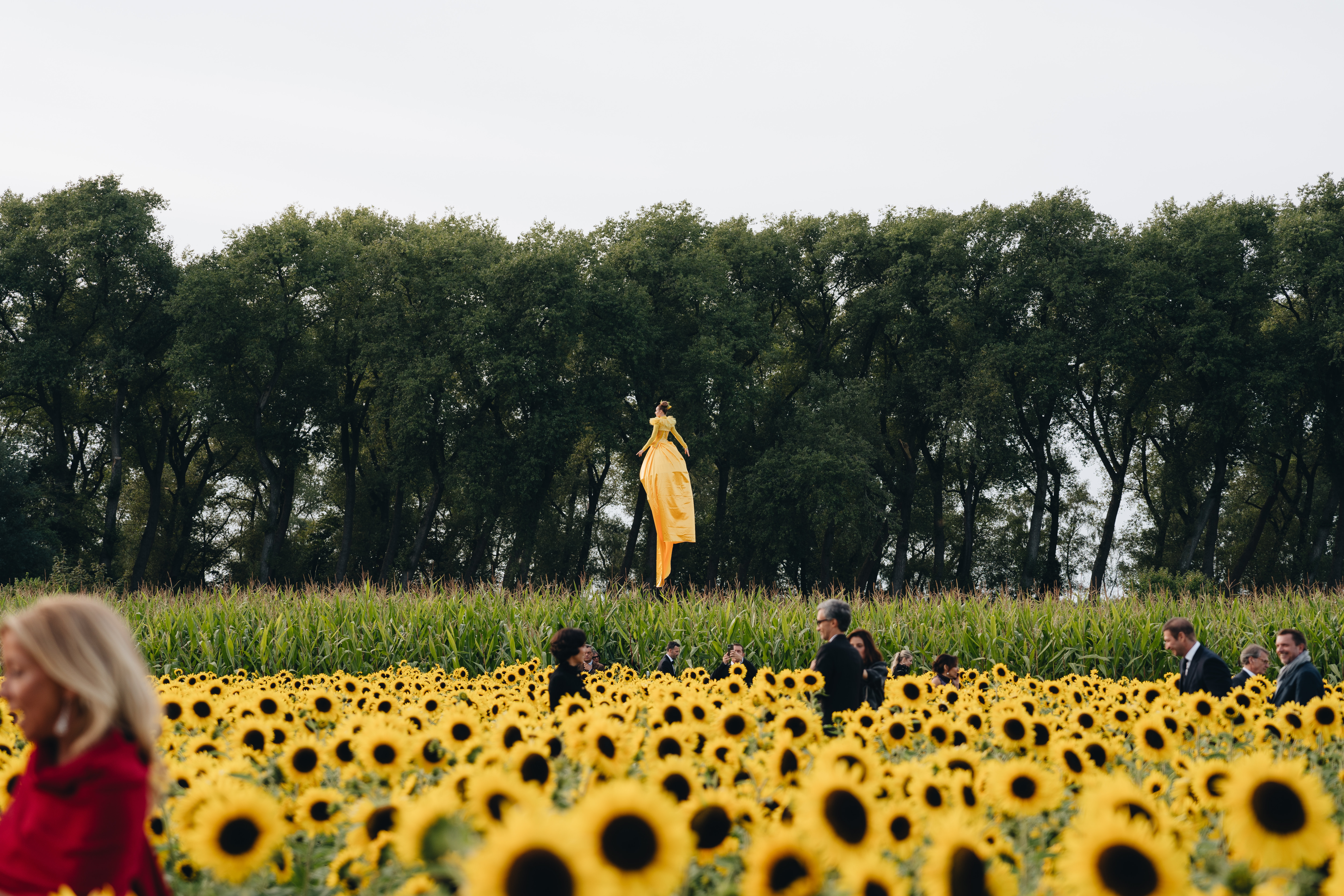
That wedding went viral globally. Did that change anything: the way you work, the kind of briefs you receive, what couples now ask of you?
It only made me realise more clearly that when we get full trust from our clients, we can create the best kind of events. The results are always better in that situation than when a client wants to change many things or comes in with their own fixed ideas. And yes, I do now receive more requests for out-of-the-box weddings and celebrations. Which suits me perfectly.
Your manifesto ends with the line: most of all, you will cherish how intimate even the largest parties felt. How do you create intimacy at scale, and why does that matter more to you than spectacle?
Most of the time I am a less-is-more kind of person, unless it is sunflowers or Christmas trees, in which case it is always more is more. I am not particularly drawn to too much spectacle for weddings or private events because I want everything to still feel natural in some way, not too much, just enough.
What I find truly important, however grand a space might feel on arrival, is that guests still feel comfortable and connected to each other. The most beautiful events I have done are the ones where people stopped noticing the design because they were too busy being present with the people they love.
Is there a celebration you consider a personal masterpiece, beyond the sunflower wedding? One that still stays with you?
In my early days I organised a Christmas wedding with 37 Christmas trees hanging in the air, with lights we could direct from a distance. The cocktail hour had a white winter wedding theme, and then the curtains opened to reveal the Christmas tables with all the trees suspended above. The couple came in on Mariah Carey. All the lights went out, and when the climax of the song arrived, the couple walked in and the trees were switched on and off individually, all twinkling.
It was a real goosebumps moment. People still refer to it as the Christmas tree wedding. It very much put me on the map in my early days, and I still think about it.
Belgium has a very specific and sophisticated culture of hospitality, entertaining, and design. How much of that lives in your work?
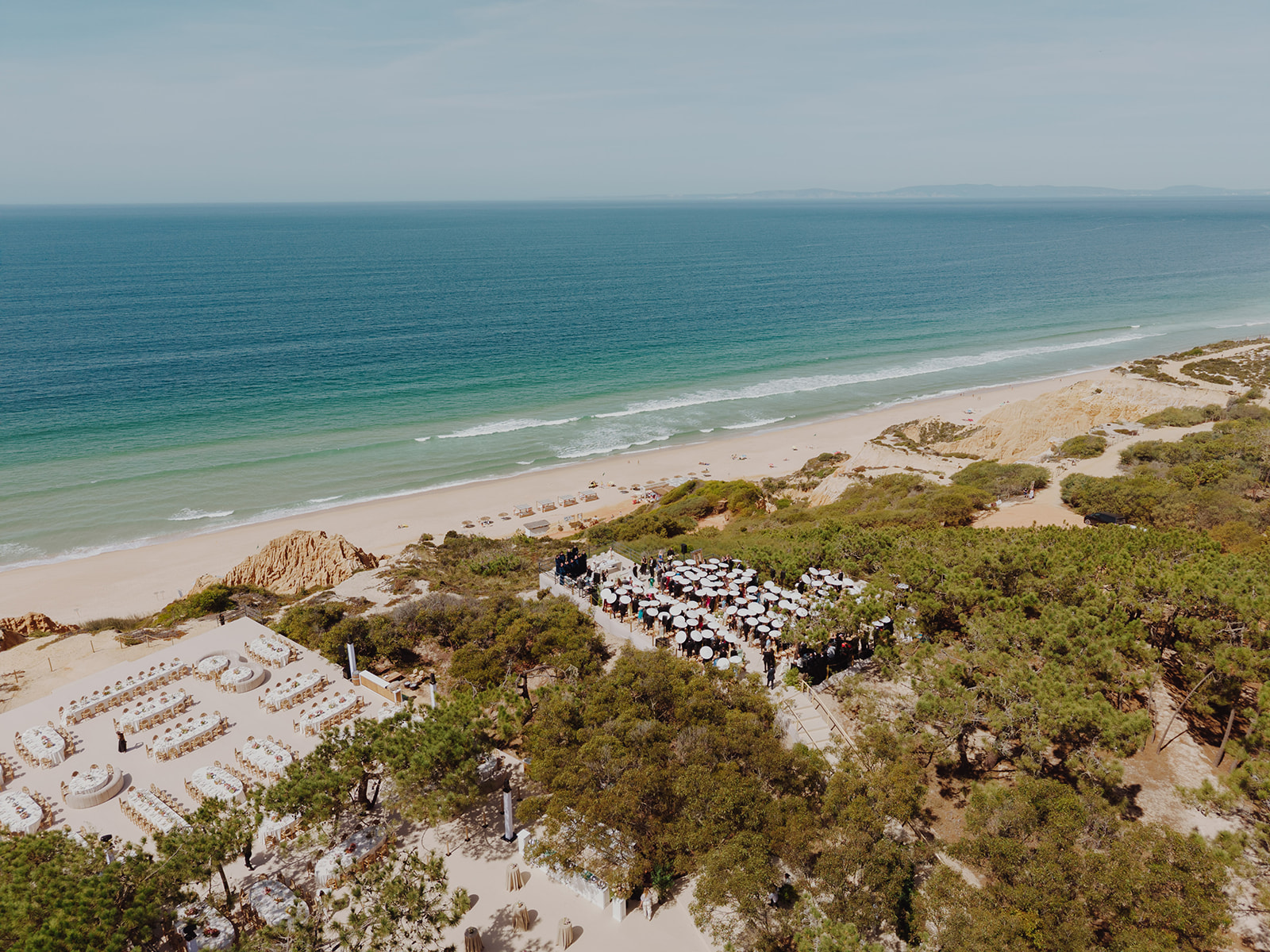
Belgium has a very understated but refined approach to hospitality. Nothing is overly loud, but everything is intentional. That sensibility lives deeply in our work. At Tabloo Margot, we are very focused on atmosphere rather than just decoration. It is about layering textures, balancing elegance with warmth, and creating spaces that feel curated but never rigid. Belgian design has this ability to feel both minimal and rich at the same time, and we naturally translate that into our events.
What still surprises you about what people want from their most important celebrations?
There used to be a stronger focus on impressing guests. But today, clients want their celebration to reflect who they really are. They are not just asking for something beautiful. They are asking for something that feels like them.
At the same time, there is a growing desire for experience over spectacle. People remember how something felt much more than how it looked. That shift keeps me constantly rethinking how we design events, not just visually, but emotionally.
What does the future of extraordinary events look like, and what does Tabloo Margot look like in it?
I believe the future of extraordinary events is more immersive, more intentional, and more personal. We are moving toward highly curated experiences where every detail tells a story.
For Tabloo Margot, I see us continuing to evolve as a creative studio rather than just an event design company. I want us to push boundaries, explore new formats, and find new ways of gathering. But always with the same core: make it memorable.
And what defines us just as much is everything that happens behind the scenes. Our role is to oversee the entire experience, from the first idea to the final moment. That means managing the logistics, the hospitality, the flow of the event, and maintaining a close, intuitive dialogue with our clients throughout the process. For me, creativity and organisation are inseparable. The most beautiful concept only becomes meaningful when it is executed flawlessly. That balance between vision and precision is really where Tabloo Margot lives.
Follow Best List India for the culture, conversations, and ideas worth paying attention to.